Defense urges reversal in State v. Motley, saying state failed to prove beating caused victim's fatal cardiac arrest
March 06, 2026 | Other Court, Judicial , Washington
This article was created by AI summarizing key points discussed. AI makes mistakes, so for full details and context, please refer to the video of the full meeting. Please report any errors so we can fix them. Report an error »
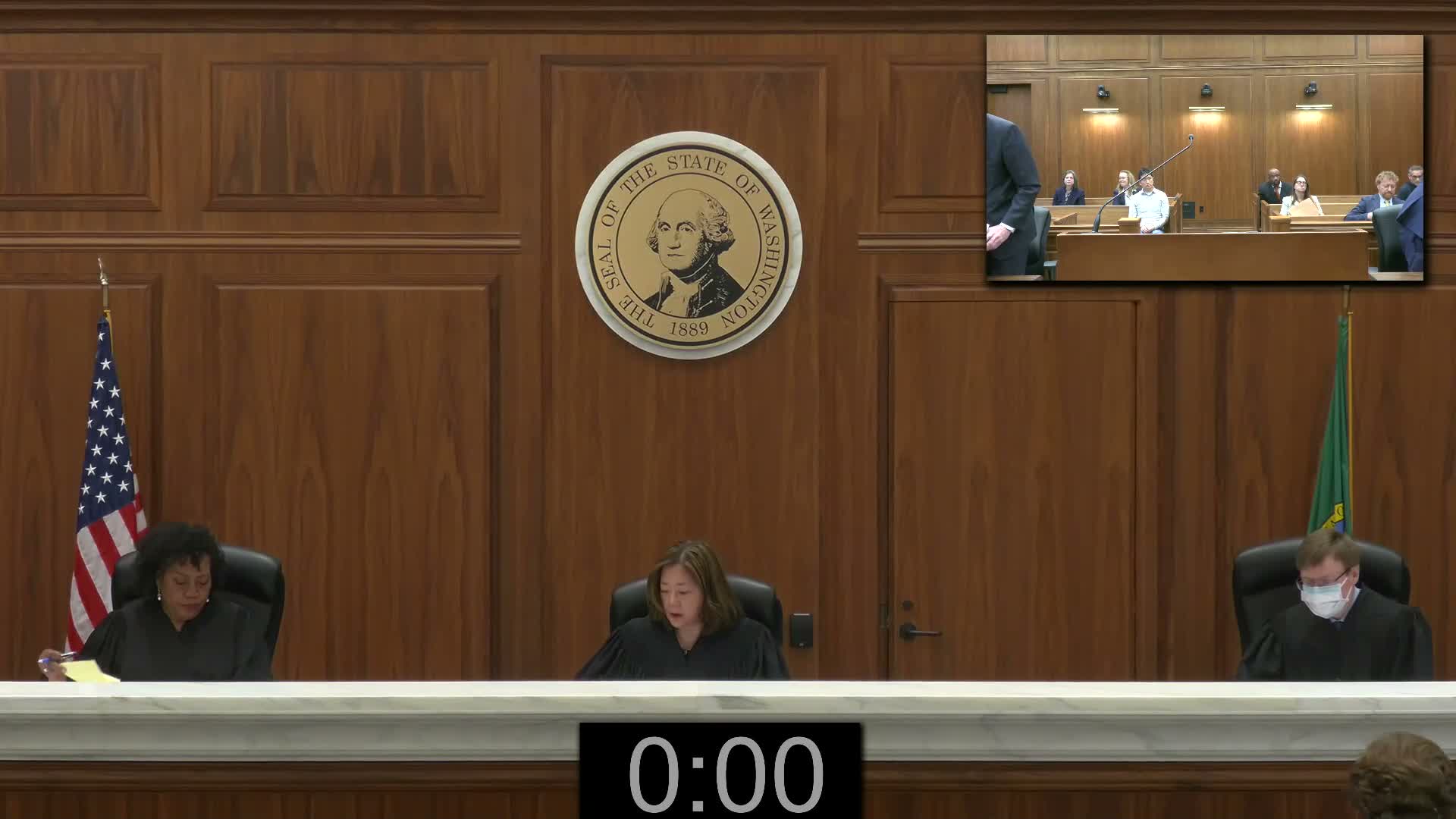
An appellate panel heard competing arguments in State v. Motley over whether the state proved that a beating directly caused a victim’s fatal cardiac arrest and whether the prosecutor’s closing remarks improperly shifted the burden of proof.
Defense counsel Moses Okeo, who said he represents Edward Motley Jr., told the court the state never proved a "direct unbroken causal chain" between the punch and the cardiac arrest. Okeo argued the victim, Wesley Benson, had multiple serious preexisting conditions—emphysema, coronary artery disease and, later, aspiration pneumonitis—that the state’s experts did not rule out as independent causes of death. "You're asking the jury to resolve the speculation," Okeo said, urging the court to reverse for insufficiency of evidence and for prosecutorial misconduct during closing.
Anne Summers, arguing for the state of Washington, told the panel the defendant "beat a 60 year old man senseless," producing brain injuries that dysregulated Benson’s heart rate, blood pressure and respiratory system and thereby led to a heart attack and death. Summers said the state’s treating physicians and medical records supported the experts’ opinions and that a reasonable jury could credit the state’s causation theory. "Viewing the evidence in the light most favorable to the state…a rational jury could certainly find that the brain injuries from the beating caused his death," she said, and asked that the first-degree murder conviction be affirmed.
The judges probed both sides on medical certainty and standards of review. One panel questioner observed that the medical examiner concluded the cause of death was blunt-force trauma and reported no lung evidence of pneumonia or bleeding; the questioner asked whether that finding alone could allow a jury to credit causation. Defense counsel responded that the examiner’s postmortem conclusions reflected an absence of alternative explanations but did not resolve which potential medical process actually triggered the cardiac arrest.
The court and counsel also debated appellate standards. The panel noted this is an appeal under a sufficiency-of-the-evidence standard —meaning the court must view the record in the light most favorable to the state rather than resolving reasonable doubt as a trier of fact. Defense counsel countered that, because multiple medical processes could plausibly have caused the cardiac arrest, affirmance would require the court to accept speculative inferences rather than proof beyond a reasonable doubt.
A separate line of argument concerned remarks during closing argument. Counsel and the panel discussed the prosecutor’s statement that jurors would be presented with verdict forms on both first- and second-degree murder and that, for double jeopardy purposes, any duplicate conviction would be merged at sentencing. Defense counsel objected at trial and later argued that the prosecutor’s comments risked improperly informing jurors about punishment and thereby shifting their focus. Summers told the court she did not believe the prosecutor’s brief explanation rose to the level of flagrant misconduct and noted the jury had been instructed not to consider punishment.
After the rebuttal phase, the court acknowledged the parties' briefs and submitted the case for decision. The panel did not announce a ruling during the argument.
The arguments centered on legal causation standards in criminal law, the scope and limits of postmortem medical interpretation, the proper scope of prosecutorial closing argument, and how appellate sufficiency review applies to contested medical causation evidence. The court will issue a decision after considering the briefs and argument.
Defense counsel Moses Okeo, who said he represents Edward Motley Jr., told the court the state never proved a "direct unbroken causal chain" between the punch and the cardiac arrest. Okeo argued the victim, Wesley Benson, had multiple serious preexisting conditions—emphysema, coronary artery disease and, later, aspiration pneumonitis—that the state’s experts did not rule out as independent causes of death. "You're asking the jury to resolve the speculation," Okeo said, urging the court to reverse for insufficiency of evidence and for prosecutorial misconduct during closing.
Anne Summers, arguing for the state of Washington, told the panel the defendant "beat a 60 year old man senseless," producing brain injuries that dysregulated Benson’s heart rate, blood pressure and respiratory system and thereby led to a heart attack and death. Summers said the state’s treating physicians and medical records supported the experts’ opinions and that a reasonable jury could credit the state’s causation theory. "Viewing the evidence in the light most favorable to the state…a rational jury could certainly find that the brain injuries from the beating caused his death," she said, and asked that the first-degree murder conviction be affirmed.
The judges probed both sides on medical certainty and standards of review. One panel questioner observed that the medical examiner concluded the cause of death was blunt-force trauma and reported no lung evidence of pneumonia or bleeding; the questioner asked whether that finding alone could allow a jury to credit causation. Defense counsel responded that the examiner’s postmortem conclusions reflected an absence of alternative explanations but did not resolve which potential medical process actually triggered the cardiac arrest.
The court and counsel also debated appellate standards. The panel noted this is an appeal under a sufficiency-of-the-evidence standard —meaning the court must view the record in the light most favorable to the state rather than resolving reasonable doubt as a trier of fact. Defense counsel countered that, because multiple medical processes could plausibly have caused the cardiac arrest, affirmance would require the court to accept speculative inferences rather than proof beyond a reasonable doubt.
A separate line of argument concerned remarks during closing argument. Counsel and the panel discussed the prosecutor’s statement that jurors would be presented with verdict forms on both first- and second-degree murder and that, for double jeopardy purposes, any duplicate conviction would be merged at sentencing. Defense counsel objected at trial and later argued that the prosecutor’s comments risked improperly informing jurors about punishment and thereby shifting their focus. Summers told the court she did not believe the prosecutor’s brief explanation rose to the level of flagrant misconduct and noted the jury had been instructed not to consider punishment.
After the rebuttal phase, the court acknowledged the parties' briefs and submitted the case for decision. The panel did not announce a ruling during the argument.
The arguments centered on legal causation standards in criminal law, the scope and limits of postmortem medical interpretation, the proper scope of prosecutorial closing argument, and how appellate sufficiency review applies to contested medical causation evidence. The court will issue a decision after considering the briefs and argument.
View the Full Meeting & All Its Details
This article offers just a summary. Unlock complete video, transcripts, and insights as a Founder Member.
✓
Watch full, unedited meeting videos
✓
Search every word spoken in unlimited transcripts
✓
AI summaries & real-time alerts (all government levels)
✓
Permanent access to expanding government content
30-day money-back guarantee
