Appeals court hears dispute over whether Washington Lemon Law bars follow-on CPA claims for attorney fees
March 06, 2026 | Other Court, Judicial , Washington
This article was created by AI summarizing key points discussed. AI makes mistakes, so for full details and context, please refer to the video of the full meeting. Please report any errors so we can fix them. Report an error »
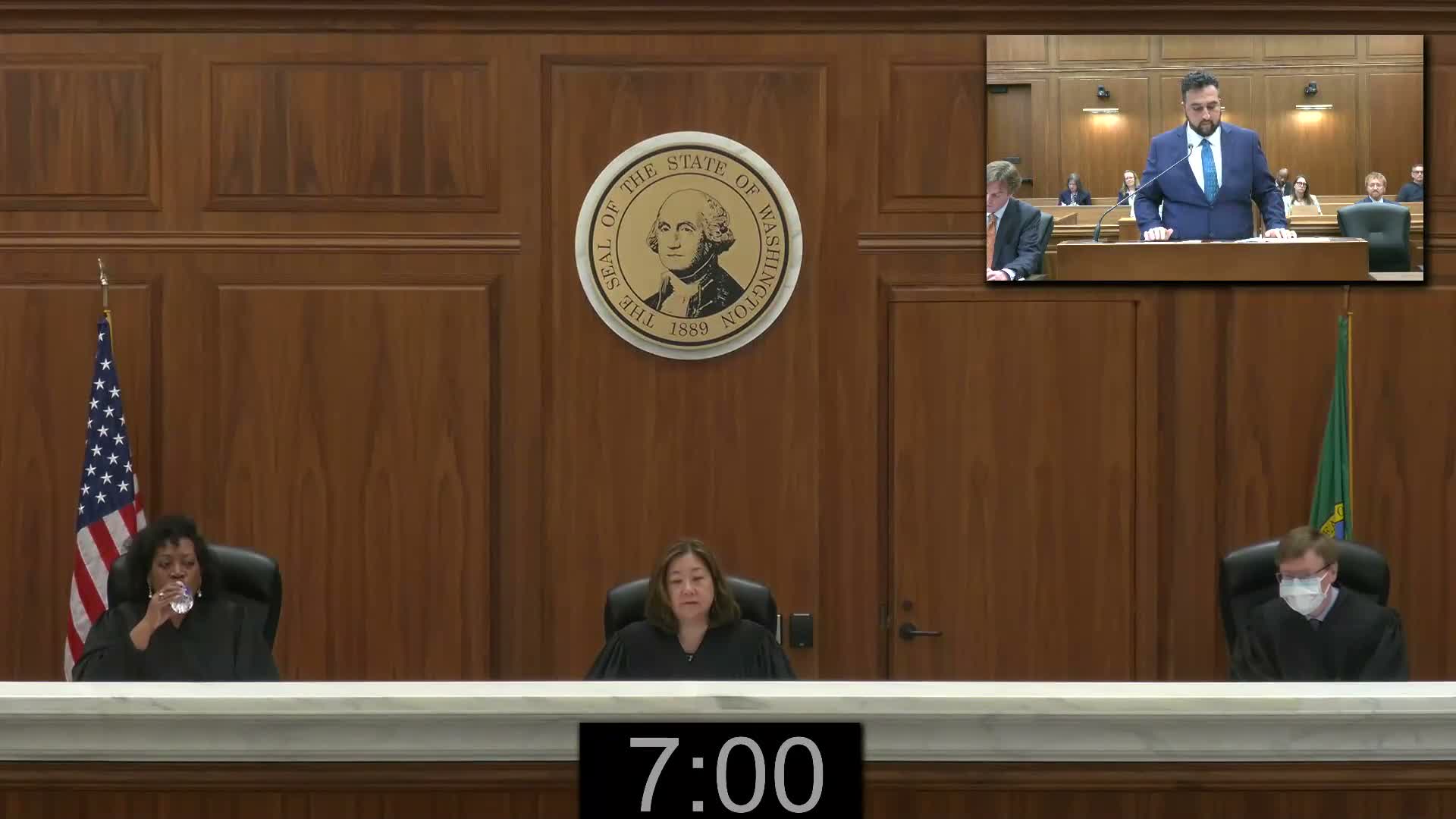
An appellate panel heard argument in Dale v. Kia America over whether Washington’s Lemon Law and its arbitration program bar follow-on claims under the Consumer Protection Act (CPA), including requests for attorney fees.
Nathan Khayyam, attorney for appellant Dwyer Dale, told the court the case turns on statutory text and whether arbitration forecloses later CPA claims. "This is a Consumer Protection Act case involving Washington's … Lemon Laws under RCW 19.118," Khayyam said, arguing that several provisions of RCW 19.118 — including RCW 19.118.120 (which treats violations as CPA violations), RCW 19.118.140 ("nothing in this chapter limits" other remedies), RCW 19.118.070 (remedies are cumulative), and RCW 19.118.080(3) (permitting court filing after arbitration) — show the legislature intended consumers to be able to pursue CPA claims after arbitration.
Khayyam emphasized that arbitration sometimes does not make attorney fees available to claimants (for example, when a manufacturer is unrepresented in arbitration) and said that allowing a follow-on court action is necessary to vindicate consumers’ rights. He noted that the arbitration award here provided plaintiff Dale a check for $12,868 and argued that precluding attorney-fee recovery in court would leave consumers bearing litigation costs. He also cited Washington precedent (Panag, Talmadge) and other remedies (including repair statutes and Magnuson‑Moss warranty claims) to argue that separate causes of action can permit fee awards when arbitration cannot.
Robert Wise of Nelson Mullins, counsel for Kia America Inc., countered that Kia complied with the arbitration award and that the ensuing lawsuit sought items already awarded or not recoverable under the Lemon Law. "Kia fully complied with the arbitration decision and provided plaintiff Dale with everything he was awarded," Wise said, and he urged the court to respect the statutory scheme. He noted that the trial court granted summary judgment for Kia while denying plaintiff’s partial summary judgment and that the trial court observed allegations of personal injury and economic losses not covered by Lemon Law remedies; Wise said those types of claims are more properly pursued under Washington’s product‑liability law, the WPLA.
On the question of delay, Wise said statutory WAC procedures provide a mechanism to address manufacturer delay (including fines), but he observed the fines appear to go to the state rather than operate as direct compensation for the claimant. Wise also argued that the plaintiff’s pleadings and litigation positions had shifted over time — focusing on attorney fees and later on physical‑injury claims — and characterized the plaintiff’s presentation as a "moving target," invoking res judicata and waiver principles to support dismissal of claims that were not preserved or that were improperly framed in the proceedings below.
The bench pressed both sides on closely related procedural and statutory points: whether a recovery available in arbitration for a particular component would preclude the same recovery in court, whether the Lemon Law's explicit textual limits should be read narrowly or broadly, and whether the timing of asserted injuries (for example delay damages occurring after arbitration) affected claim‑preclusion analysis. Khayyam replied that claim preclusion has four elements that the defense had not shown were met as to the attorney‑fee claims.
The panel submitted the case for decision at the close of argument. No decision was announced from the bench.
The panel’s ruling will determine whether consumers who obtain relief in the Lemon Law arbitration program can pursue CPA remedies — including attorney fees — in court when certain components of relief are unavailable in arbitration or when additional harms are alleged to arise after arbitration.
Nathan Khayyam, attorney for appellant Dwyer Dale, told the court the case turns on statutory text and whether arbitration forecloses later CPA claims. "This is a Consumer Protection Act case involving Washington's … Lemon Laws under RCW 19.118," Khayyam said, arguing that several provisions of RCW 19.118 — including RCW 19.118.120 (which treats violations as CPA violations), RCW 19.118.140 ("nothing in this chapter limits" other remedies), RCW 19.118.070 (remedies are cumulative), and RCW 19.118.080(3) (permitting court filing after arbitration) — show the legislature intended consumers to be able to pursue CPA claims after arbitration.
Khayyam emphasized that arbitration sometimes does not make attorney fees available to claimants (for example, when a manufacturer is unrepresented in arbitration) and said that allowing a follow-on court action is necessary to vindicate consumers’ rights. He noted that the arbitration award here provided plaintiff Dale a check for $12,868 and argued that precluding attorney-fee recovery in court would leave consumers bearing litigation costs. He also cited Washington precedent (Panag, Talmadge) and other remedies (including repair statutes and Magnuson‑Moss warranty claims) to argue that separate causes of action can permit fee awards when arbitration cannot.
Robert Wise of Nelson Mullins, counsel for Kia America Inc., countered that Kia complied with the arbitration award and that the ensuing lawsuit sought items already awarded or not recoverable under the Lemon Law. "Kia fully complied with the arbitration decision and provided plaintiff Dale with everything he was awarded," Wise said, and he urged the court to respect the statutory scheme. He noted that the trial court granted summary judgment for Kia while denying plaintiff’s partial summary judgment and that the trial court observed allegations of personal injury and economic losses not covered by Lemon Law remedies; Wise said those types of claims are more properly pursued under Washington’s product‑liability law, the WPLA.
On the question of delay, Wise said statutory WAC procedures provide a mechanism to address manufacturer delay (including fines), but he observed the fines appear to go to the state rather than operate as direct compensation for the claimant. Wise also argued that the plaintiff’s pleadings and litigation positions had shifted over time — focusing on attorney fees and later on physical‑injury claims — and characterized the plaintiff’s presentation as a "moving target," invoking res judicata and waiver principles to support dismissal of claims that were not preserved or that were improperly framed in the proceedings below.
The bench pressed both sides on closely related procedural and statutory points: whether a recovery available in arbitration for a particular component would preclude the same recovery in court, whether the Lemon Law's explicit textual limits should be read narrowly or broadly, and whether the timing of asserted injuries (for example delay damages occurring after arbitration) affected claim‑preclusion analysis. Khayyam replied that claim preclusion has four elements that the defense had not shown were met as to the attorney‑fee claims.
The panel submitted the case for decision at the close of argument. No decision was announced from the bench.
The panel’s ruling will determine whether consumers who obtain relief in the Lemon Law arbitration program can pursue CPA remedies — including attorney fees — in court when certain components of relief are unavailable in arbitration or when additional harms are alleged to arise after arbitration.
Don't Miss a Word: See the Full Meeting!
Go beyond summaries. Unlock every video, transcript, and key insight with a Founder Membership.
✓
Get instant access to full meeting videos
✓
Search and clip any phrase from complete transcripts
✓
Receive AI-powered summaries & custom alerts
✓
Enjoy lifetime, unrestricted access to government data
30-day money-back guarantee
