Arlington planning commission recommends downtown form‑based code, citing predictability for redevelopment
March 04, 2026 | Arlington, Tarrant County, Texas
This article was created by AI summarizing key points discussed. AI makes mistakes, so for full details and context, please refer to the video of the full meeting. Please report any errors so we can fix them. Report an error »
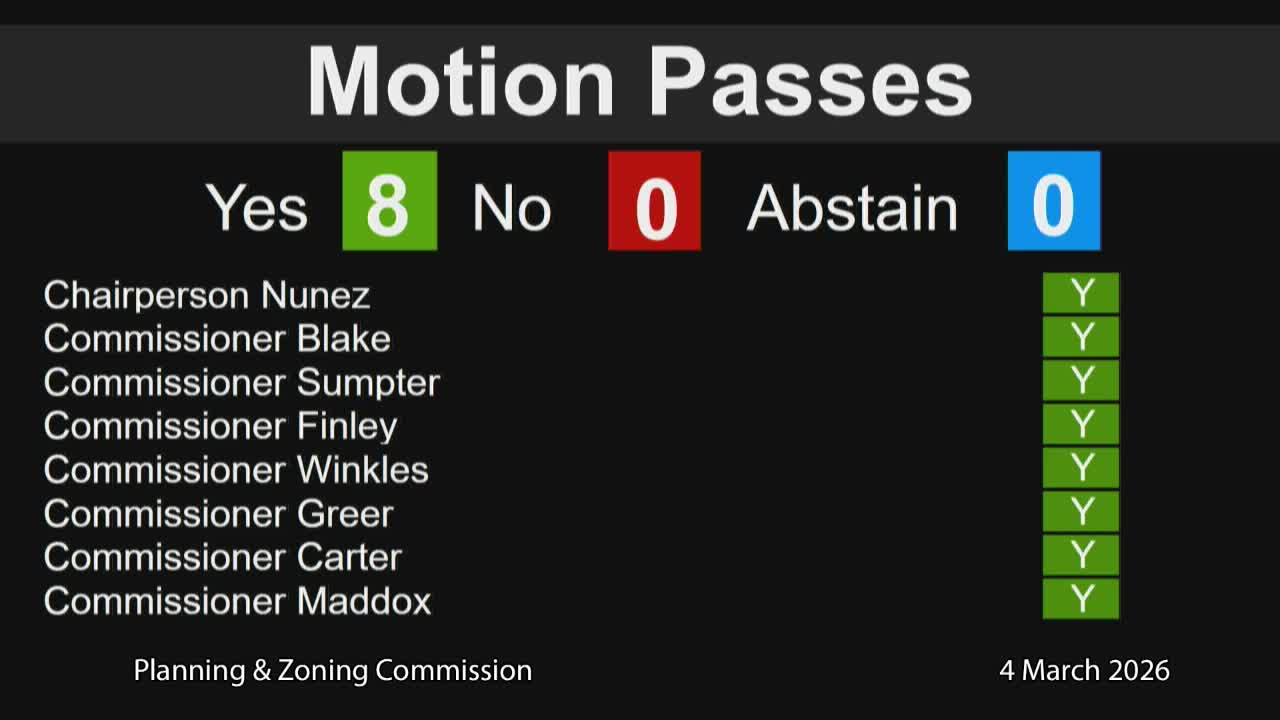
The Arlington Planning and Zoning Commission recommended adoption of a downtown form‑based code and corresponding regulating plan after a public hearing on March 4.
The 8–0 vote by the commission approves a draft UDC amendment that adds a new Article 13 creating general form‑based standards and supplemental downtown standards, and sends the zoning map implementing those rules to the City Council for final action. Commissioner Blake made the motion to approve the amendment, which the commission adopted with recommended changes.
Why it matters: Staff and the consultant said the code is designed to provide predictable rules for future redevelopment so applicants know up front what is allowed. Tarani Devi Palma, principal planner and project manager for the code, told the commission, "this is not an eminent domain case," repeating staff's pledge that the regulation is a tool for future development and not a mechanism to take private property. Consultant Jay Narayana described the structure of the new Article 13 and how the regulating plan divides downtown into five subdistricts with distinct building‑form and streetscape requirements.
Key provisions and incentives: Under the proposal, the code would:
- Create five downtown subdistricts (traditional neighborhood, urban neighborhood, corridor mixed‑use, core and downtown gateway) with differing height limits (for example, traditional neighborhood capped at about 2.5 stories, the downtown core up to 12 stories and the gateway up to 18 stories).
- Set a parking standard of 1 space per 400 square feet for nonresidential uses and exempt the first 2,000 square feet from parking calculations, while encouraging shared parking and credits for on‑street parking.
- Require a 5 percent open‑space minimum for developments larger than 20,000 square feet and call for at least 60 percent of that open space to be common space (the remainder can be private or common areas such as rooftop terraces or balconies).
- Establish ADU standards (units 800 sq ft or smaller qualify, with one required parking space) and provide design standards for facades, transparency and street activation.
- Provide tiered density bonuses (36–60 units/acre; 60–100 units/acre; more than 100 units/acre would trigger a major modification review) intended to allow greater housing capacity in core areas by right if design and parking standards are met.
Public reaction and staff response: Supporters at the hearing said the code would help activate Downtown Arlington and improve sidewalks and streetscapes. Liam Crowley, who identified himself as president of Walkable Arlington, said he was "very excited by this form based code" and welcomed the streetscape improvements. Some residents raised concerns about displacement: Olga Torres, who said she lives in a mobile home park, asked whether residents would be required to move; staff responded that existing nonconforming uses may remain and that the code would not force relocation. Tarani Palma reiterated that nonconforming uses can remain "as long as they do not move" and that discontinuing a use for more than six months could affect its status.
Next steps: Staff noted the commission's recommendation will go to City Council, which is scheduled to hold two public hearings on the measure on April 7 and April 21, 2026. If council approves the change, the new Article 13 and the regulating plan will be added to the UDC and the official zoning map.
The commission's action is intended to make downtown redevelopment more predictable for property owners and developers by codifying design and streetscape expectations and reducing the need for negotiated planned developments.
The 8–0 vote by the commission approves a draft UDC amendment that adds a new Article 13 creating general form‑based standards and supplemental downtown standards, and sends the zoning map implementing those rules to the City Council for final action. Commissioner Blake made the motion to approve the amendment, which the commission adopted with recommended changes.
Why it matters: Staff and the consultant said the code is designed to provide predictable rules for future redevelopment so applicants know up front what is allowed. Tarani Devi Palma, principal planner and project manager for the code, told the commission, "this is not an eminent domain case," repeating staff's pledge that the regulation is a tool for future development and not a mechanism to take private property. Consultant Jay Narayana described the structure of the new Article 13 and how the regulating plan divides downtown into five subdistricts with distinct building‑form and streetscape requirements.
Key provisions and incentives: Under the proposal, the code would:
- Create five downtown subdistricts (traditional neighborhood, urban neighborhood, corridor mixed‑use, core and downtown gateway) with differing height limits (for example, traditional neighborhood capped at about 2.5 stories, the downtown core up to 12 stories and the gateway up to 18 stories).
- Set a parking standard of 1 space per 400 square feet for nonresidential uses and exempt the first 2,000 square feet from parking calculations, while encouraging shared parking and credits for on‑street parking.
- Require a 5 percent open‑space minimum for developments larger than 20,000 square feet and call for at least 60 percent of that open space to be common space (the remainder can be private or common areas such as rooftop terraces or balconies).
- Establish ADU standards (units 800 sq ft or smaller qualify, with one required parking space) and provide design standards for facades, transparency and street activation.
- Provide tiered density bonuses (36–60 units/acre; 60–100 units/acre; more than 100 units/acre would trigger a major modification review) intended to allow greater housing capacity in core areas by right if design and parking standards are met.
Public reaction and staff response: Supporters at the hearing said the code would help activate Downtown Arlington and improve sidewalks and streetscapes. Liam Crowley, who identified himself as president of Walkable Arlington, said he was "very excited by this form based code" and welcomed the streetscape improvements. Some residents raised concerns about displacement: Olga Torres, who said she lives in a mobile home park, asked whether residents would be required to move; staff responded that existing nonconforming uses may remain and that the code would not force relocation. Tarani Palma reiterated that nonconforming uses can remain "as long as they do not move" and that discontinuing a use for more than six months could affect its status.
Next steps: Staff noted the commission's recommendation will go to City Council, which is scheduled to hold two public hearings on the measure on April 7 and April 21, 2026. If council approves the change, the new Article 13 and the regulating plan will be added to the UDC and the official zoning map.
The commission's action is intended to make downtown redevelopment more predictable for property owners and developers by codifying design and streetscape expectations and reducing the need for negotiated planned developments.
View the Full Meeting & All Its Details
This article offers just a summary. Unlock complete video, transcripts, and insights as a Founder Member.
✓
Watch full, unedited meeting videos
✓
Search every word spoken in unlimited transcripts
✓
AI summaries & real-time alerts (all government levels)
✓
Permanent access to expanding government content
30-day money-back guarantee
