Dr. Novotny: cigarette filters are persistent plastic waste and a public-nuisance problem
March 05, 2026 | California Water Quality Monitoring Council, Boards and Commissions, Executive, California
This article was created by AI summarizing key points discussed. AI makes mistakes, so for full details and context, please refer to the video of the full meeting. Please report any errors so we can fix them. Report an error »
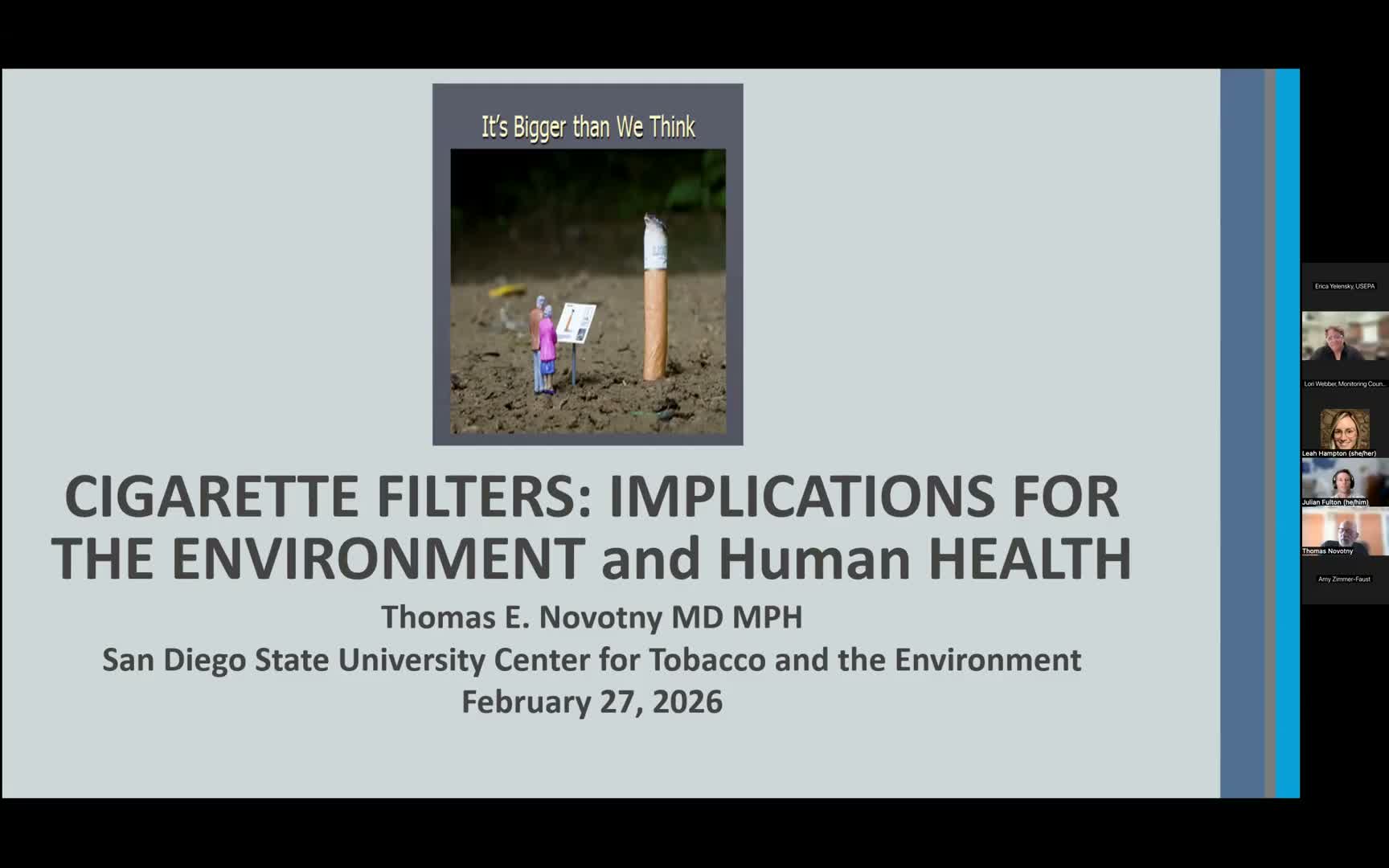
Dr. Novotny, from the Center for Tobacco and the Environment at San Diego State University, told the work group that cellulose-acetate cigarette filters are a widespread source of plastic pollution, persist in the environment for years and release micro- and nanoplastics and embedded toxins.
"It's not really degradable," Dr. Novotny said, describing cellulose acetate’s persistence and noting studies that document microplastic release and ecological toxicity. He described a range of evidence — municipal cleanups, runoff studies and toxicity tests — and reported that cigarette filters often make up a substantial fraction of items found during cleanups.
Dr. Novotny cited several quantitative and policy points in his presentation: he said nearly all cigarettes sold in the U.S. (about 99.8%) are filtered, global cigarette sales amount to trillions of units per year, and the mass of discarded filters is on the order of hundreds of thousands of metric tons annually. He warned recycling and biodegradable-filter claims have practical limits and suggested that voluntary cleanup efforts alone will not address the scale of the problem.
He also summarized emerging policy responses. He pointed to a local sales ban in Santa Cruz County and ongoing litigation in Baltimore seeking to hold manufacturers responsible for cleanup costs, and said these legal and regulatory developments could force industry disclosures and support stronger controls.
Audience exchange: A presenter asked where monitoring and source-identification fall short. Dr. Novotny emphasized the need to trace cellulose acetate specifically to cigarette filters (rather than other rayon or acetate sources) and to gather targeted monitoring evidence that can support policy measures such as taxes, bans or producer-responsibility approaches.
Why it matters: Cigarette filters are ubiquitous litter items that are difficult to remove at scale, carry hazardous residues and contribute microplastics to aquatic and urban environments. Dr. Novotny argued these features make filters both an environmental and a public-health concern that intersects trash-monitoring and tobacco-control efforts.
Closing: Dr. Novotny said more surveillance and discovery material from litigation could improve understanding of industry practices and waste streams; he offered to discuss research collaborations and follow-up questions after the presentation.
"It's not really degradable," Dr. Novotny said, describing cellulose acetate’s persistence and noting studies that document microplastic release and ecological toxicity. He described a range of evidence — municipal cleanups, runoff studies and toxicity tests — and reported that cigarette filters often make up a substantial fraction of items found during cleanups.
Dr. Novotny cited several quantitative and policy points in his presentation: he said nearly all cigarettes sold in the U.S. (about 99.8%) are filtered, global cigarette sales amount to trillions of units per year, and the mass of discarded filters is on the order of hundreds of thousands of metric tons annually. He warned recycling and biodegradable-filter claims have practical limits and suggested that voluntary cleanup efforts alone will not address the scale of the problem.
He also summarized emerging policy responses. He pointed to a local sales ban in Santa Cruz County and ongoing litigation in Baltimore seeking to hold manufacturers responsible for cleanup costs, and said these legal and regulatory developments could force industry disclosures and support stronger controls.
Audience exchange: A presenter asked where monitoring and source-identification fall short. Dr. Novotny emphasized the need to trace cellulose acetate specifically to cigarette filters (rather than other rayon or acetate sources) and to gather targeted monitoring evidence that can support policy measures such as taxes, bans or producer-responsibility approaches.
Why it matters: Cigarette filters are ubiquitous litter items that are difficult to remove at scale, carry hazardous residues and contribute microplastics to aquatic and urban environments. Dr. Novotny argued these features make filters both an environmental and a public-health concern that intersects trash-monitoring and tobacco-control efforts.
Closing: Dr. Novotny said more surveillance and discovery material from litigation could improve understanding of industry practices and waste streams; he offered to discuss research collaborations and follow-up questions after the presentation.
Don't Miss a Word: See the Full Meeting!
Go beyond summaries. Unlock every video, transcript, and key insight with a Founder Membership.
✓
Get instant access to full meeting videos
✓
Search and clip any phrase from complete transcripts
✓
Receive AI-powered summaries & custom alerts
✓
Enjoy lifetime, unrestricted access to government data
30-day money-back guarantee
