Senate subcommittee presses Cal OES for costs, timeline after next-gen 911 deployment problems
March 05, 2026 | California State Senate, Senate, Legislative, California
This article was created by AI summarizing key points discussed. AI makes mistakes, so for full details and context, please refer to the video of the full meeting. Please report any errors so we can fix them. Report an error »
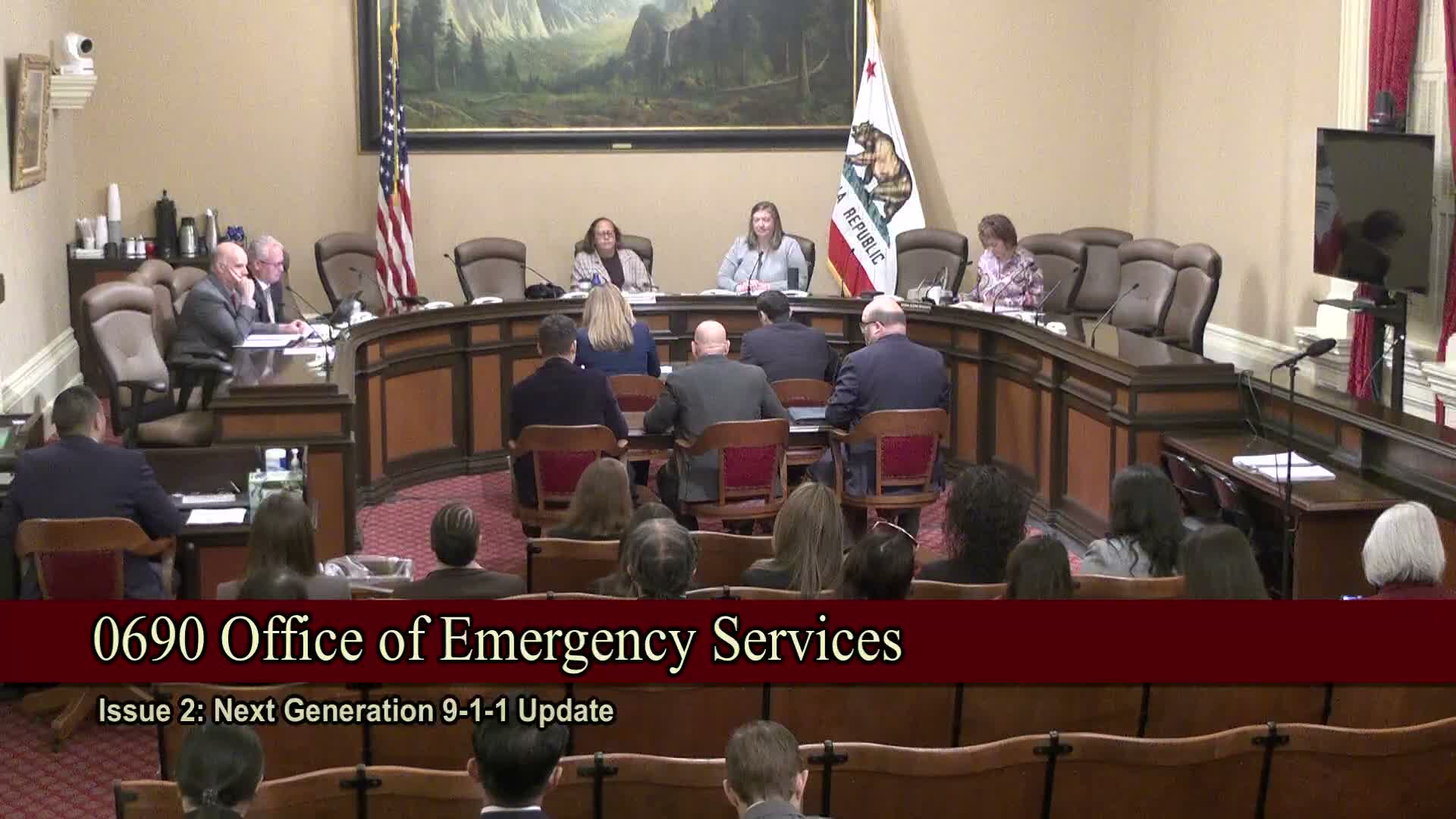
The Senate Budget Subcommittee No. 5 heard detailed testimony on March 6 about the troubled deployment of CaliforniaNext Generation 9-1-1.
Cal OES deputy director Steve Yarbrough told the committee that the department paused further voice migrations about a year ago after testing found call-routing errors and failed transfers that could send calls to the wrong public safety answering point. He said about 23 PSAPs had moved voice traffic before the pause and that the departmentis pursuing a phased transition: an interim statewide provider to stabilize operations, an open competitive procurement for a long-term vendor, and targeted migration of Los Angeles region PSAPs in advance of the 2028 Olympic and major events schedule. Cal OESstated a bridging contract would be executed in 2026, an RFP released in 2026 and a contract awarded in fall 2026, with an aim to have regional providers phased out starting in 2027 and a full transition by 2030.
Lawmakers pressed Cal OES for specifics. Committee Chair Senator Richardson asked for a clear accounting of past spending and projected costs for the new approach; Yarbrough said the state has spent roughly $450 million so far, of which about $76 million was nonrecurring equipment and installation. Cal OES said the location database (GIS data) is state-owned and that vendor contracts require hand-off files to avoid data loss during sunsets.
The Legislative AnalystOffice recommended pausing major changes until the legislature receives comparative analysis of options and trade-offs, including cost estimates and the technical case for switching from the prior regional architecture. LAO analyst Heather Gonzales said oversight is currently lacking and urged quarterly fiscal reports and monthly progress updates until the legacy system is decommissioned.
Several senators raised operational risk questions, including the possibility of a statewide outage under a single-provider model, redundancy and cybersecurity requirements, and how the department will validate vendor compliance. Yarbrough said the procurement will require five-nines (99.999%) availability and redundancy at all levels and that Cal OES will work with the California Department of Technology to write enforceable contract terms.
The committee asked Cal OES to deliver cost breakdowns, a timeline for hazard mitigation grant applications (an April submission was noted), and monthly updates on FEMA public assistance obligations related to the Los Angeles wildfires. Cal OES reported it had submitted about 700 public assistance applications (estimated eligible costs of roughly $1.2 billion) and that FEMA had obligated about 4% of that universe to date. The department also reported about $545 million had been allocated under state AB 100 for wildfire response and recovery to frontload relief while federal reimbursements lag.
The committee did not take a vote but directed staff to schedule follow-up oversight and to seek additional analysis before approving authority for the statewide approach. Cal OES agreed to provide the requested fiscal and program details.
Cal OES deputy director Steve Yarbrough told the committee that the department paused further voice migrations about a year ago after testing found call-routing errors and failed transfers that could send calls to the wrong public safety answering point. He said about 23 PSAPs had moved voice traffic before the pause and that the departmentis pursuing a phased transition: an interim statewide provider to stabilize operations, an open competitive procurement for a long-term vendor, and targeted migration of Los Angeles region PSAPs in advance of the 2028 Olympic and major events schedule. Cal OESstated a bridging contract would be executed in 2026, an RFP released in 2026 and a contract awarded in fall 2026, with an aim to have regional providers phased out starting in 2027 and a full transition by 2030.
Lawmakers pressed Cal OES for specifics. Committee Chair Senator Richardson asked for a clear accounting of past spending and projected costs for the new approach; Yarbrough said the state has spent roughly $450 million so far, of which about $76 million was nonrecurring equipment and installation. Cal OES said the location database (GIS data) is state-owned and that vendor contracts require hand-off files to avoid data loss during sunsets.
The Legislative AnalystOffice recommended pausing major changes until the legislature receives comparative analysis of options and trade-offs, including cost estimates and the technical case for switching from the prior regional architecture. LAO analyst Heather Gonzales said oversight is currently lacking and urged quarterly fiscal reports and monthly progress updates until the legacy system is decommissioned.
Several senators raised operational risk questions, including the possibility of a statewide outage under a single-provider model, redundancy and cybersecurity requirements, and how the department will validate vendor compliance. Yarbrough said the procurement will require five-nines (99.999%) availability and redundancy at all levels and that Cal OES will work with the California Department of Technology to write enforceable contract terms.
The committee asked Cal OES to deliver cost breakdowns, a timeline for hazard mitigation grant applications (an April submission was noted), and monthly updates on FEMA public assistance obligations related to the Los Angeles wildfires. Cal OES reported it had submitted about 700 public assistance applications (estimated eligible costs of roughly $1.2 billion) and that FEMA had obligated about 4% of that universe to date. The department also reported about $545 million had been allocated under state AB 100 for wildfire response and recovery to frontload relief while federal reimbursements lag.
The committee did not take a vote but directed staff to schedule follow-up oversight and to seek additional analysis before approving authority for the statewide approach. Cal OES agreed to provide the requested fiscal and program details.
Don't Miss a Word: See the Full Meeting!
Go beyond summaries. Unlock every video, transcript, and key insight with a Founder Membership.
✓
Get instant access to full meeting videos
✓
Search and clip any phrase from complete transcripts
✓
Receive AI-powered summaries & custom alerts
✓
Enjoy lifetime, unrestricted access to government data
30-day money-back guarantee
