WCRIB attorney tells Supreme Judicial Court commissioner offered no reasoned explanation for 14.6% workers'comp rate cut
March 06, 2026 | Judicial - Supreme Court, Judicial, Massachusetts
This article was created by AI summarizing key points discussed. AI makes mistakes, so for full details and context, please refer to the video of the full meeting. Please report any errors so we can fix them. Report an error »
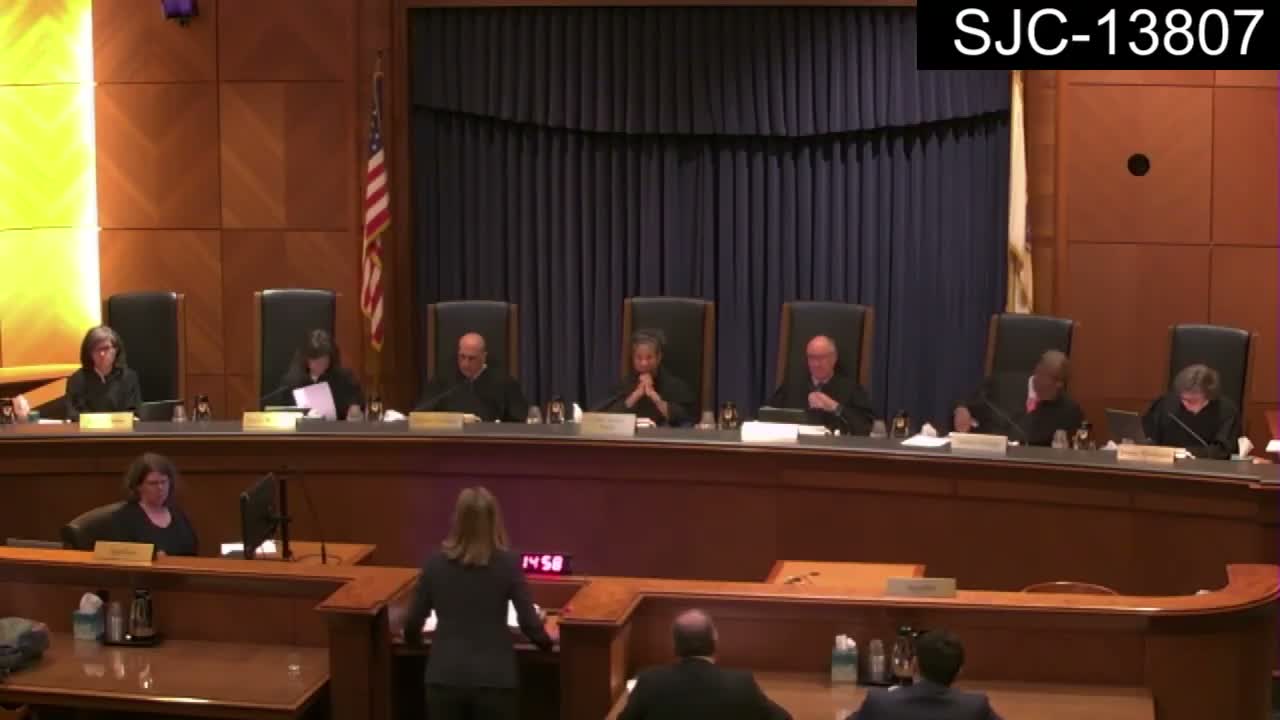
Tony Allison, counsel for the Workers Compensation Rating and Inspection Bureau of Massachusetts, told the Supreme Judicial Court that the commissioner of insurance provided "no reasoned explanation" for imposing a 14.6% decrease in workers' compensation rates in the 2024 decision and then maintaining that figure in 2025. Allison told the justices the 2024 decision addressed the decrease in a single concluding sentence and that the 2025 order merely held that unexplained figure in place.
The issue matters, Allison said, because the statute requires a reviewing official to evaluate proposed prospective rates under the statutory standard of review rather than "set rates" from the bench. He urged the court not only to remand for a mathematic explanation of the 14.6% figure but also to decide whether the commissioner misapplied the applicable standard of review, a legal error that Allison argued taints both the 2024 and 2025 decisions.
During argument the justices parsed the case as a two-step inquiry: first whether the commissioner permissibly disapproved the filer's proposed rate, and second, if disapproved, what specific decrease the statute requires. Several justices asked whether a remand limited to an explanation of the arithmetic would be sufficient or whether the court should resolve the standard-of-review question now to avoid multiple returns to the court. Allison warned that remand without clarifying the applicable legal standard could leave the parties "right back here" after the commissioner explained the math.
Technical disputes underlay the debate. Allison drew a contrast between "paid losses," which he said are appropriately measured by a two-year lookback, and "case reserves," for which a five-year lookback may be appropriate to smooth out inconsistent reserve practices across insurers. He argued the commissioner's 2003 guidance favoring two-year data for paid losses is inconsistent with the commissioner's later application of a five-year lookback in these decisions and that the commissioner's inclusion of COVID-era years in a five-year average was internally inconsistent with the recognition that COVID effects were not likely to recur.
Assistant Attorney General John Hipp, representing the commissioner, responded that the 14.6% decrease sits between the parties' proposals (Allison's bureau proposals in the single-digit range and the Attorney General's larger proposed decrease) and that, while the decision's text may be brief, the evidentiary record supports the commissioner's choice. Hipp said the commissioner has statutory authority both to review methodologies and to order a specific decrease when existing rates are excessive, and he pointed to testimony and evidentiary materials that, he argued, explain why use of five years of data produced a more consistent result in this proceeding.
The justices also questioned whether the commissioner's prospective guidance on methodology (for example, instructing prospectively that a five-year lookback be used) crosses the line from review into rate-making. Hipp acknowledged the difference between selecting a rate and reviewing methodology but said the commissioner may prescribe an approach when supported by the record and explained reasonably in the decision.
The bench pressed both sides about lost-profit (underwriting profit) calculations and whether undisputed bases in the record could allow the court to affirm without resolving every contested actuarial choice. Hipp cited a prior decision and offered to supply a post-argument letter on how states sometimes treat local versus national data; he also called the court's attention to Associated Industries of Massachusetts v. Commissioner of Insurance, 403 Mass. 37, for related dictum on when a commissioner may order a decrease.
Argument closed with counsel resting on their briefs and no ruling announced in the transcript. The central legal questions presented to the justices were (1) whether the commissioner's identification of a 14.6% decrease was accompanied by a legally adequate, reasoned explanation, and (2) whether the commissioner exceeded the statutory role as a reviewer by prescribing methodology in a way that effectively sets prospective rates.
The issue matters, Allison said, because the statute requires a reviewing official to evaluate proposed prospective rates under the statutory standard of review rather than "set rates" from the bench. He urged the court not only to remand for a mathematic explanation of the 14.6% figure but also to decide whether the commissioner misapplied the applicable standard of review, a legal error that Allison argued taints both the 2024 and 2025 decisions.
During argument the justices parsed the case as a two-step inquiry: first whether the commissioner permissibly disapproved the filer's proposed rate, and second, if disapproved, what specific decrease the statute requires. Several justices asked whether a remand limited to an explanation of the arithmetic would be sufficient or whether the court should resolve the standard-of-review question now to avoid multiple returns to the court. Allison warned that remand without clarifying the applicable legal standard could leave the parties "right back here" after the commissioner explained the math.
Technical disputes underlay the debate. Allison drew a contrast between "paid losses," which he said are appropriately measured by a two-year lookback, and "case reserves," for which a five-year lookback may be appropriate to smooth out inconsistent reserve practices across insurers. He argued the commissioner's 2003 guidance favoring two-year data for paid losses is inconsistent with the commissioner's later application of a five-year lookback in these decisions and that the commissioner's inclusion of COVID-era years in a five-year average was internally inconsistent with the recognition that COVID effects were not likely to recur.
Assistant Attorney General John Hipp, representing the commissioner, responded that the 14.6% decrease sits between the parties' proposals (Allison's bureau proposals in the single-digit range and the Attorney General's larger proposed decrease) and that, while the decision's text may be brief, the evidentiary record supports the commissioner's choice. Hipp said the commissioner has statutory authority both to review methodologies and to order a specific decrease when existing rates are excessive, and he pointed to testimony and evidentiary materials that, he argued, explain why use of five years of data produced a more consistent result in this proceeding.
The justices also questioned whether the commissioner's prospective guidance on methodology (for example, instructing prospectively that a five-year lookback be used) crosses the line from review into rate-making. Hipp acknowledged the difference between selecting a rate and reviewing methodology but said the commissioner may prescribe an approach when supported by the record and explained reasonably in the decision.
The bench pressed both sides about lost-profit (underwriting profit) calculations and whether undisputed bases in the record could allow the court to affirm without resolving every contested actuarial choice. Hipp cited a prior decision and offered to supply a post-argument letter on how states sometimes treat local versus national data; he also called the court's attention to Associated Industries of Massachusetts v. Commissioner of Insurance, 403 Mass. 37, for related dictum on when a commissioner may order a decrease.
Argument closed with counsel resting on their briefs and no ruling announced in the transcript. The central legal questions presented to the justices were (1) whether the commissioner's identification of a 14.6% decrease was accompanied by a legally adequate, reasoned explanation, and (2) whether the commissioner exceeded the statutory role as a reviewer by prescribing methodology in a way that effectively sets prospective rates.
Don't Miss a Word: See the Full Meeting!
Go beyond summaries. Unlock every video, transcript, and key insight with a Founder Membership.
✓
Get instant access to full meeting videos
✓
Search and clip any phrase from complete transcripts
✓
Receive AI-powered summaries & custom alerts
✓
Enjoy lifetime, unrestricted access to government data
30-day money-back guarantee
