Senate concurs on $8 million waste and stormwater infrastructure study amid security concerns
February 27, 2026 | Joint & Standing, Committees, Legislative, Wyoming
This article was created by AI summarizing key points discussed. AI makes mistakes, so for full details and context, please refer to the video of the full meeting. Please report any errors so we can fix them. Report an error »
The Wyoming Senate on March 6 concurred with the House on Senate File 69, a study and inventory of wastewater and stormwater infrastructure, approving the measure by a roll-call vote of 28 ayes, 1 no and 2 excused.
A senator who moved concurrence said the bill will gather information on municipal infrastructure across the state and noted the cost associated with the effort, saying, “if we’re gonna spend $8,000,000 that that information is gonna be publicly available and be used by, not just the state of Wyoming, but for anybody who wants amendment.” The mover asked colleagues to support the measure and offered to work on language if members thought it needed clarification.
Senator Crago raised concerns about the scope of public access, asking whether the bill would publish detailed data such as the location of manholes and pipelines and warning of potential security risks if sensitive infrastructure information were made widely available. “I guess, I’m just trying to figure out what kind of data is accessible… Do we want every single manhole, every single pipeline, that data published online or is there some security risks involved?” she asked.
Senator Barlow also urged caution about exposing critical infrastructure and asked what role the new agency responsible for these systems would play in protecting data.
Responding to those concerns, the mover pointed to a provision in the bill drafted to preserve confidentiality, saying the amendment attempted to strike a balance and that “paragraph 3, nothing in the subsection shall be construed or acquired disclosure of any information as confidential or privileged under state or federal law,” as a safeguard to address security concerns.
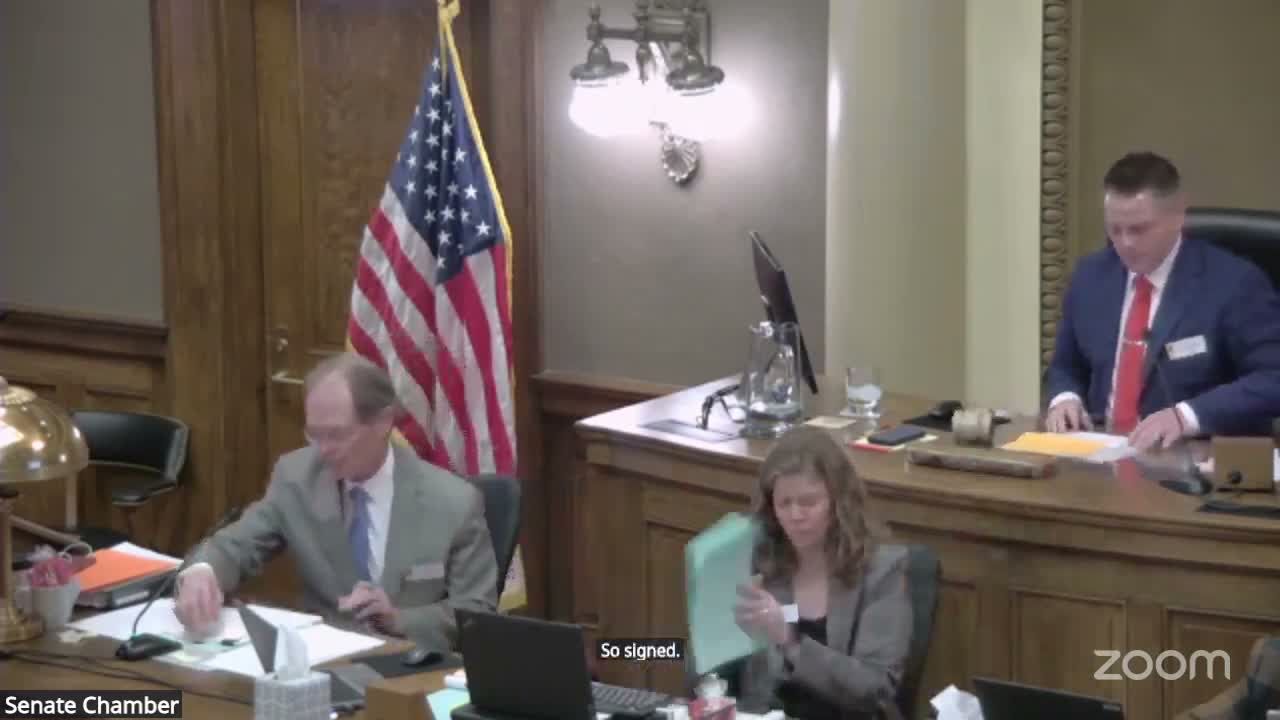
The Senate’s concurrence means the study will proceed under the version accepted by the House; President Beau Beitman later signed the enrolled act on the floor. The bill’s passage does not, in itself, require the state to publish sensitive infrastructure detail beyond the protections enumerated in the bill’s language. Further implementation details and any public-release plans will be governed by the bill’s text and any follow-up guidance from implementing agencies.
A senator who moved concurrence said the bill will gather information on municipal infrastructure across the state and noted the cost associated with the effort, saying, “if we’re gonna spend $8,000,000 that that information is gonna be publicly available and be used by, not just the state of Wyoming, but for anybody who wants amendment.” The mover asked colleagues to support the measure and offered to work on language if members thought it needed clarification.
Senator Crago raised concerns about the scope of public access, asking whether the bill would publish detailed data such as the location of manholes and pipelines and warning of potential security risks if sensitive infrastructure information were made widely available. “I guess, I’m just trying to figure out what kind of data is accessible… Do we want every single manhole, every single pipeline, that data published online or is there some security risks involved?” she asked.
Senator Barlow also urged caution about exposing critical infrastructure and asked what role the new agency responsible for these systems would play in protecting data.
Responding to those concerns, the mover pointed to a provision in the bill drafted to preserve confidentiality, saying the amendment attempted to strike a balance and that “paragraph 3, nothing in the subsection shall be construed or acquired disclosure of any information as confidential or privileged under state or federal law,” as a safeguard to address security concerns.
The Senate’s concurrence means the study will proceed under the version accepted by the House; President Beau Beitman later signed the enrolled act on the floor. The bill’s passage does not, in itself, require the state to publish sensitive infrastructure detail beyond the protections enumerated in the bill’s language. Further implementation details and any public-release plans will be governed by the bill’s text and any follow-up guidance from implementing agencies.
Don't Miss a Word: See the Full Meeting!
Go beyond summaries. Unlock every video, transcript, and key insight with a Founder Membership.
✓
Get instant access to full meeting videos
✓
Search and clip any phrase from complete transcripts
✓
Receive AI-powered summaries & custom alerts
✓
Enjoy lifetime, unrestricted access to government data
30-day money-back guarantee
