Tucson and Pima County officials tout Safe City work and preliminary SAFER sobering-center results
March 04, 2026 | Pima County, Arizona
This article was created by AI summarizing key points discussed. AI makes mistakes, so for full details and context, please refer to the video of the full meeting. Please report any errors so we can fix them. Report an error »
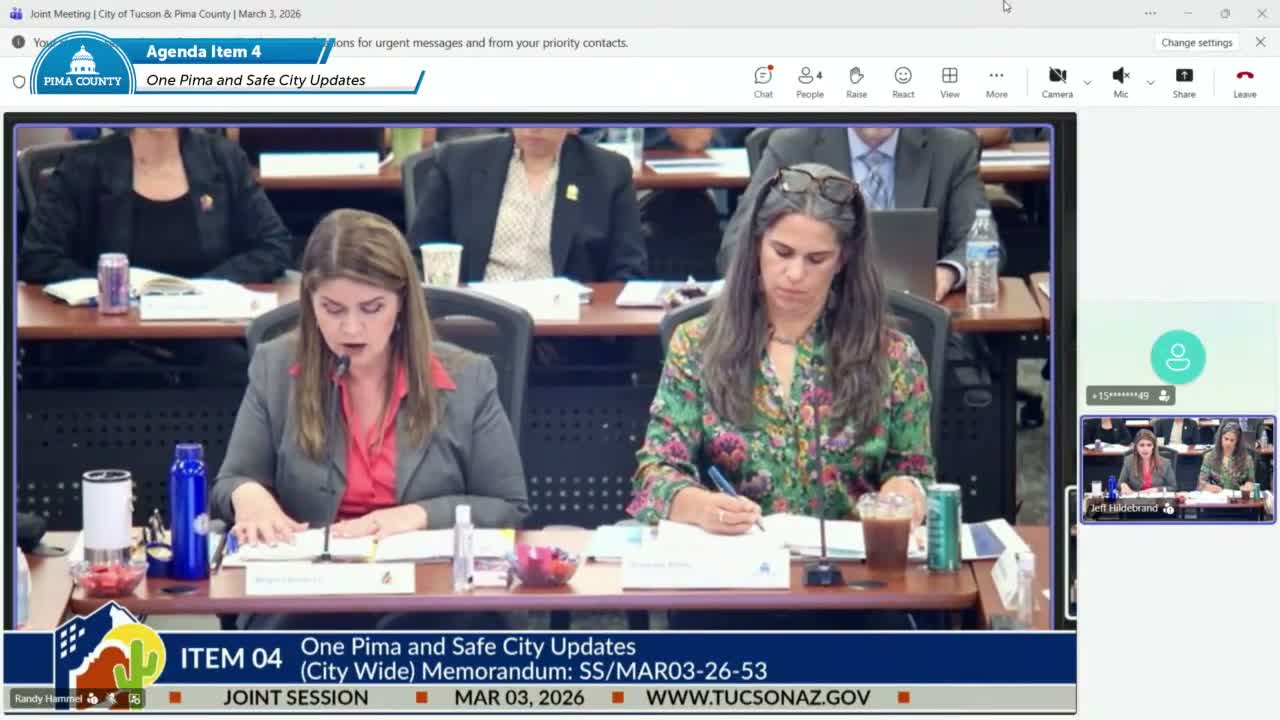
Tucson and Pima County officials on March 3 described coordinated steps to address street homelessness, substance use and public-safety concerns, highlighting the Safe City initiative's deployments and early data from a new SAFER sobering center pilot.
Assistant City Manager Les Morales said the Safe City Task Force, launched in November, is moving the effort "from a coordinated response" toward "a structured framework built around measurable outcomes." Morales described targeted police deployments and outreach that pair enforcement with diversion to services and said the city is circulating a draft Safe City Action Plan for public comment.
Pima County Health Director Dr. Terry Cohen, who led the county's SAFER briefing, provided preliminary operational numbers for the pilot: "Since January 1 through February 21, there have been 113 admissions," she said, adding that January recorded 47 admissions (30 male, 17 female), ages 24 to 79 and an average age of 41. Cohen warned the data are early and variable: one recent week saw 7 of 14 admissions transition to a behavioral unit (50 percent), while another week had 3 of 17 transition to treatment.
Cohen described the SAFER model as low-barrier, 24/7 stabilization with up to 96-hour stays, pet-friendly policies and an emphasis on clinical screening, withdrawal management, initiation of medication-assisted treatment and warm handoffs to further care. The county required an external evaluator, and Cohen said CBI (the contract operator) selected a University of Arizona division to conduct ongoing performance improvement and monthly evaluation reporting.
City and county officials said the SAFER center is one part of a broader continuum: Morales noted that Safe City deployments produced shelter placements, detox acceptances and MAT referrals as part of a strategy to redirect people from emergency rooms and jails into services.
Elected officials used the joint meeting's Q&A to press for clearer performance measures and fiscal context. Several members asked for crime and cost-savings analytics tied to these programs; Morales and other presenters said those metrics are being developed and will be shared at future meetings. Cohen emphasized that the county and operator are collecting both quantitative metrics and qualitative discharge data to understand why some clients accept treatment and others leave without it.
The meeting closed with officials agreeing to share evaluation results, deployment metrics and crime-impact data at the next joint session and to continue public engagement on the draft action plan.
Assistant City Manager Les Morales said the Safe City Task Force, launched in November, is moving the effort "from a coordinated response" toward "a structured framework built around measurable outcomes." Morales described targeted police deployments and outreach that pair enforcement with diversion to services and said the city is circulating a draft Safe City Action Plan for public comment.
Pima County Health Director Dr. Terry Cohen, who led the county's SAFER briefing, provided preliminary operational numbers for the pilot: "Since January 1 through February 21, there have been 113 admissions," she said, adding that January recorded 47 admissions (30 male, 17 female), ages 24 to 79 and an average age of 41. Cohen warned the data are early and variable: one recent week saw 7 of 14 admissions transition to a behavioral unit (50 percent), while another week had 3 of 17 transition to treatment.
Cohen described the SAFER model as low-barrier, 24/7 stabilization with up to 96-hour stays, pet-friendly policies and an emphasis on clinical screening, withdrawal management, initiation of medication-assisted treatment and warm handoffs to further care. The county required an external evaluator, and Cohen said CBI (the contract operator) selected a University of Arizona division to conduct ongoing performance improvement and monthly evaluation reporting.
City and county officials said the SAFER center is one part of a broader continuum: Morales noted that Safe City deployments produced shelter placements, detox acceptances and MAT referrals as part of a strategy to redirect people from emergency rooms and jails into services.
Elected officials used the joint meeting's Q&A to press for clearer performance measures and fiscal context. Several members asked for crime and cost-savings analytics tied to these programs; Morales and other presenters said those metrics are being developed and will be shared at future meetings. Cohen emphasized that the county and operator are collecting both quantitative metrics and qualitative discharge data to understand why some clients accept treatment and others leave without it.
The meeting closed with officials agreeing to share evaluation results, deployment metrics and crime-impact data at the next joint session and to continue public engagement on the draft action plan.
View the Full Meeting & All Its Details
This article offers just a summary. Unlock complete video, transcripts, and insights as a Founder Member.
✓
Watch full, unedited meeting videos
✓
Search every word spoken in unlimited transcripts
✓
AI summaries & real-time alerts (all government levels)
✓
Permanent access to expanding government content
30-day money-back guarantee
