Commissioners use interactive workshop to weigh MG‑zone changes, data centers, retail and self‑storage
March 06, 2026 | Murray City Council, Murray , Salt Lake County, Utah
This article was created by AI summarizing key points discussed. AI makes mistakes, so for full details and context, please refer to the video of the full meeting. Please report any errors so we can fix them. Report an error »
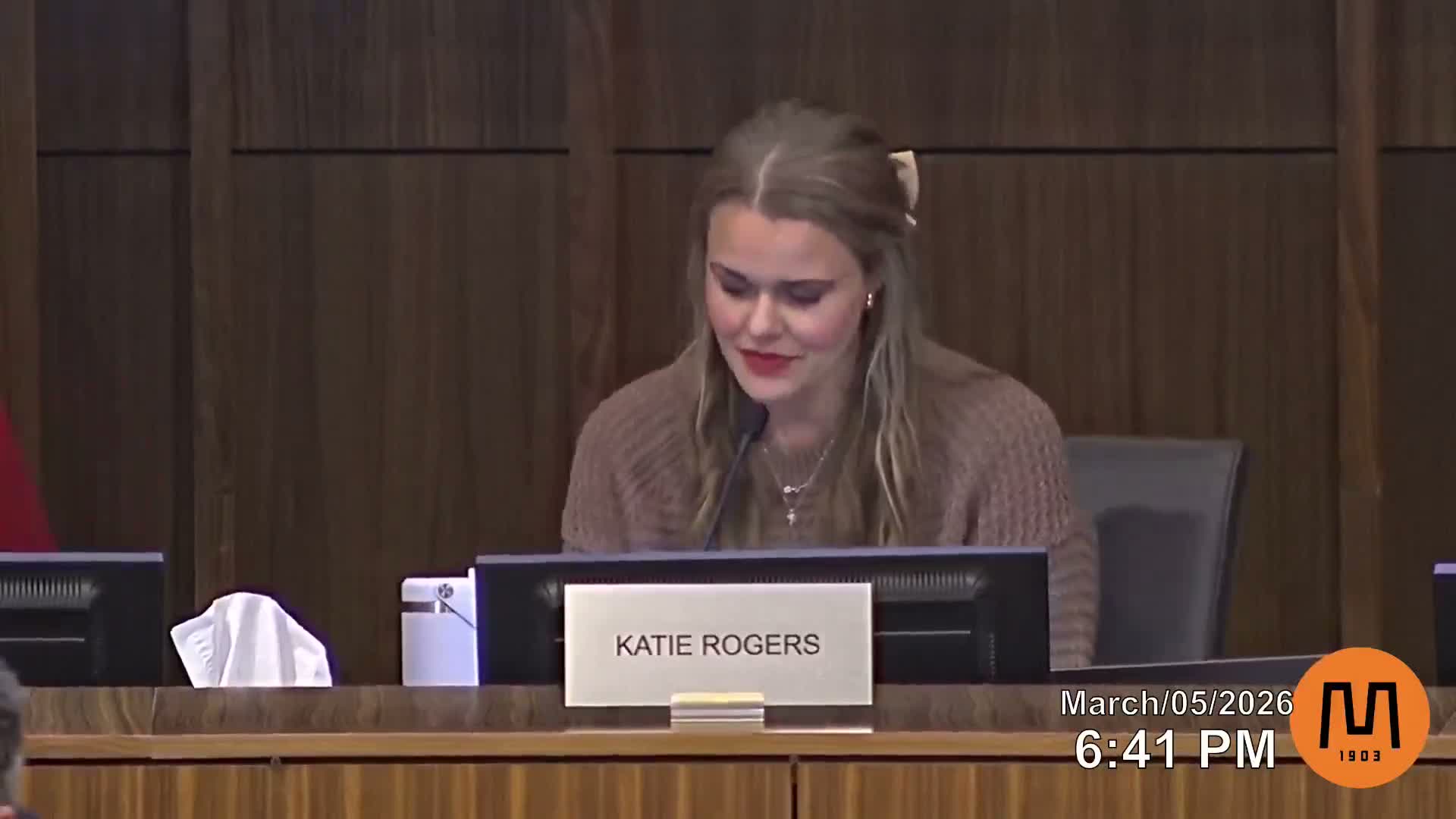
After a five-minute break, the Murray City Planning Commission reconvened for an extended workshop on the land-use table and the Manufacturing General (MG) zone, using an interactive Mentimeter tool to gather commissioner priorities and questions.
Planning staff summarized the anonymous poll results and framed the workshop as a policy-direction exercise rather than a standards-setting meeting. "So it looks like the majority say the primary goal should be to preserve land for high intensity industrial jobs in manufacturing," staff said when reviewing the results.
Commissioners debated whether retail should be allowed in the MG zone and, if so, whether it must be accessory to an industrial use (for example, a manufacturer with an on-site showroom) or permitted as stand-alone retail. Some members argued retail adds higher assessed value and sales tax potential; others cautioned that allowing retail could dilute the purpose of an industrial zone. Commissioner comments clustered around two tradeoffs: job quality (manufacturing jobs often pay more than retail) and assessed-value/revenue differences.
Staff cited a quick, illustrative assessment comparing parcels: "It came out to $335,000 per acre" for a data-center example and "$12,049,114 per acre" for a mixed-use example (presented as Focal on 48 in staff remarks), arguing mixed-use can produce far higher assessed value per acre while noting industrial uses still provide jobs.
Data centers prompted extended discussion. Commissioners worried about scale, power and water impacts and whether some data centers could be conditioned or limited by size. Planning staff and commissioners discussed options including requiring objective standards, conditioning on size or infrastructure needs, or requiring developers to submit power/water impact information during review. "Should we require data center developers to submit some sort of impact study regarding their power over usage?" a commissioner asked; staff responded that the city could require objective standards and involve public-works/utilities review.
Other workshop topics included outdoor storage screening (debate over masonry versus lower‑cost nontransparent screening), auto-sales display-vs-parking calculations, and where to allow distilleries/breweries/wineries. On self-storage the group did not reach a conclusion but agreed to bring self-storage back for a focused work session.
Staff said the exercise is intended to identify policy direction; where commissioners express a preference, staff will draft objective standards for later review. The commission did not make formal code changes at the meeting — it used the workshop to guide future drafts and agreed to return specific contentious items such as self-storage for another session.
Planning staff summarized the anonymous poll results and framed the workshop as a policy-direction exercise rather than a standards-setting meeting. "So it looks like the majority say the primary goal should be to preserve land for high intensity industrial jobs in manufacturing," staff said when reviewing the results.
Commissioners debated whether retail should be allowed in the MG zone and, if so, whether it must be accessory to an industrial use (for example, a manufacturer with an on-site showroom) or permitted as stand-alone retail. Some members argued retail adds higher assessed value and sales tax potential; others cautioned that allowing retail could dilute the purpose of an industrial zone. Commissioner comments clustered around two tradeoffs: job quality (manufacturing jobs often pay more than retail) and assessed-value/revenue differences.
Staff cited a quick, illustrative assessment comparing parcels: "It came out to $335,000 per acre" for a data-center example and "$12,049,114 per acre" for a mixed-use example (presented as Focal on 48 in staff remarks), arguing mixed-use can produce far higher assessed value per acre while noting industrial uses still provide jobs.
Data centers prompted extended discussion. Commissioners worried about scale, power and water impacts and whether some data centers could be conditioned or limited by size. Planning staff and commissioners discussed options including requiring objective standards, conditioning on size or infrastructure needs, or requiring developers to submit power/water impact information during review. "Should we require data center developers to submit some sort of impact study regarding their power over usage?" a commissioner asked; staff responded that the city could require objective standards and involve public-works/utilities review.
Other workshop topics included outdoor storage screening (debate over masonry versus lower‑cost nontransparent screening), auto-sales display-vs-parking calculations, and where to allow distilleries/breweries/wineries. On self-storage the group did not reach a conclusion but agreed to bring self-storage back for a focused work session.
Staff said the exercise is intended to identify policy direction; where commissioners express a preference, staff will draft objective standards for later review. The commission did not make formal code changes at the meeting — it used the workshop to guide future drafts and agreed to return specific contentious items such as self-storage for another session.
Don't Miss a Word: See the Full Meeting!
Go beyond summaries. Unlock every video, transcript, and key insight with a Founder Membership.
✓
Get instant access to full meeting videos
✓
Search and clip any phrase from complete transcripts
✓
Receive AI-powered summaries & custom alerts
✓
Enjoy lifetime, unrestricted access to government data
30-day money-back guarantee
