Plaintiffs press for summary judgment, say Reliance Health vicariously liable after Fayette County crash
March 05, 2026 | Clayton County State Court 304, Texas Courts, Judicial, Texas
This article was created by AI summarizing key points discussed. AI makes mistakes, so for full details and context, please refer to the video of the full meeting. Please report any errors so we can fix them. Report an error »
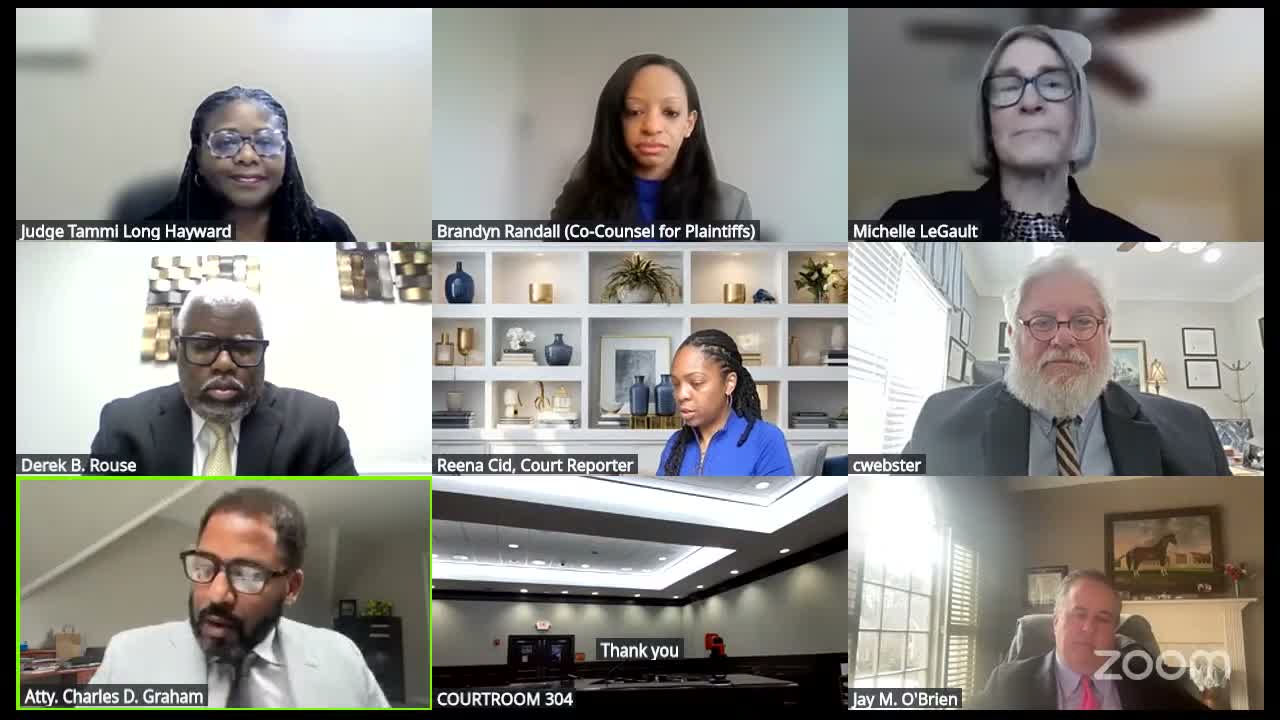
Plaintiffs asked Judge Tammy Long Hayward to grant partial summary judgment Wednesday in a personal-injury suit, arguing evidence shows defendant Rose Saint Hilaire failed to yield at a stop sign on Georgia Highway 92 on Sept. 22, 2022, and was acting in the scope of her employment for Reliance Health when the collision occurred.
Charles Graham, the plaintiffs' attorney, told the court he would establish three points: that Saint Hilaire solely caused the crash, that she was operating an employer vehicle while furthering Reliance Health’s business, and that those breaches proximately caused the Barclays’ injuries. Graham cited the responding officers’ finding, Saint Hilaire’s paid citation for failure to yield and deposition testimony as showing there is no genuine issue of material fact.
The defense urged the court to disregard several items plaintiffs referenced orally as hearsay and outside the motion record. "When a party is presenting evidence on a motion for summary judgment… that evidence needs to be trial-quality evidence, it cannot be hearsay," defense counsel Michelle LeGault told the court, arguing police footage and company documents presented today were not properly before the court.
LeGault said key questions remain for a jury, including whether Saint Hilaire exercised ordinary care when entering the intersection, whether she actually saw the Barclays’ vehicle before proceeding, and whether she was acting within the scope of employment. "Plaintiff's motion for partial summary judgment as to liability should be denied because there are fact issues that defendants are entitled to have a jury decide," she said.
Craig Webster, counsel for Saint Hilaire, acknowledged plaintiffs presented strong evidence but likewise urged denial of summary judgment, saying deposition testimony raises credibility and causation questions that a jury should resolve. Webster quoted Saint Hilaire’s sworn deposition, in which she said the plaintiff’s car "came from nowhere with a speed I can't even explain to you," arguing that contested factual descriptions make liability unsuitable for determination on motion.
Graham countered that Saint Hilaire repeatedly admitted she did not see the plaintiff’s vehicle before the collision and that she paid the citation. He also pointed to internal Reliance records and 30(b)(6) testimony presented in discovery indicating the company had authorized routes and that a supervisor had directed the driver’s route. Graham told the court that internal documents acknowledging the driver caused the accident and testimony that a supervisor had previously disconnected GPS tracking undercut any employer rebuttal.
The parties also debated the legal effect of a paid traffic citation. The judge discussed with counsel that payment can create a rebuttable presumption of negligence in a civil action but noted that the defendant may rebut that presumption through credible evidence or testimony. The attorneys disagreed about whether and how the on-scene statements and the video should be considered for context or as substantive evidence at the summary-judgment stage.
The court heard arguments from both sides and took the matter under advisement; no final ruling on the plaintiffs' motion for partial summary judgment was announced at the hearing. The plaintiffs indicated they intended to present deputy testimony and video; defense counsel asked the court to limit consideration to materials properly submitted in the motion record. The case will proceed under the court’s scheduling order pending the judge's ruling.
The hearing concluded with the court moving on to the next calendar matter.
Charles Graham, the plaintiffs' attorney, told the court he would establish three points: that Saint Hilaire solely caused the crash, that she was operating an employer vehicle while furthering Reliance Health’s business, and that those breaches proximately caused the Barclays’ injuries. Graham cited the responding officers’ finding, Saint Hilaire’s paid citation for failure to yield and deposition testimony as showing there is no genuine issue of material fact.
The defense urged the court to disregard several items plaintiffs referenced orally as hearsay and outside the motion record. "When a party is presenting evidence on a motion for summary judgment… that evidence needs to be trial-quality evidence, it cannot be hearsay," defense counsel Michelle LeGault told the court, arguing police footage and company documents presented today were not properly before the court.
LeGault said key questions remain for a jury, including whether Saint Hilaire exercised ordinary care when entering the intersection, whether she actually saw the Barclays’ vehicle before proceeding, and whether she was acting within the scope of employment. "Plaintiff's motion for partial summary judgment as to liability should be denied because there are fact issues that defendants are entitled to have a jury decide," she said.
Craig Webster, counsel for Saint Hilaire, acknowledged plaintiffs presented strong evidence but likewise urged denial of summary judgment, saying deposition testimony raises credibility and causation questions that a jury should resolve. Webster quoted Saint Hilaire’s sworn deposition, in which she said the plaintiff’s car "came from nowhere with a speed I can't even explain to you," arguing that contested factual descriptions make liability unsuitable for determination on motion.
Graham countered that Saint Hilaire repeatedly admitted she did not see the plaintiff’s vehicle before the collision and that she paid the citation. He also pointed to internal Reliance records and 30(b)(6) testimony presented in discovery indicating the company had authorized routes and that a supervisor had directed the driver’s route. Graham told the court that internal documents acknowledging the driver caused the accident and testimony that a supervisor had previously disconnected GPS tracking undercut any employer rebuttal.
The parties also debated the legal effect of a paid traffic citation. The judge discussed with counsel that payment can create a rebuttable presumption of negligence in a civil action but noted that the defendant may rebut that presumption through credible evidence or testimony. The attorneys disagreed about whether and how the on-scene statements and the video should be considered for context or as substantive evidence at the summary-judgment stage.
The court heard arguments from both sides and took the matter under advisement; no final ruling on the plaintiffs' motion for partial summary judgment was announced at the hearing. The plaintiffs indicated they intended to present deputy testimony and video; defense counsel asked the court to limit consideration to materials properly submitted in the motion record. The case will proceed under the court’s scheduling order pending the judge's ruling.
The hearing concluded with the court moving on to the next calendar matter.
View the Full Meeting & All Its Details
This article offers just a summary. Unlock complete video, transcripts, and insights as a Founder Member.
✓
Watch full, unedited meeting videos
✓
Search every word spoken in unlimited transcripts
✓
AI summaries & real-time alerts (all government levels)
✓
Permanent access to expanding government content
30-day money-back guarantee
