NMDOT explains road safety audits as Mesilla Valley MPO eyes HSIP grant
March 06, 2026 | Doña Ana County, New Mexico
This article was created by AI summarizing key points discussed. AI makes mistakes, so for full details and context, please refer to the video of the full meeting. Please report any errors so we can fix them. Report an error »
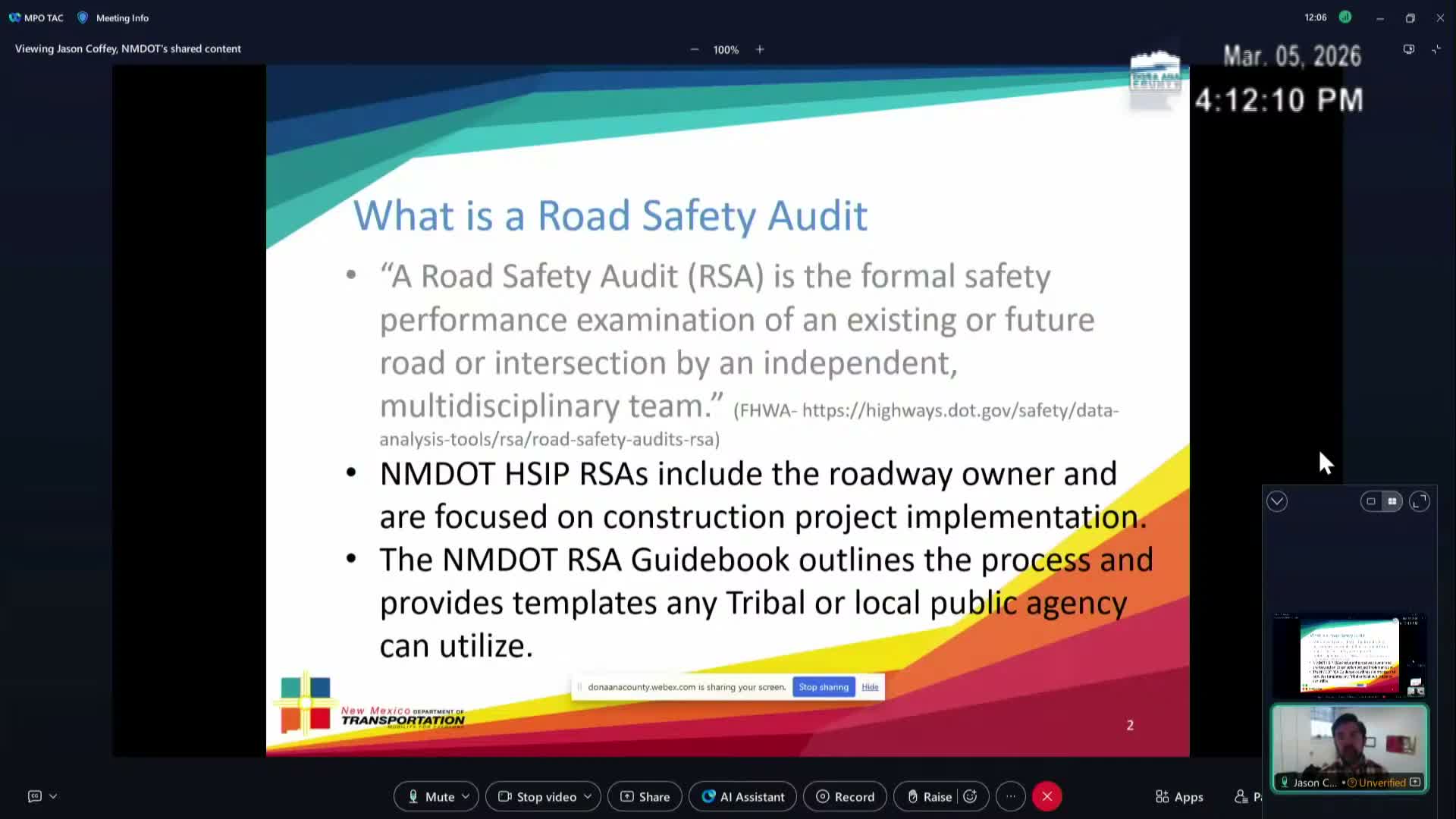
Jason Coffey, the Highway Safety Improvement Program manager at the New Mexico Department of Transportation, told the Mesilla Valley Metropolitan Planning Organization technical advisory committee on March 5 that NMDOT's approach to road safety audits (RSAs) differs from Federal Highway Administration guidance because "we do include the roadway owner" in the department's RSA process.
Coffey, joining remotely after an early Webex connectivity issue, reviewed the FHWA definition of RSAs as "a formal safety performance examination of existing or future road or intersection by an independent multidisciplinary team" and emphasized that while FHWA guidance envisions an independent review, the NMDOT HSIP program typically includes the roadway owner in the review and in follow-up project development.
"That's one way that our process diverges from the FHWA process," Coffey said, noting downstream effects: because NMDOT often conducts RSAs on DOT-owned roads, the department seeks district concurrence when an RSA would involve an NMDOT leg of an intersection and aims to move RSA recommendations into funded design and construction projects where possible.
Coffey described NMDOT's administrative process: the HSIP program uses an on-call contract to perform RSAs, a safety committee meets quarterly to approve RSA and HSIP applications, and program capacity is limited to a small number of RSAs per year. He advised jurisdictions that if they already know a feasible solution for a safety problem, it may be more appropriate to apply directly for design and construction funding rather than an RSA.
The manager urged jurisdictions that plan to seek HSIP funds to structure RSAs using the NMDOT RSA guidebook so the findings will be suitable for later HSIP implementation funding. "If you apply for a road safety audit through the NMDOT HSIP, we use that on-call contract that we've already funded to do the RSA," Coffey said, adding that following the guidebook "sets you up for an application for HSIP funding for implementation of the projects."
Coffey also told the committee that NMDOT generally treats RSAs as having a five-year shelf life: "If it is more than 5 years old, we will probably request that you update some of the data analysis there."
MPO staff told the committee the MPO is targeting submission of one HSIP grant within the calendar year and has begun identifying candidate locations. "We are, in fact, targeting, submitting a grant to NMDOT for HSIP monies within this calendar year," MPO staff said, noting the MPO had not conducted an RSA in the Mesilla Valley area since 2014 and that the item grew out of concerns in last year's annual safety report.
Coffey said the safety committee's next meeting is in April (the third week, he said), which provides an opportunity to submit a correctly structured application if staff screening and coordination with NMDOT district staff are completed in time. He encouraged the committee to contact HSIP staff for follow-up questions.
The presentation closed with committee members thanking Coffey and noting next steps: MPO staff will continue the site-identification process and coordinate with NMDOT if the MPO moves forward with an HSIP-funded RSA or with an HSIP-funded procurement for consultant-led RSAs.
The committee then moved on to routine member updates and other business.
Coffey, joining remotely after an early Webex connectivity issue, reviewed the FHWA definition of RSAs as "a formal safety performance examination of existing or future road or intersection by an independent multidisciplinary team" and emphasized that while FHWA guidance envisions an independent review, the NMDOT HSIP program typically includes the roadway owner in the review and in follow-up project development.
"That's one way that our process diverges from the FHWA process," Coffey said, noting downstream effects: because NMDOT often conducts RSAs on DOT-owned roads, the department seeks district concurrence when an RSA would involve an NMDOT leg of an intersection and aims to move RSA recommendations into funded design and construction projects where possible.
Coffey described NMDOT's administrative process: the HSIP program uses an on-call contract to perform RSAs, a safety committee meets quarterly to approve RSA and HSIP applications, and program capacity is limited to a small number of RSAs per year. He advised jurisdictions that if they already know a feasible solution for a safety problem, it may be more appropriate to apply directly for design and construction funding rather than an RSA.
The manager urged jurisdictions that plan to seek HSIP funds to structure RSAs using the NMDOT RSA guidebook so the findings will be suitable for later HSIP implementation funding. "If you apply for a road safety audit through the NMDOT HSIP, we use that on-call contract that we've already funded to do the RSA," Coffey said, adding that following the guidebook "sets you up for an application for HSIP funding for implementation of the projects."
Coffey also told the committee that NMDOT generally treats RSAs as having a five-year shelf life: "If it is more than 5 years old, we will probably request that you update some of the data analysis there."
MPO staff told the committee the MPO is targeting submission of one HSIP grant within the calendar year and has begun identifying candidate locations. "We are, in fact, targeting, submitting a grant to NMDOT for HSIP monies within this calendar year," MPO staff said, noting the MPO had not conducted an RSA in the Mesilla Valley area since 2014 and that the item grew out of concerns in last year's annual safety report.
Coffey said the safety committee's next meeting is in April (the third week, he said), which provides an opportunity to submit a correctly structured application if staff screening and coordination with NMDOT district staff are completed in time. He encouraged the committee to contact HSIP staff for follow-up questions.
The presentation closed with committee members thanking Coffey and noting next steps: MPO staff will continue the site-identification process and coordinate with NMDOT if the MPO moves forward with an HSIP-funded RSA or with an HSIP-funded procurement for consultant-led RSAs.
The committee then moved on to routine member updates and other business.
View the Full Meeting & All Its Details
This article offers just a summary. Unlock complete video, transcripts, and insights as a Founder Member.
✓
Watch full, unedited meeting videos
✓
Search every word spoken in unlimited transcripts
✓
AI summaries & real-time alerts (all government levels)
✓
Permanent access to expanding government content
30-day money-back guarantee
