Appellate court hears arguments in LG v. DCYF over negligent-investigation standard
March 05, 2026 | Other Court, Judicial , Washington
This article was created by AI summarizing key points discussed. AI makes mistakes, so for full details and context, please refer to the video of the full meeting. Please report any errors so we can fix them. Report an error »
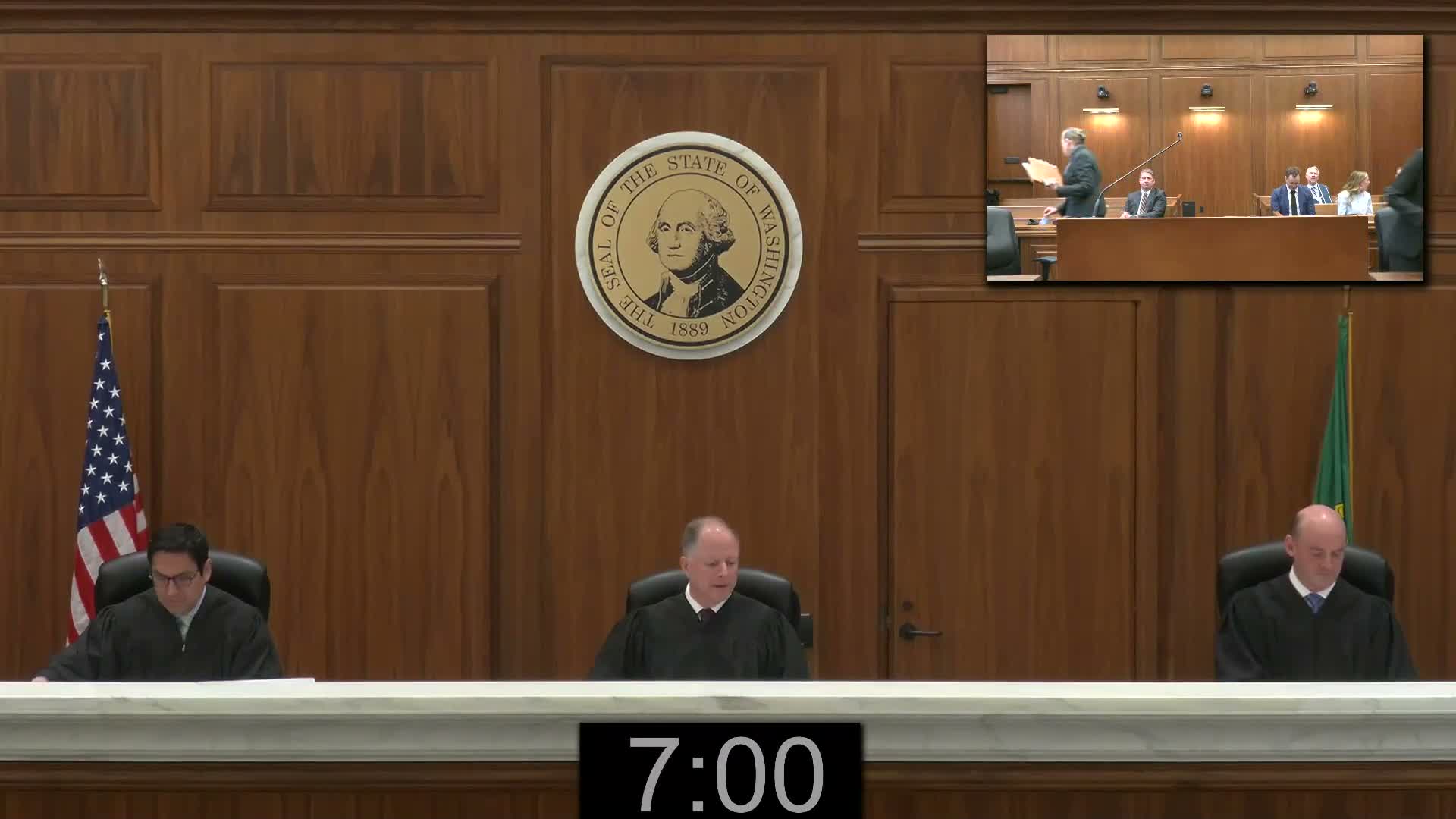
At oral argument before the court, Meg Price, counsel for the appellants in LG v. DCYF, told the panel the trial court erred by removing the negligent-investigation claim from the jury and that the department's investigatory failures meet the statutory gross-negligence standard.
"The trial court erred by taking from the jury a negligent investigation placement," Price said, arguing proximate cause is a question for jurors and pointing to expert Barbara Stone's declaration, which she said documents multiple investigatory failures and concludes "the children have suffered because of it." Price asked the court to reverse the summary-judgment order and remand the case for trial to allow the children to present evidence of the harm they sustained.
Assistant Attorney General Joshua Sher, representing the department, urged the court to affirm summary judgment. Sher told the panel the plaintiffs' expert relied on hypothetical possibilities rather than showing what would have happened on a "more likely than not" basis and cited precedent holding that "mere possibility" does not satisfy proximate-cause requirements. "We have could have. We have mere possibility," Sher said, arguing that decades of case law require more concrete proof of causation.
Judges pressed both sides on the evidentiary standard for gross negligence and on whether repeated instances of deficient investigations, considered cumulatively, can support a finding that the department's conduct was a substantial departure from the standard of care. One judge framed the record as consisting of five or six referrals between 2017 and 2020 and asked whether those referrals split into two buckets: those that triggered a duty to investigate and those handled as family assessments.
Price urged the court to consider the record as a whole, saying the referrals and the allegations of escalating physical abuse create triable issues. She cited the unpublished Heidemann decision as the appellants' best analogy, arguing that multiple referrals can create a red flag warranting more searching investigation and that investigative steps the department took do not automatically foreclose liability.
Sher countered that the record indicates the parties agree on the underlying facts and that plaintiffs failed to show how alleged investigatory deficiencies would, on balance, have led to a different outcome. Sher referenced recent and controlling decisions (including Peter Hans and Atkerson) to argue experts must explain how the care fell substantially short of the applicable standard and how different actions would have caused different outcomes, not only what could have happened.
The panel also questioned whether an expert must state explicitly that conduct amounted to gross negligence or whether the jury may infer gross negligence from the record. Judges noted that gross negligence requires more than ordinary negligence and said courts look for a serious breach or a substantial departure from the standard of care.
Price closed by urging that affirmance would amount to blanket immunity for negligent investigations and asked for remand so appellants can develop the record and present their evidence. The court thanked counsel and concluded argument; a decision timeline was not included in the oral record.
The argument focused on legal standards for proximate cause and gross negligence in the negligent-investigation context and on the sufficiency of expert testimony and cumulative referrals to create triable issues for a jury.
"The trial court erred by taking from the jury a negligent investigation placement," Price said, arguing proximate cause is a question for jurors and pointing to expert Barbara Stone's declaration, which she said documents multiple investigatory failures and concludes "the children have suffered because of it." Price asked the court to reverse the summary-judgment order and remand the case for trial to allow the children to present evidence of the harm they sustained.
Assistant Attorney General Joshua Sher, representing the department, urged the court to affirm summary judgment. Sher told the panel the plaintiffs' expert relied on hypothetical possibilities rather than showing what would have happened on a "more likely than not" basis and cited precedent holding that "mere possibility" does not satisfy proximate-cause requirements. "We have could have. We have mere possibility," Sher said, arguing that decades of case law require more concrete proof of causation.
Judges pressed both sides on the evidentiary standard for gross negligence and on whether repeated instances of deficient investigations, considered cumulatively, can support a finding that the department's conduct was a substantial departure from the standard of care. One judge framed the record as consisting of five or six referrals between 2017 and 2020 and asked whether those referrals split into two buckets: those that triggered a duty to investigate and those handled as family assessments.
Price urged the court to consider the record as a whole, saying the referrals and the allegations of escalating physical abuse create triable issues. She cited the unpublished Heidemann decision as the appellants' best analogy, arguing that multiple referrals can create a red flag warranting more searching investigation and that investigative steps the department took do not automatically foreclose liability.
Sher countered that the record indicates the parties agree on the underlying facts and that plaintiffs failed to show how alleged investigatory deficiencies would, on balance, have led to a different outcome. Sher referenced recent and controlling decisions (including Peter Hans and Atkerson) to argue experts must explain how the care fell substantially short of the applicable standard and how different actions would have caused different outcomes, not only what could have happened.
The panel also questioned whether an expert must state explicitly that conduct amounted to gross negligence or whether the jury may infer gross negligence from the record. Judges noted that gross negligence requires more than ordinary negligence and said courts look for a serious breach or a substantial departure from the standard of care.
Price closed by urging that affirmance would amount to blanket immunity for negligent investigations and asked for remand so appellants can develop the record and present their evidence. The court thanked counsel and concluded argument; a decision timeline was not included in the oral record.
The argument focused on legal standards for proximate cause and gross negligence in the negligent-investigation context and on the sufficiency of expert testimony and cumulative referrals to create triable issues for a jury.
View the Full Meeting & All Its Details
This article offers just a summary. Unlock complete video, transcripts, and insights as a Founder Member.
✓
Watch full, unedited meeting videos
✓
Search every word spoken in unlimited transcripts
✓
AI summaries & real-time alerts (all government levels)
✓
Permanent access to expanding government content
30-day money-back guarantee
