Appellate defense argues felony‑murder rule violates due process in State v. Williams
March 05, 2026 | Other Court, Judicial , Washington
This article was created by AI summarizing key points discussed. AI makes mistakes, so for full details and context, please refer to the video of the full meeting. Please report any errors so we can fix them. Report an error »
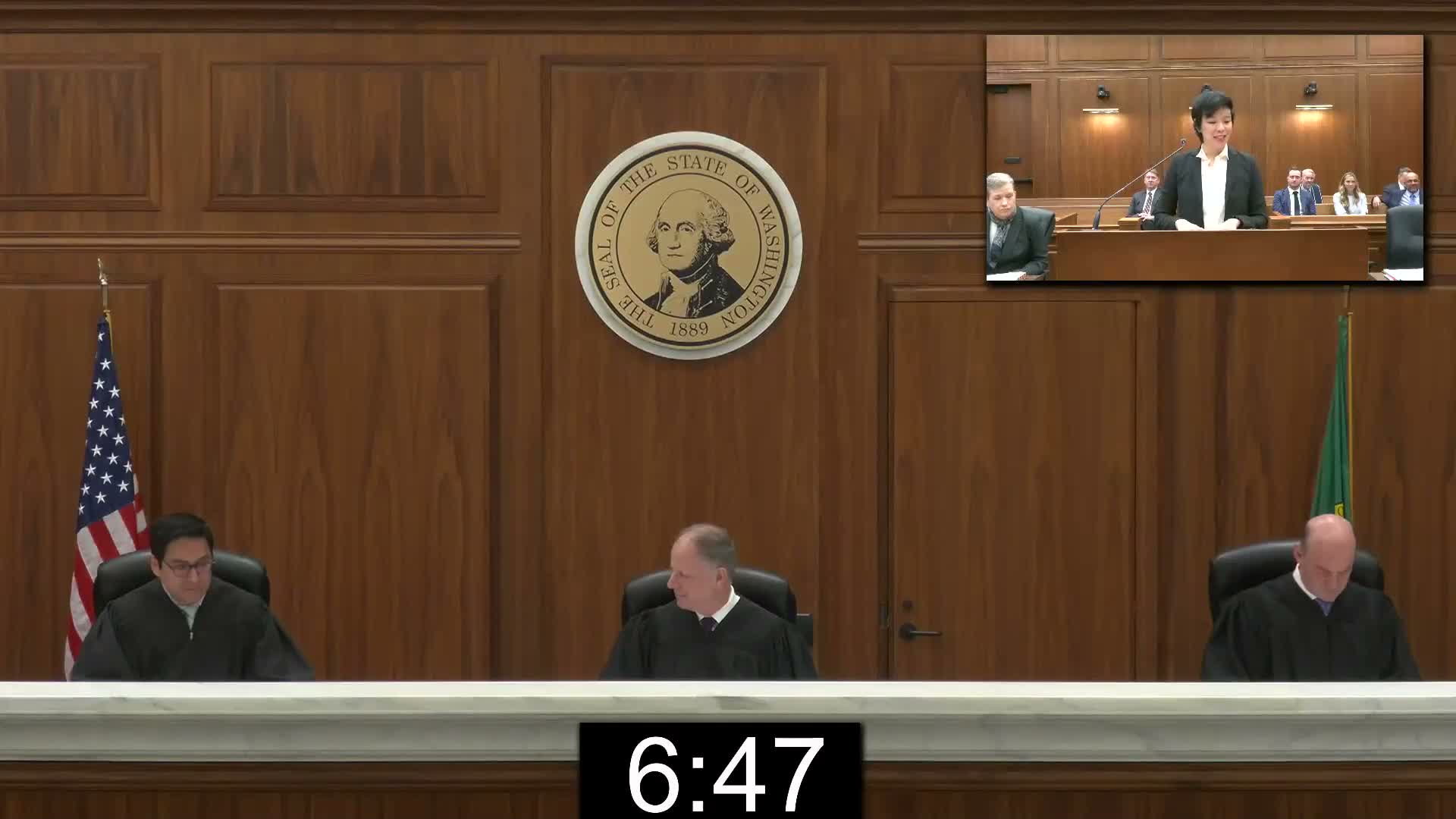
Beverly Tsai, appellate counsel with the Washington Appellate Project, told a three‑judge panel in State v. Williams that the felony‑murder rule “ratchets up any felony to equate a murder because a death occurred” and, when paired with accomplice liability, can convict people of murder without proof of a mental state as to the death.
Tsai argued the statute, as applied, creates a constitutional due‑process problem because it permits murder convictions based on a lower culpability standard for the predicate felony. “The state doesn’t have to prove any mental state regarding the death,” she said, framing the appeal as an as‑applied challenge rather than an equal‑protection or cruel‑and‑unusual‑punishment claim.
The defense also pressed a sufficiency‑of‑the‑evidence argument. Tsai said the record rests largely on circumstantial links — a silver car tied to incidents, one recovered gun and one unrecovered, cell‑phone and social‑media location data and eyewitness statements — and lacks direct proof that Marcus Williams was the driver or shooter. She asked the court to reverse for insufficient evidence or, alternatively, for a new sentencing or restitution proceedings.
Andrea Vitilich of the King County Prosecutor’s Office, representing the State, urged the court to affirm. Vitilich said felony murder is not a strict‑liability offense because the mens rea for the underlying felony substitutes for the homicide mens rea and that the legislature has the authority to define offenses and penalties. She told the panel jurors heard substantial circumstantial evidence, and she listed vehicles, guns, video and Snapchat recordings, cell‑phone location data, text threads and ballistics among the items linked to the incidents.
Vitilich cited the trial record to explain why the jury could infer Williams’ role: jurors saw what they reasonably concluded was the murder weapon on a defendant’s lap in video and reviewed a text message thread that the prosecutor described as reading, “I got it on me,” arguing at minimum that Williams supplied the weapon to the shooter.
Panel members probed whether the defense sought a broad constitutional invalidation of the felony‑murder statute or an as‑applied ruling tied to the facts here, and they asked both sides to clarify the interplay between accomplice liability and the statute’s mens‑rea mechanics. The prosecutor urged the court that overturning the statute on the constitutional ground Tsai urged would be a policy determination for the legislature and, where prior cases have addressed similar arguments, the legislature responded by reenacting statutes.
On racial‑disparity evidence, Vitilich told the panel that precedent requires more than a disparate‑impact showing to declare a statute unconstitutional; she cited prior cases that required Washington‑specific studies or detailed evidentiary showings before courts invalidate statutes on that basis. Tsai said racial‑disparity statistics provide contextual support for the due‑process concern but are not the independent basis for the present challenge: “We are resting on a due‑process argument and arguing that the racial disparity provides additional context,” she said, and noted a statistic in the record asserting that Black people in Washington are, she said, about 13 times more likely to be convicted of felony murder.
The parties completed argument; the defense had reserved three minutes for rebuttal at the start of the hearing. The panel did not announce a ruling during argument; further court action or an opinion will follow the usual appellate process.
Tsai argued the statute, as applied, creates a constitutional due‑process problem because it permits murder convictions based on a lower culpability standard for the predicate felony. “The state doesn’t have to prove any mental state regarding the death,” she said, framing the appeal as an as‑applied challenge rather than an equal‑protection or cruel‑and‑unusual‑punishment claim.
The defense also pressed a sufficiency‑of‑the‑evidence argument. Tsai said the record rests largely on circumstantial links — a silver car tied to incidents, one recovered gun and one unrecovered, cell‑phone and social‑media location data and eyewitness statements — and lacks direct proof that Marcus Williams was the driver or shooter. She asked the court to reverse for insufficient evidence or, alternatively, for a new sentencing or restitution proceedings.
Andrea Vitilich of the King County Prosecutor’s Office, representing the State, urged the court to affirm. Vitilich said felony murder is not a strict‑liability offense because the mens rea for the underlying felony substitutes for the homicide mens rea and that the legislature has the authority to define offenses and penalties. She told the panel jurors heard substantial circumstantial evidence, and she listed vehicles, guns, video and Snapchat recordings, cell‑phone location data, text threads and ballistics among the items linked to the incidents.
Vitilich cited the trial record to explain why the jury could infer Williams’ role: jurors saw what they reasonably concluded was the murder weapon on a defendant’s lap in video and reviewed a text message thread that the prosecutor described as reading, “I got it on me,” arguing at minimum that Williams supplied the weapon to the shooter.
Panel members probed whether the defense sought a broad constitutional invalidation of the felony‑murder statute or an as‑applied ruling tied to the facts here, and they asked both sides to clarify the interplay between accomplice liability and the statute’s mens‑rea mechanics. The prosecutor urged the court that overturning the statute on the constitutional ground Tsai urged would be a policy determination for the legislature and, where prior cases have addressed similar arguments, the legislature responded by reenacting statutes.
On racial‑disparity evidence, Vitilich told the panel that precedent requires more than a disparate‑impact showing to declare a statute unconstitutional; she cited prior cases that required Washington‑specific studies or detailed evidentiary showings before courts invalidate statutes on that basis. Tsai said racial‑disparity statistics provide contextual support for the due‑process concern but are not the independent basis for the present challenge: “We are resting on a due‑process argument and arguing that the racial disparity provides additional context,” she said, and noted a statistic in the record asserting that Black people in Washington are, she said, about 13 times more likely to be convicted of felony murder.
The parties completed argument; the defense had reserved three minutes for rebuttal at the start of the hearing. The panel did not announce a ruling during argument; further court action or an opinion will follow the usual appellate process.
Don't Miss a Word: See the Full Meeting!
Go beyond summaries. Unlock every video, transcript, and key insight with a Founder Membership.
✓
Get instant access to full meeting videos
✓
Search and clip any phrase from complete transcripts
✓
Receive AI-powered summaries & custom alerts
✓
Enjoy lifetime, unrestricted access to government data
30-day money-back guarantee
