Marquette Area Public Schools proposes $59.995 million bond, 1.55‑mill increase, for May 5 ballot
March 04, 2026 | Marquette Area Public Schools, School Boards, Michigan
This article was created by AI summarizing key points discussed. AI makes mistakes, so for full details and context, please refer to the video of the full meeting. Please report any errors so we can fix them. Report an error »
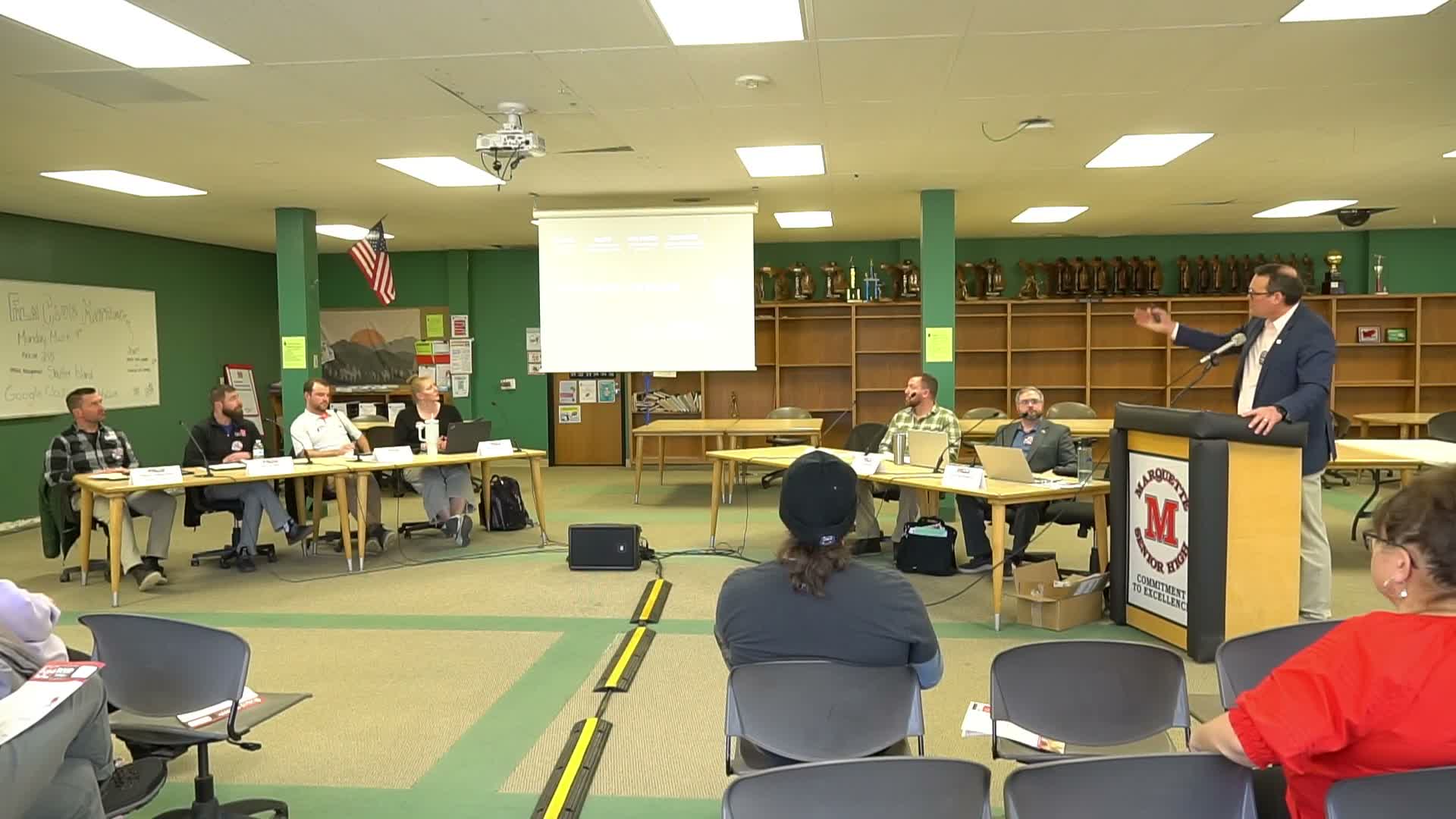
Superintendent Zach Sedgwick presented a $59,995,000 bond proposal at Marquette Senior High School, saying the plan would address safety, aging infrastructure and classroom programming across Marquette Area Public Schools and would appear on the May 5 ballot if the board’s action stands.
The proposal would raise the district’s levy by roughly 1.55 mills, a change Sedgwick illustrated this way: on a house with a $100,000 market value (about $50,000 taxable value) the increase would cost an estimated $77.50 a year — about $6.45 a month or roughly 21¢ a day.
Why it matters: district officials said Marquette has roughly 750,000 square feet of school buildings and about 3,200 students that would be affected by the work. The bond is intended to preserve and modernize systems — heating, ventilation and air conditioning; plumbing and electrical; accessibility — and to fund safety improvements, CTE and arts spaces, playgrounds and local operational efficiencies.
Sedgwick described three pillars guiding the proposal: safety, infrastructure and programming. He pointed to past investments in security cameras, secure entrances and a radio/PA network that allow direct coordination with local law enforcement and Northern Michigan University in emergencies. "We could not communicate with our entire buildings — I literally had to walk around with a bullhorn at one point," Sedgwick said, arguing modern communications and secure access are essential to student safety.
Scope and examples: officials said the district used internal studies plus a statewide Michigan infrastructure analysis to identify needs that exceed $100 million for the district. The board presented a $60 million base plan driven by the district’s "priority 1" lists compiled with consultants. Sedgwick cited recent project costs to illustrate scale — a high‑school parking lot cost about $2 million and science lab renovations were around $1.3 million.
Bothell Middle School was singled out as the largest single investment in the plan, receiving about 40% of the proposed funds because of its size and a 1970s ‘‘pod’’ layout that officials said requires an addition and major second‑floor renovation to make classrooms accessible and better suited to modern instruction.
Survey and electoral outlook: the district said it mailed a third‑party survey (conducted by School Perceptions) to roughly 17,000 households and received about 1,900 responses (roughly a 13% response rate). Officials reported 89% staff support and 69% parent support. A weighted estimate accounting for voter turnout patterns put likely support in the low‑to‑mid‑50s (about 53–54%), with a reported margin of error near ±2%, which district officials characterized as a close result and a reason for active outreach.
Legal and fiscal details: the district described the financing as two phased borrowings with a 28‑year total term and an option to refinance in about 10 years to reduce future tax pressure. Officials said the estimated simple average annual millage to retire the debt is about 1.58 mills and emphasized that, pursuant to state law, bond proceeds must be audited and cannot be used for salaries, operating expenses or routine maintenance.
Community questions: during a Q&A, residents raised why some newer or recently improved sites (such as Cherry Creek) would see work and questioned the meaning of "unlimited tax bonds" in the ballot language. Assistant Superintendent for Finance Jim Lampman and other finance staff explained that "unlimited" is industry terminology for a general tax obligation bond and that any bond proceeds would be voter‑approved for a specific dollar amount and purpose; they said the district could not spend more than the amount approved by voters without returning to the electorate.
Next steps: the board previously approved putting the measure on the May 5 ballot; district officials urged residents to visit www.mapsnet.org for the ballot language, detailed project lists and tax‑impact information and encouraged community participation ahead of the vote.
The proposal would raise the district’s levy by roughly 1.55 mills, a change Sedgwick illustrated this way: on a house with a $100,000 market value (about $50,000 taxable value) the increase would cost an estimated $77.50 a year — about $6.45 a month or roughly 21¢ a day.
Why it matters: district officials said Marquette has roughly 750,000 square feet of school buildings and about 3,200 students that would be affected by the work. The bond is intended to preserve and modernize systems — heating, ventilation and air conditioning; plumbing and electrical; accessibility — and to fund safety improvements, CTE and arts spaces, playgrounds and local operational efficiencies.
Sedgwick described three pillars guiding the proposal: safety, infrastructure and programming. He pointed to past investments in security cameras, secure entrances and a radio/PA network that allow direct coordination with local law enforcement and Northern Michigan University in emergencies. "We could not communicate with our entire buildings — I literally had to walk around with a bullhorn at one point," Sedgwick said, arguing modern communications and secure access are essential to student safety.
Scope and examples: officials said the district used internal studies plus a statewide Michigan infrastructure analysis to identify needs that exceed $100 million for the district. The board presented a $60 million base plan driven by the district’s "priority 1" lists compiled with consultants. Sedgwick cited recent project costs to illustrate scale — a high‑school parking lot cost about $2 million and science lab renovations were around $1.3 million.
Bothell Middle School was singled out as the largest single investment in the plan, receiving about 40% of the proposed funds because of its size and a 1970s ‘‘pod’’ layout that officials said requires an addition and major second‑floor renovation to make classrooms accessible and better suited to modern instruction.
Survey and electoral outlook: the district said it mailed a third‑party survey (conducted by School Perceptions) to roughly 17,000 households and received about 1,900 responses (roughly a 13% response rate). Officials reported 89% staff support and 69% parent support. A weighted estimate accounting for voter turnout patterns put likely support in the low‑to‑mid‑50s (about 53–54%), with a reported margin of error near ±2%, which district officials characterized as a close result and a reason for active outreach.
Legal and fiscal details: the district described the financing as two phased borrowings with a 28‑year total term and an option to refinance in about 10 years to reduce future tax pressure. Officials said the estimated simple average annual millage to retire the debt is about 1.58 mills and emphasized that, pursuant to state law, bond proceeds must be audited and cannot be used for salaries, operating expenses or routine maintenance.
Community questions: during a Q&A, residents raised why some newer or recently improved sites (such as Cherry Creek) would see work and questioned the meaning of "unlimited tax bonds" in the ballot language. Assistant Superintendent for Finance Jim Lampman and other finance staff explained that "unlimited" is industry terminology for a general tax obligation bond and that any bond proceeds would be voter‑approved for a specific dollar amount and purpose; they said the district could not spend more than the amount approved by voters without returning to the electorate.
Next steps: the board previously approved putting the measure on the May 5 ballot; district officials urged residents to visit www.mapsnet.org for the ballot language, detailed project lists and tax‑impact information and encouraged community participation ahead of the vote.
Don't Miss a Word: See the Full Meeting!
Go beyond summaries. Unlock every video, transcript, and key insight with a Founder Membership.
✓
Get instant access to full meeting videos
✓
Search and clip any phrase from complete transcripts
✓
Receive AI-powered summaries & custom alerts
✓
Enjoy lifetime, unrestricted access to government data
30-day money-back guarantee
