Committee weighs revamp of exit interviews to improve staff feedback
March 04, 2026 | ITHACA, School Districts, New York
This article was created by AI summarizing key points discussed. AI makes mistakes, so for full details and context, please refer to the video of the full meeting. Please report any errors so we can fix them. Report an error »
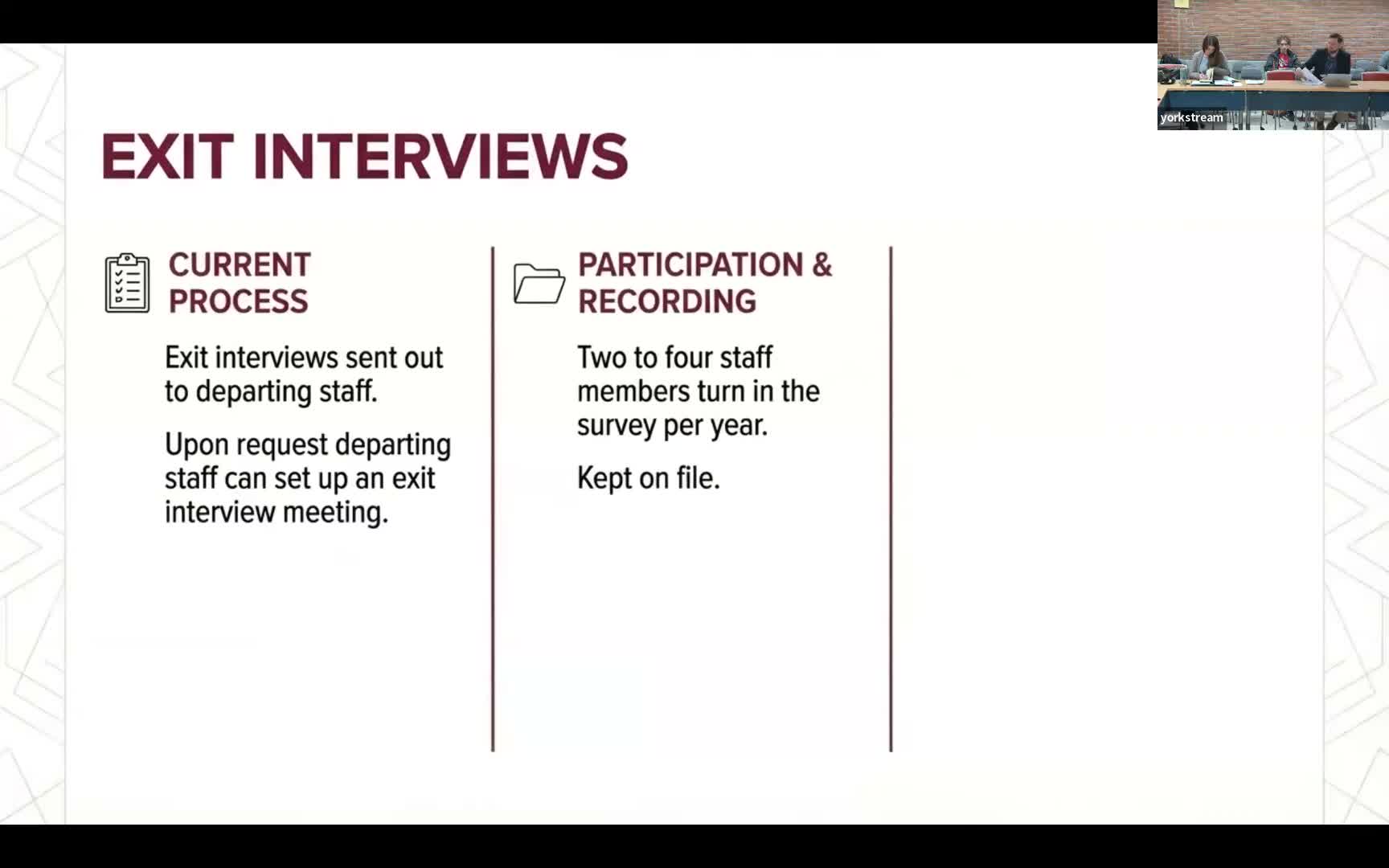
At a Feb. 3 human resources committee work session, members discussed overhauling the district’s exit-interview process to increase response rates and collect data that the board can act on. Zach Jin, the HR presenter at the meeting, outlined the existing practice and possible first steps.
Jin said the district currently sends an electronic exit survey when staff depart and offers the option of an in-person interview. “When folks depart our organization, we send out an exit interview, survey,” he said, and added that in a typical year “2 to 4, highest being maybe 9” surveys are returned. Committee members and staff described those return levels as too low to reliably identify trends.
Board members pressed for clarity on who receives the survey and what it asks. Jin said all departing staff are supposed to receive the survey; the instrument asks about role, length of service, reasons for leaving, ratings of work culture and supervisors, and includes short-answer fields for constructive feedback. One committee member urged simplifying the form and pre-filling administrative items (position, length of service) to reduce respondent burden.
Several members raised privacy concerns about storing responses in personnel files. “Personally, I wouldn't fill it out just because it's gonna be in my personnel file,” one committee member said, arguing that perceived lack of anonymity can suppress responses. Jin acknowledged the tradeoff between depth and anonymity: in-person interviews can yield richer, probeable feedback but reduce anonymity; anonymous digital surveys may generate higher counts but less depth.
Participants agreed that digitizing the current paper-based forms would be a low-cost first step to capture more responses and create a searchable archive. “I see no reason not to digitize this,” Jin said, recommending a pilot that would automatically funnel responses into a system the district can query and use to produce annual summaries for the board.
Committee members also discussed offering options—HR interview, building-leader interview, or anonymous survey—to raise participation, and suggested the board define the specific information it wants in annual exit reports (for example, percent who left for pay versus relocation). The presenter estimated present response rates around 5–10 percent and said digitization plus clearer workflows could increase yield.
The committee did not take formal action. Next steps are for staff to digitize the current instrument, draft mock-ups of reporting workflows and tenure-report templates, and return to the committee with a proposed pilot and the aggregated numbers the board requested.
Jin said the district currently sends an electronic exit survey when staff depart and offers the option of an in-person interview. “When folks depart our organization, we send out an exit interview, survey,” he said, and added that in a typical year “2 to 4, highest being maybe 9” surveys are returned. Committee members and staff described those return levels as too low to reliably identify trends.
Board members pressed for clarity on who receives the survey and what it asks. Jin said all departing staff are supposed to receive the survey; the instrument asks about role, length of service, reasons for leaving, ratings of work culture and supervisors, and includes short-answer fields for constructive feedback. One committee member urged simplifying the form and pre-filling administrative items (position, length of service) to reduce respondent burden.
Several members raised privacy concerns about storing responses in personnel files. “Personally, I wouldn't fill it out just because it's gonna be in my personnel file,” one committee member said, arguing that perceived lack of anonymity can suppress responses. Jin acknowledged the tradeoff between depth and anonymity: in-person interviews can yield richer, probeable feedback but reduce anonymity; anonymous digital surveys may generate higher counts but less depth.
Participants agreed that digitizing the current paper-based forms would be a low-cost first step to capture more responses and create a searchable archive. “I see no reason not to digitize this,” Jin said, recommending a pilot that would automatically funnel responses into a system the district can query and use to produce annual summaries for the board.
Committee members also discussed offering options—HR interview, building-leader interview, or anonymous survey—to raise participation, and suggested the board define the specific information it wants in annual exit reports (for example, percent who left for pay versus relocation). The presenter estimated present response rates around 5–10 percent and said digitization plus clearer workflows could increase yield.
The committee did not take formal action. Next steps are for staff to digitize the current instrument, draft mock-ups of reporting workflows and tenure-report templates, and return to the committee with a proposed pilot and the aggregated numbers the board requested.
Don't Miss a Word: See the Full Meeting!
Go beyond summaries. Unlock every video, transcript, and key insight with a Founder Membership.
✓
Get instant access to full meeting videos
✓
Search and clip any phrase from complete transcripts
✓
Receive AI-powered summaries & custom alerts
✓
Enjoy lifetime, unrestricted access to government data
30-day money-back guarantee
