Senate panel lays over bill to widen access to de‑escalation training for school staff after amendment and funding questions
March 04, 2026 | 2026 Legislature MN, Minnesota
This article was created by AI summarizing key points discussed. AI makes mistakes, so for full details and context, please refer to the video of the full meeting. Please report any errors so we can fix them. Report an error »
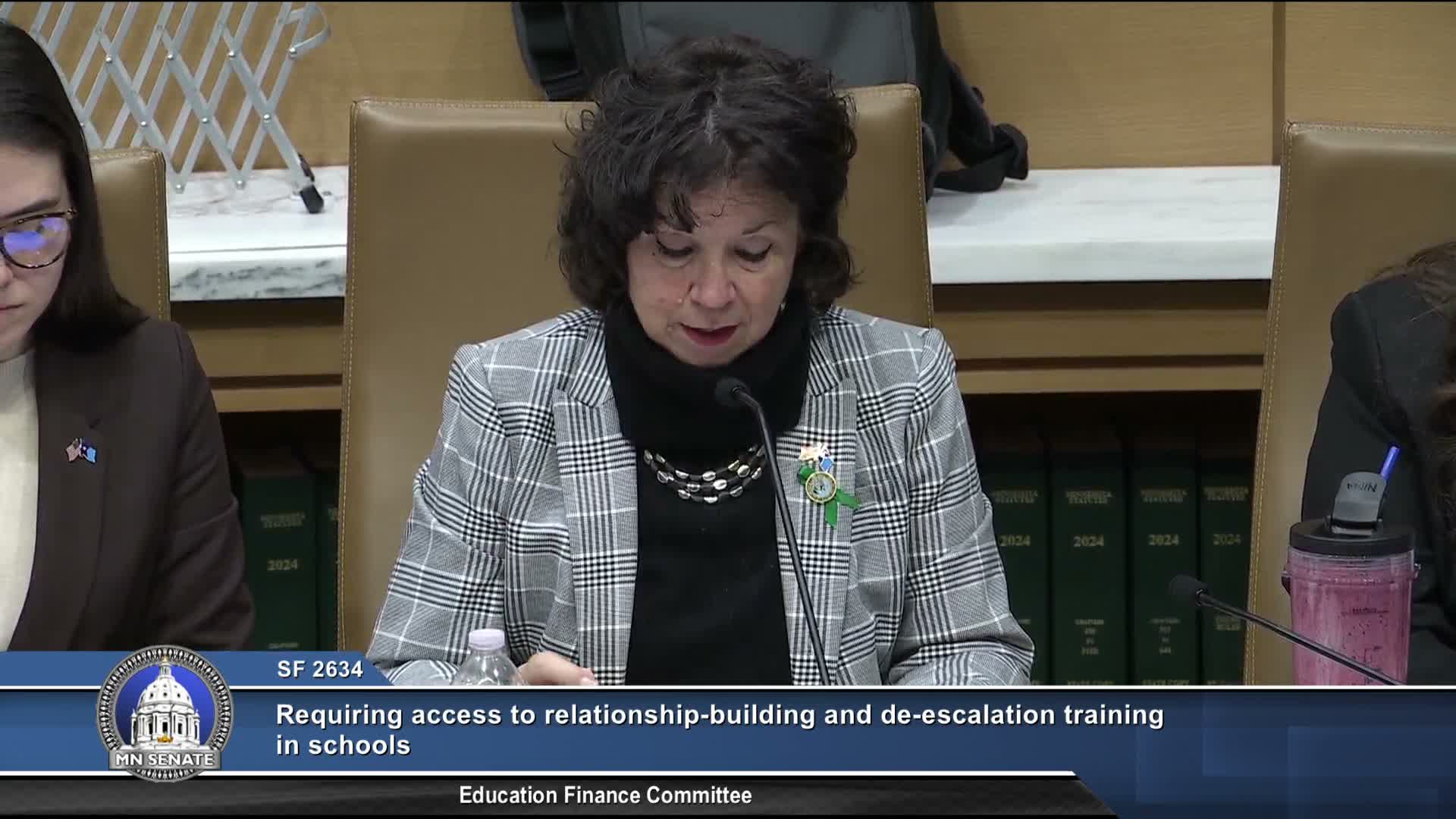
The Minnesota Senate Education Finance Committee amended and laid over Senate File 2634, a bill to expand access to evidence‑based de‑escalation and relationship‑building training for school personnel, after members raised questions about funding, private‑school coverage and what "must have access" would require districts to do.
Sponsor Senator Westland moved an A3 author's amendment that the sponsor said adds an effective date and a one‑time appropriation intended as reimbursement rather than ongoing grant funding. Chair Kunish called the voice vote; the committee adopted the A3 amendment. "The A3 is passed and amended to senate file 2,634," the chair said.
Senator Westland said the bill is not a mandate but would expand availability so any school employee who wants training can access it; he described the training as existing modules (some provided through the Minnesota Department of Education) and said the A3 appropriation is designed as reimbursement for districts that incur costs to provide training to staff who opt in.
Advocates and parents testified in support. Laura Jean of PACER Center said wider access would reduce exclusion and restrictive procedures for students with disabilities and help staff meet emotional needs. "With expanded access to this optional annual training... school teams can help ensure students' needs are met and prevent escalating behaviors from becoming a crisis," she said. Sarah McGinn, a former paraprofessional, urged training for the many adults who interact with students during a school day. Marin Christiansen Hofer, executive director of the Multicultural Autism Action Network, said co‑regulation and collaborative problem solving reduce escalation.
Committee members pressed the sponsor on implementation details. Some senators worried that the bill's line requiring schools "must have access" (line 1.9 in the amendment) could be read as imposing an ongoing requirement on districts, and others asked whether the one‑time appropriation (discussed as $10,000,000 during floor remarks) would create an unfunded mandate after the funds lapse. Members asked staff to draft clarified language and consider including nonpublic schools in the appropriation; the sponsor agreed to consult nonpartisan staff and stakeholders.
After questions and offers to refine the bill text, the committee laid SF 2634 over for possible inclusion in a future omnibus bill. Chair Kunish said the authors and staff will work on language and bring the bill back when ready.
Sponsor Senator Westland moved an A3 author's amendment that the sponsor said adds an effective date and a one‑time appropriation intended as reimbursement rather than ongoing grant funding. Chair Kunish called the voice vote; the committee adopted the A3 amendment. "The A3 is passed and amended to senate file 2,634," the chair said.
Senator Westland said the bill is not a mandate but would expand availability so any school employee who wants training can access it; he described the training as existing modules (some provided through the Minnesota Department of Education) and said the A3 appropriation is designed as reimbursement for districts that incur costs to provide training to staff who opt in.
Advocates and parents testified in support. Laura Jean of PACER Center said wider access would reduce exclusion and restrictive procedures for students with disabilities and help staff meet emotional needs. "With expanded access to this optional annual training... school teams can help ensure students' needs are met and prevent escalating behaviors from becoming a crisis," she said. Sarah McGinn, a former paraprofessional, urged training for the many adults who interact with students during a school day. Marin Christiansen Hofer, executive director of the Multicultural Autism Action Network, said co‑regulation and collaborative problem solving reduce escalation.
Committee members pressed the sponsor on implementation details. Some senators worried that the bill's line requiring schools "must have access" (line 1.9 in the amendment) could be read as imposing an ongoing requirement on districts, and others asked whether the one‑time appropriation (discussed as $10,000,000 during floor remarks) would create an unfunded mandate after the funds lapse. Members asked staff to draft clarified language and consider including nonpublic schools in the appropriation; the sponsor agreed to consult nonpartisan staff and stakeholders.
After questions and offers to refine the bill text, the committee laid SF 2634 over for possible inclusion in a future omnibus bill. Chair Kunish said the authors and staff will work on language and bring the bill back when ready.
View the Full Meeting & All Its Details
This article offers just a summary. Unlock complete video, transcripts, and insights as a Founder Member.
✓
Watch full, unedited meeting videos
✓
Search every word spoken in unlimited transcripts
✓
AI summaries & real-time alerts (all government levels)
✓
Permanent access to expanding government content
30-day money-back guarantee
