Woodburn budget committee holds training; district warned enrollment dips and COLAs are stressing next year’s budget
March 04, 2026 | Woodburn SD 103, School Districts, Oregon
This article was created by AI summarizing key points discussed. AI makes mistakes, so for full details and context, please refer to the video of the full meeting. Please report any errors so we can fix them. Report an error »
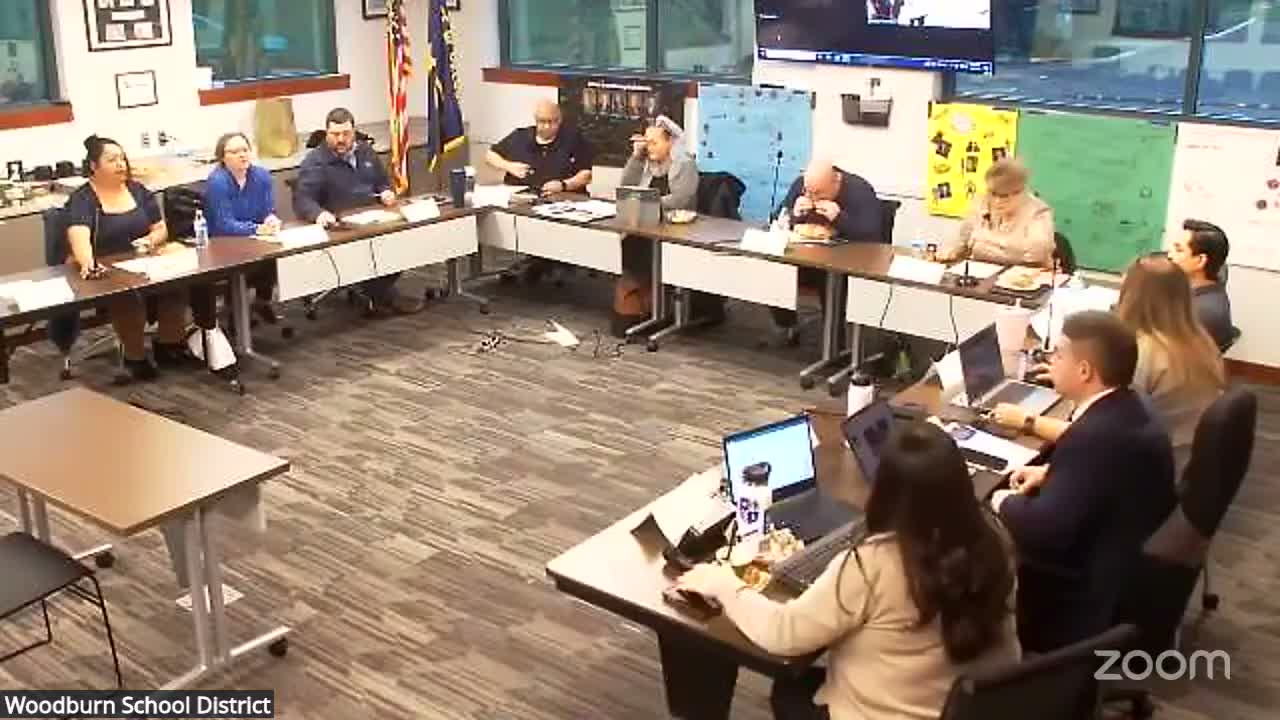
Woodburn School District held a budget committee training that walked members through how the district builds its annual spending plan, how state funding is calculated and where budget pressures are likely to appear in the 2026–27 budget.
"The budget is really our best estimate of revenues and expenditures," Sarah Bishop, the district's director of business and human resources, told the committee, urging members to review the full budget prior to the first formal meeting on May 5. Bishop said the district’s fiscal year runs July 1–June 30 and that the budget document provides legal spending authority for a single year.
Bishop highlighted the district’s fund‑balance policy — the board requires an ending fund balance budgeted between 5% and 10% — and warned that "without an adopted budget, the district can't legally expend any funds." She said the district will submit a detailed budget resolution (more than 100 pages) to the Oregon Department of Education and the county; that resolution, she added, is the board’s spending authority.
The presentation reviewed how Oregon’s State School Fund is driven by Average Daily Membership (ADM) and weighted ADM (ADMW). "Students in ESL programs, pregnant and parenting programs, students on IEPs and students in poverty receive additional weights," Bishop said, describing how those weights are used in the state formula and noting the state uses the higher of the prior two years when estimating allocations.
On enrollment, district officials said projected total enrollment for 2025–26 is down by 43 students from the prior year, a change the staff called "flat" rather than a steep drop. Superintendent Juan Lehi said district leaders expect an elementary‑level bubble (higher counts in certain lower grades) to move through the system even as overall enrollment flattens.
Staffing levels have not fully adjusted to a 2021 enrollment decline. Bishop showed staffing reductions being made largely through attrition in order to avoid layoffs. She said the district prioritizes keeping elementary class sizes small — the district reported average class sizes in the low 20s for K–5 and noted some language strands and classrooms range as high as the upper 20s to about 30.
Salaries and benefits, Bishop said, consume roughly 70%–80% of the general fund. That means negotiated cost‑of‑living adjustments (COLAs) and teacher salary steps are major budget drivers. "Our negotiated COLAs were higher than our State School Fund increases," Bishop said, adding that the district is being conservative in budgeting until bargaining concludes.
The committee heard an overview of the district's major funds: the general fund (operating), debt service (property tax–funded bond payments), special revenue (grants) and the child nutrition fund. Bishop said Woodburn runs a notably efficient child nutrition program that typically operates in the black; that surplus allowed the program to purchase new cafeteria tables after prior approval from ODE.
Bishop outlined grant management and oversight, explaining federal programs such as Title I, IDEA and the 21st Century grant require narrative budgets, quarterly reporting and rotating desk audits; unallowable expenditures discovered in those reviews must be repaid to the state.
The training closed with calendar reminders: the committee will meet again for budget review on May 5 and reconvene in early June for additional hearings. "We appreciate the questions and we want you to feel comfortable with the budgeting process," Bishop told the committee. The meeting adjourned at 7:22 p.m.
The committee adopted the agenda at the start of the session on a voice vote, 8–0. No public comments were received at the opening public‑comment call.
Next steps: committee members were asked to review the proposed budget packet before May 5 and submit additional questions via the district’s survey or directly to Superintendent Lehi or Sarah Bishop.
"The budget is really our best estimate of revenues and expenditures," Sarah Bishop, the district's director of business and human resources, told the committee, urging members to review the full budget prior to the first formal meeting on May 5. Bishop said the district’s fiscal year runs July 1–June 30 and that the budget document provides legal spending authority for a single year.
Bishop highlighted the district’s fund‑balance policy — the board requires an ending fund balance budgeted between 5% and 10% — and warned that "without an adopted budget, the district can't legally expend any funds." She said the district will submit a detailed budget resolution (more than 100 pages) to the Oregon Department of Education and the county; that resolution, she added, is the board’s spending authority.
The presentation reviewed how Oregon’s State School Fund is driven by Average Daily Membership (ADM) and weighted ADM (ADMW). "Students in ESL programs, pregnant and parenting programs, students on IEPs and students in poverty receive additional weights," Bishop said, describing how those weights are used in the state formula and noting the state uses the higher of the prior two years when estimating allocations.
On enrollment, district officials said projected total enrollment for 2025–26 is down by 43 students from the prior year, a change the staff called "flat" rather than a steep drop. Superintendent Juan Lehi said district leaders expect an elementary‑level bubble (higher counts in certain lower grades) to move through the system even as overall enrollment flattens.
Staffing levels have not fully adjusted to a 2021 enrollment decline. Bishop showed staffing reductions being made largely through attrition in order to avoid layoffs. She said the district prioritizes keeping elementary class sizes small — the district reported average class sizes in the low 20s for K–5 and noted some language strands and classrooms range as high as the upper 20s to about 30.
Salaries and benefits, Bishop said, consume roughly 70%–80% of the general fund. That means negotiated cost‑of‑living adjustments (COLAs) and teacher salary steps are major budget drivers. "Our negotiated COLAs were higher than our State School Fund increases," Bishop said, adding that the district is being conservative in budgeting until bargaining concludes.
The committee heard an overview of the district's major funds: the general fund (operating), debt service (property tax–funded bond payments), special revenue (grants) and the child nutrition fund. Bishop said Woodburn runs a notably efficient child nutrition program that typically operates in the black; that surplus allowed the program to purchase new cafeteria tables after prior approval from ODE.
Bishop outlined grant management and oversight, explaining federal programs such as Title I, IDEA and the 21st Century grant require narrative budgets, quarterly reporting and rotating desk audits; unallowable expenditures discovered in those reviews must be repaid to the state.
The training closed with calendar reminders: the committee will meet again for budget review on May 5 and reconvene in early June for additional hearings. "We appreciate the questions and we want you to feel comfortable with the budgeting process," Bishop told the committee. The meeting adjourned at 7:22 p.m.
The committee adopted the agenda at the start of the session on a voice vote, 8–0. No public comments were received at the opening public‑comment call.
Next steps: committee members were asked to review the proposed budget packet before May 5 and submit additional questions via the district’s survey or directly to Superintendent Lehi or Sarah Bishop.
View the Full Meeting & All Its Details
This article offers just a summary. Unlock complete video, transcripts, and insights as a Founder Member.
✓
Watch full, unedited meeting videos
✓
Search every word spoken in unlimited transcripts
✓
AI summaries & real-time alerts (all government levels)
✓
Permanent access to expanding government content
30-day money-back guarantee
