Subcommittee approves bill to bar Chinese-linked telecom equipment near military bases
March 04, 2026 | 2026 Legislative Meetings, South Carolina
This article was created by AI summarizing key points discussed. AI makes mistakes, so for full details and context, please refer to the video of the full meeting. Please report any errors so we can fix them. Report an error »
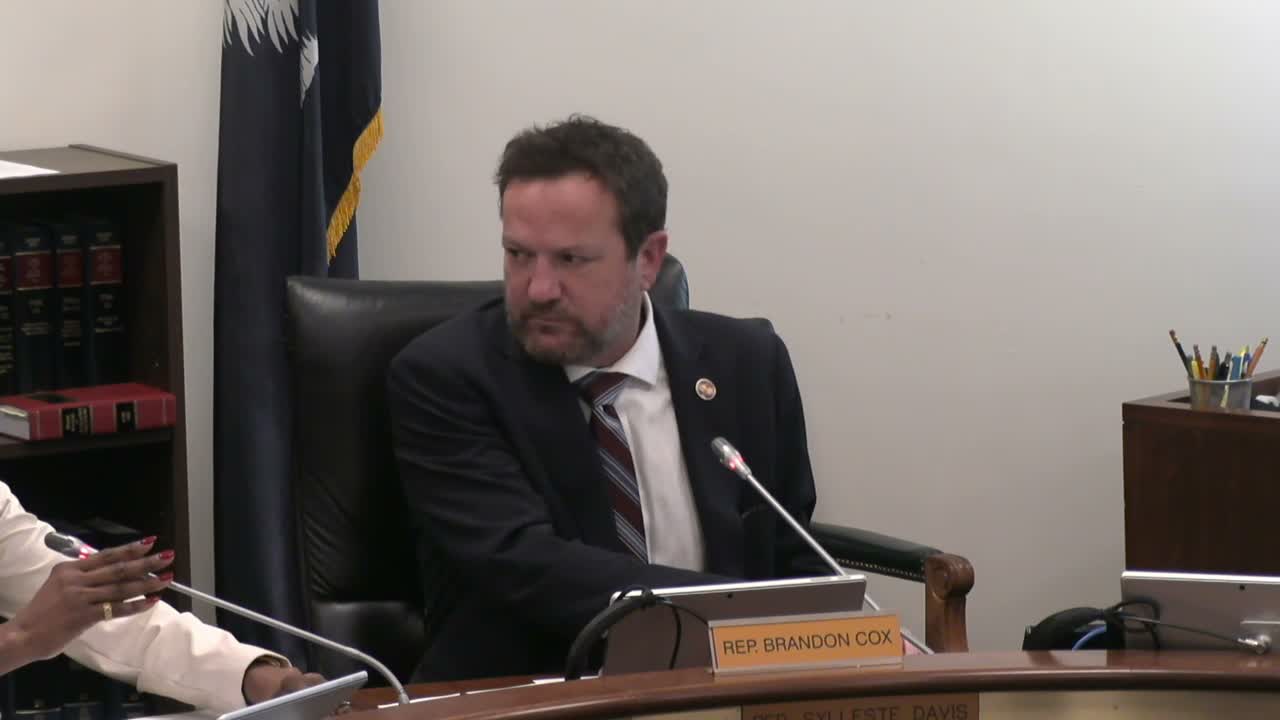
A South Carolina House subcommittee voted to advance House Bill 4974 after hearing testimony that the measure would protect military installations by restricting telecommunications and broadcasting equipment tied to Chinese ownership or control.
Rep. Gilliam, the bill’s sponsor, told the Military and Veterans Affairs Subcommittee that his concerns stem from national‑security risks he encountered during military service and from open‑source reports about foreign cyber operations. "We could intercept and jam their telecommunications with small pieces of equipment," he said, arguing the bill seeks "to cut that loop" by preventing towers owned or controlled by Chinese‑linked entities from being sited near bases.
Miss Aver summarized the measure for the committee, saying the bill would bar any company or development owned or controlled in whole or in part by the People’s Republic of China or the Chinese Communist Party from installing telecommunications or broadcasting towers within 25 miles of state or federal military bases. She said equipment installed before January 1, 2025, would have to be replaced with equipment made in the United States and installed by a U.S. company, and that the bill authorizes inspections without notice to detect and remove "monitoring, jamming, or interception equipment."
Tom Rollins, policy director at the nonprofit State Shield, testified in favor, describing what he called a growing threat from Chinese state and state‑aligned actors. "China has become a very aggressive, formidable opponent," Rollins said, and he pointed to reports that groups such as Volt Typhoon have targeted U.S. infrastructure. He said that Chinese laws passed in 2017 obligate domestic companies to cooperate with government authorities, creating a risk that equipment could send data back to China.
Committee members asked for technical and legal clarifications. One member suggested a 50‑mile buffer would provide greater assurance; another pressed for definition of the bill’s phrase "made in the United States," noting many products use foreign components. Rep. Gilliam responded that the bill is intended to ensure American equipment and allow for inspection and "swap and replace" of suspect gear, which he said would be performed by U.S. equipment makers.
Mr. White signaled he will propose an amendment to require that replacement equipment be approved or certified by a government authority (he mentioned Department of Defense as an example) rather than relying solely on a "made in America" label.
Chair Davis offered an amendment to tighten definitions of "owned," "controlled," and "principal place of business" to align with federal standards including the Foreign Investment Risk Review Modernization Act of 2018; the committee adopted that amendment. The subcommittee then voted to adopt House Bill 4974 as amended; the clerk recorded the members present voting in favor and the chair declared the bill approved by the panel.
The committee requested a fiscal impact statement; the clerk said the fiscal analysis had been requested but was not yet available. The bill now moves forward as the Legislature’s next procedures require.
Rep. Gilliam, the bill’s sponsor, told the Military and Veterans Affairs Subcommittee that his concerns stem from national‑security risks he encountered during military service and from open‑source reports about foreign cyber operations. "We could intercept and jam their telecommunications with small pieces of equipment," he said, arguing the bill seeks "to cut that loop" by preventing towers owned or controlled by Chinese‑linked entities from being sited near bases.
Miss Aver summarized the measure for the committee, saying the bill would bar any company or development owned or controlled in whole or in part by the People’s Republic of China or the Chinese Communist Party from installing telecommunications or broadcasting towers within 25 miles of state or federal military bases. She said equipment installed before January 1, 2025, would have to be replaced with equipment made in the United States and installed by a U.S. company, and that the bill authorizes inspections without notice to detect and remove "monitoring, jamming, or interception equipment."
Tom Rollins, policy director at the nonprofit State Shield, testified in favor, describing what he called a growing threat from Chinese state and state‑aligned actors. "China has become a very aggressive, formidable opponent," Rollins said, and he pointed to reports that groups such as Volt Typhoon have targeted U.S. infrastructure. He said that Chinese laws passed in 2017 obligate domestic companies to cooperate with government authorities, creating a risk that equipment could send data back to China.
Committee members asked for technical and legal clarifications. One member suggested a 50‑mile buffer would provide greater assurance; another pressed for definition of the bill’s phrase "made in the United States," noting many products use foreign components. Rep. Gilliam responded that the bill is intended to ensure American equipment and allow for inspection and "swap and replace" of suspect gear, which he said would be performed by U.S. equipment makers.
Mr. White signaled he will propose an amendment to require that replacement equipment be approved or certified by a government authority (he mentioned Department of Defense as an example) rather than relying solely on a "made in America" label.
Chair Davis offered an amendment to tighten definitions of "owned," "controlled," and "principal place of business" to align with federal standards including the Foreign Investment Risk Review Modernization Act of 2018; the committee adopted that amendment. The subcommittee then voted to adopt House Bill 4974 as amended; the clerk recorded the members present voting in favor and the chair declared the bill approved by the panel.
The committee requested a fiscal impact statement; the clerk said the fiscal analysis had been requested but was not yet available. The bill now moves forward as the Legislature’s next procedures require.
Don't Miss a Word: See the Full Meeting!
Go beyond summaries. Unlock every video, transcript, and key insight with a Founder Membership.
✓
Get instant access to full meeting videos
✓
Search and clip any phrase from complete transcripts
✓
Receive AI-powered summaries & custom alerts
✓
Enjoy lifetime, unrestricted access to government data
30-day money-back guarantee
