Durham staff unveil 10‑year CIP model as council weighs funding choices
February 27, 2026 | Durham City, Durham County, North Carolina
This article was created by AI summarizing key points discussed. AI makes mistakes, so for full details and context, please refer to the video of the full meeting. Please report any errors so we can fix them. Report an error »
City staff presented a draft 10‑year capital improvement plan and a new cash‑flow debt model at a budget retreat, saying the tool will give council a clearer long‑range picture while stopping short of committing to future appropriations.
The finance director, Tim Flora, told the council the updated model goes beyond a debt‑focused view and accounts for fees, grants and other revenue so staff can “drop something in a future year and see the impact that it will have.” He said the city’s overall debt portfolio has topped $1 billion, with about $394 million in governmental debt and roughly $614 million tied to utilities. “We are right on target” for several metrics, he said, citing a debt‑to‑operating‑expense ratio of about 16.5% and a debt‑to‑assessed‑value ratio near 1.1%.
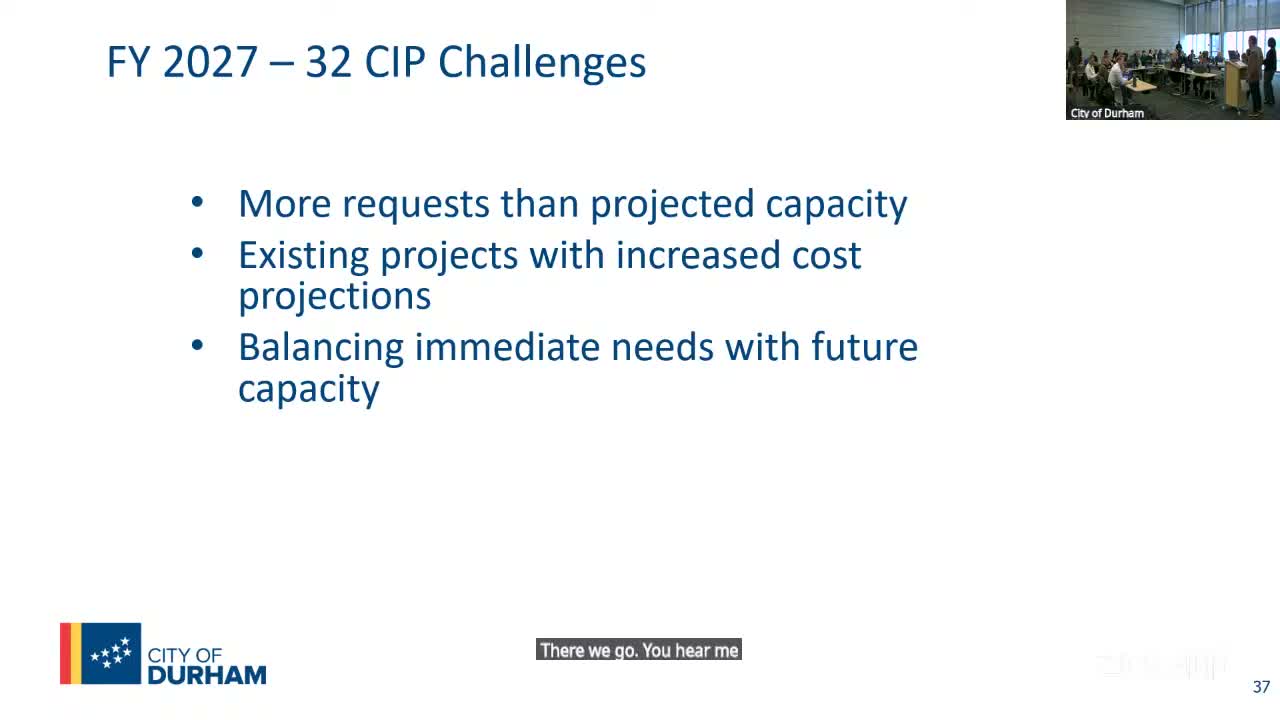
Staff presented a baseline scenario that includes currently appropriated projects plus reserved capacity for future projects. That baseline includes about $250 million for paving and $100 million for sidewalk repairs, and it shows the city can maintain a positive debt service fund balance under current assumptions. But Flora warned that price escalations on existing projects and an accumulation of new requests would erode sustainability: “if we start looking at those price escalations and we cover those costs… we would be going negative around 2030.”
Council members pressed staff on timing and transparency. Several asked whether the 10‑year model will be visible to residents; a staff presenter said the plan will be published and refreshed annually so residents can see when projects are expected to be budgeted. Council members also sought clearer scenarios quantifying the tradeoffs — for example, how much additional tax revenue a penny would raise and how different pay‑and‑step assumptions change the gap.
Why it matters: The model is meant to shift capital decisionmaking from an annual, single‑year view to a longer horizon, helping council balance near‑term needs with large out‑year investments. But staff cautioned the model only shows potential capacity and trade‑offs; specific projects will still require formal appropriation in the annual budget.
What’s next: Staff said they will continue refining estimates, incorporate committee scoring and work with finance to produce a prioritized recommendation in May for council consideration. The council directed staff to develop scenarios that trim or phase pay‑and‑step increases, show partial approaches to the Durham Minimum Livable Wage for part‑time roles, and identify one‑time uses of fund balance as options to narrow the FY27 gap.
Quotes that mattered: “We’ve got a model where you can drop something in a future year and see the impact that it will have,” Tim Flora said. He added, “what this model is to show is just what is our sustainability of our funding, what would be the impact.”
The retreat closed with staff promising detailed scenarios and inviting public comment ahead of the first budget hearing scheduled for March 16.
The finance director, Tim Flora, told the council the updated model goes beyond a debt‑focused view and accounts for fees, grants and other revenue so staff can “drop something in a future year and see the impact that it will have.” He said the city’s overall debt portfolio has topped $1 billion, with about $394 million in governmental debt and roughly $614 million tied to utilities. “We are right on target” for several metrics, he said, citing a debt‑to‑operating‑expense ratio of about 16.5% and a debt‑to‑assessed‑value ratio near 1.1%.
Staff presented a baseline scenario that includes currently appropriated projects plus reserved capacity for future projects. That baseline includes about $250 million for paving and $100 million for sidewalk repairs, and it shows the city can maintain a positive debt service fund balance under current assumptions. But Flora warned that price escalations on existing projects and an accumulation of new requests would erode sustainability: “if we start looking at those price escalations and we cover those costs… we would be going negative around 2030.”
Council members pressed staff on timing and transparency. Several asked whether the 10‑year model will be visible to residents; a staff presenter said the plan will be published and refreshed annually so residents can see when projects are expected to be budgeted. Council members also sought clearer scenarios quantifying the tradeoffs — for example, how much additional tax revenue a penny would raise and how different pay‑and‑step assumptions change the gap.
Why it matters: The model is meant to shift capital decisionmaking from an annual, single‑year view to a longer horizon, helping council balance near‑term needs with large out‑year investments. But staff cautioned the model only shows potential capacity and trade‑offs; specific projects will still require formal appropriation in the annual budget.
What’s next: Staff said they will continue refining estimates, incorporate committee scoring and work with finance to produce a prioritized recommendation in May for council consideration. The council directed staff to develop scenarios that trim or phase pay‑and‑step increases, show partial approaches to the Durham Minimum Livable Wage for part‑time roles, and identify one‑time uses of fund balance as options to narrow the FY27 gap.
Quotes that mattered: “We’ve got a model where you can drop something in a future year and see the impact that it will have,” Tim Flora said. He added, “what this model is to show is just what is our sustainability of our funding, what would be the impact.”
The retreat closed with staff promising detailed scenarios and inviting public comment ahead of the first budget hearing scheduled for March 16.
View the Full Meeting & All Its Details
This article offers just a summary. Unlock complete video, transcripts, and insights as a Founder Member.
✓
Watch full, unedited meeting videos
✓
Search every word spoken in unlimited transcripts
✓
AI summaries & real-time alerts (all government levels)
✓
Permanent access to expanding government content
30-day money-back guarantee
