Council hears updates on sidewalks, Mangum–Roxborough conversion, fleet facility and 3rd Fork Creek trail
February 27, 2026 | Durham City, Durham County, North Carolina
This article was created by AI summarizing key points discussed. AI makes mistakes, so for full details and context, please refer to the video of the full meeting. Please report any errors so we can fix them. Report an error »
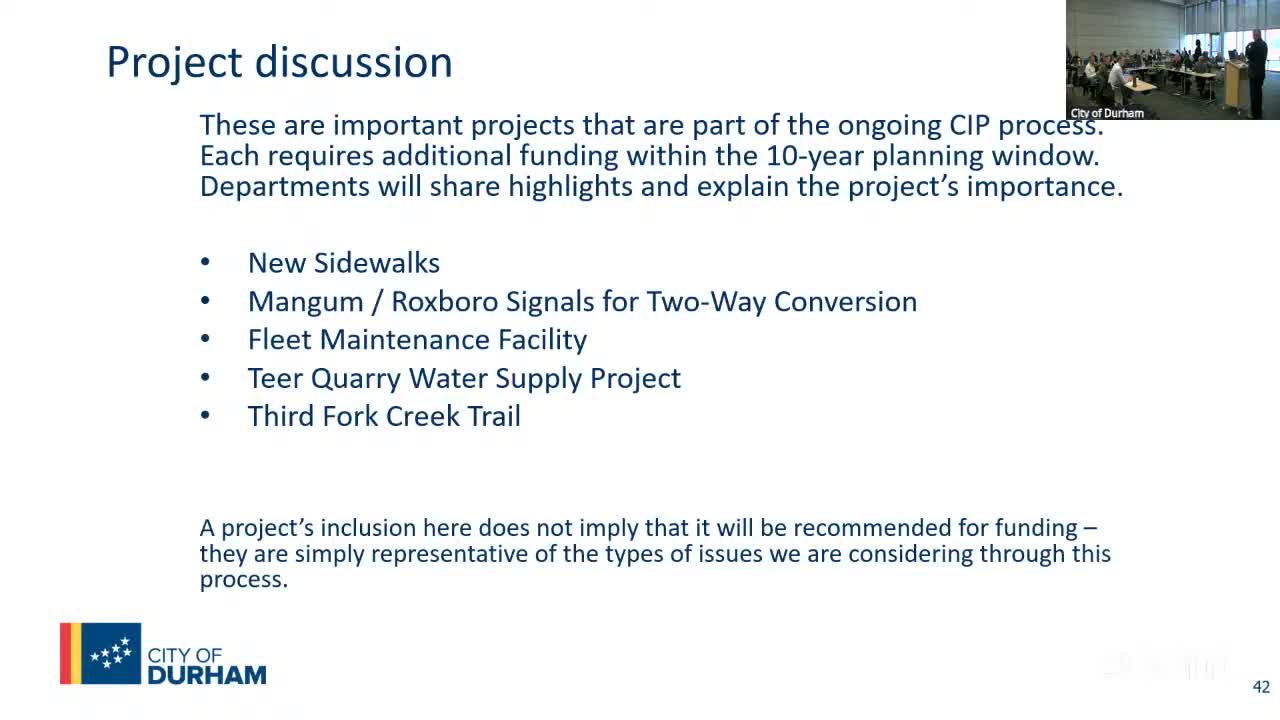
City staff used project case studies to show how the 10‑year model will translate into concrete proposals and costs.
Sean (project lead) said $40 million remaining from the 2024 Durham Connect bond will fund about 12.4 miles of new sidewalks that are now moving into construction, and that the bike‑and‑walk update identifies an additional 25.6 miles of priority corridors plus 2.1 miles of micro gaps. He gave a planning‑level estimate of $319 million for those additional corridors, explaining a base cost assumption of “more than $10,000,000 per mile” when design, right‑of‑way and escalation are included. He said prioritization uses the city’s Vision Zero high‑injury network and NCDOT’s Transportation Disadvantage Index to center equity and proximity to bus stops.
On Mangum–Roxborough, staff described a recommended two‑way conversion aimed at calming speeds and reducing crash risk; design milestones cited were 25% plans expected this spring and 100% design by 2028. Staff said resurfacing windows with NCDOT present cost‑saving opportunities for other corridors such as Duke–Gregson.
Henry Prosperi of General Services described the fleet maintenance facility’s reappearance in the long‑term plan: a FY28 feasibility and cost study, an $8 million FY29 design earmark and $42 million programmed in FY30 for construction — all flagged as initial estimates based on a 2018 feasibility study that staff plan to update. Prosperi acknowledged the $42 million is large and expects the figure to change after a modernized feasibility assessment.
Prosperi also updated the council on the 3rd Fork Creek Trail extension, noting major alignment changes into vegetated areas required bridges, boardwalks and environmental work that extended design time; the FY27 ask of $8.2 million reflects recent construction cost escalations and, he said, would be sufficient to complete the project so it could be built by 2029 pending right‑of‑way acquisition (11 parcels, three of them Durham Housing Authority parcels) and final approvals.
Why it matters: These case studies show how prioritization, design readiness and funding source (bond, federal grants, local match) affect timetables, costs and project readiness. Council members used the examples to question trade‑offs between pursuing federal funds (which can add complexity and delay) and using local money or bonds to accelerate delivery.
What’s next: Staff said they will refine project costs with updated feasibility studies and bring more detail to the CIP recommendations in coming months.
Representative quotes: “Those projects with that $40,000,000 from the bond are all fully funded and ready to move forward,” Sean said of the bond‑funded sidewalks. Henry Prosperi said of the fleet facility request: “That number we pulled from the 2018 feasibility study… I expect the number to actually go up.”
Sean (project lead) said $40 million remaining from the 2024 Durham Connect bond will fund about 12.4 miles of new sidewalks that are now moving into construction, and that the bike‑and‑walk update identifies an additional 25.6 miles of priority corridors plus 2.1 miles of micro gaps. He gave a planning‑level estimate of $319 million for those additional corridors, explaining a base cost assumption of “more than $10,000,000 per mile” when design, right‑of‑way and escalation are included. He said prioritization uses the city’s Vision Zero high‑injury network and NCDOT’s Transportation Disadvantage Index to center equity and proximity to bus stops.
On Mangum–Roxborough, staff described a recommended two‑way conversion aimed at calming speeds and reducing crash risk; design milestones cited were 25% plans expected this spring and 100% design by 2028. Staff said resurfacing windows with NCDOT present cost‑saving opportunities for other corridors such as Duke–Gregson.
Henry Prosperi of General Services described the fleet maintenance facility’s reappearance in the long‑term plan: a FY28 feasibility and cost study, an $8 million FY29 design earmark and $42 million programmed in FY30 for construction — all flagged as initial estimates based on a 2018 feasibility study that staff plan to update. Prosperi acknowledged the $42 million is large and expects the figure to change after a modernized feasibility assessment.
Prosperi also updated the council on the 3rd Fork Creek Trail extension, noting major alignment changes into vegetated areas required bridges, boardwalks and environmental work that extended design time; the FY27 ask of $8.2 million reflects recent construction cost escalations and, he said, would be sufficient to complete the project so it could be built by 2029 pending right‑of‑way acquisition (11 parcels, three of them Durham Housing Authority parcels) and final approvals.
Why it matters: These case studies show how prioritization, design readiness and funding source (bond, federal grants, local match) affect timetables, costs and project readiness. Council members used the examples to question trade‑offs between pursuing federal funds (which can add complexity and delay) and using local money or bonds to accelerate delivery.
What’s next: Staff said they will refine project costs with updated feasibility studies and bring more detail to the CIP recommendations in coming months.
Representative quotes: “Those projects with that $40,000,000 from the bond are all fully funded and ready to move forward,” Sean said of the bond‑funded sidewalks. Henry Prosperi said of the fleet facility request: “That number we pulled from the 2018 feasibility study… I expect the number to actually go up.”
View the Full Meeting & All Its Details
This article offers just a summary. Unlock complete video, transcripts, and insights as a Founder Member.
✓
Watch full, unedited meeting videos
✓
Search every word spoken in unlimited transcripts
✓
AI summaries & real-time alerts (all government levels)
✓
Permanent access to expanding government content
30-day money-back guarantee
