House committee advances slate of ceremonial naming bills, from clog‑dancing day to a burn building dedication
March 02, 2026 | 2026 Legislature TN, Tennessee
This article was created by AI summarizing key points discussed. AI makes mistakes, so for full details and context, please refer to the video of the full meeting. Please report any errors so we can fix them. Report an error »
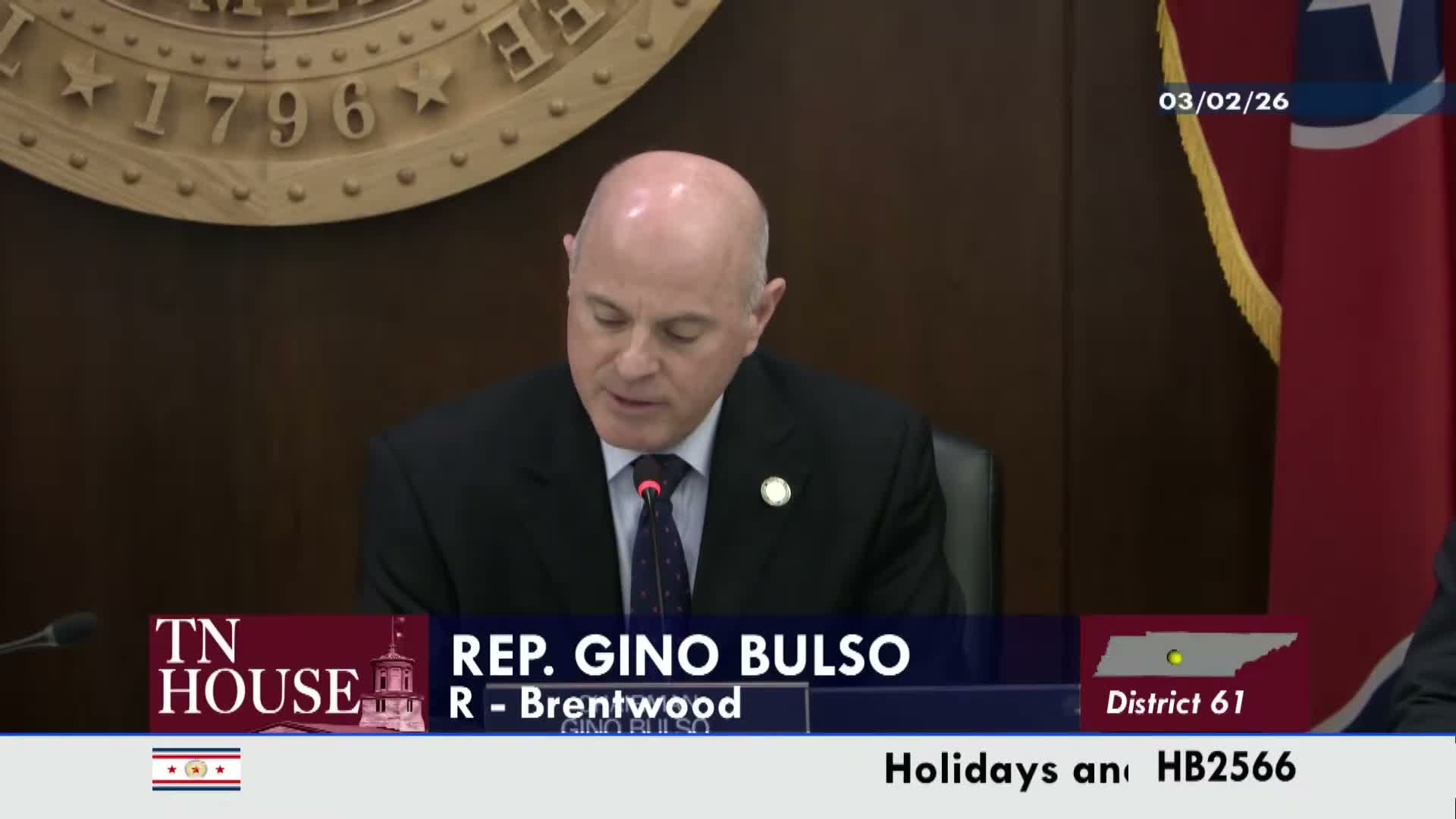
The House Naming and Designating Committee on March 2 advanced eight largely noncontroversial ceremonial bills to the next committee, including proposals to name a day for clog dancing, designate a new burn building for a fallen firefighter and add a song to the official state songs list.
Committee Chair (unnamed in the record) recognized sponsors who each described the local or cultural ties motivating their bills. Chairman Kumar, sponsor of HB2566, said the measure would designate August 8 as Clog Dancing Day to celebrate ‘‘a vibrant and enduring American folk art form’’ with ties to Tennessee. Chairman Crawford presented HB2116 to dedicate the Charles J. Lewis Residential Burn Building at the Tennessee Fire Services and Code Enforcement Academy as a small gesture to honor a fallen firefighter. Representative Barrett introduced HB1543 to add Drew Holcomb’s song “Tennessee” to the list of state songs, noting the songwriter’s Tennessee roots.
Why it matters: These bills are ceremonial but are used to recognize local traditions, institutions and individuals, promote tourism or honor service. By advancing them as a package, the committee cleared several community requests to go forward to relevant standing committees for final consideration.
What the committee did: Each bill received brief sponsor remarks and a short member exchange in most instances. Examples:
• HB2566 — Chairman Kumar described clog dancing’s cultural roots and the bill passed on voice vote with members raising a scheduling question about ensuring the observance falls on a weekend.
• HB2116 — Chairman Crawford said the dedication honors a fallen firefighter and the bill passed 9–0.
• HB2378, HB2113, HB2387, HB1981, HB2438, HB1543 — sponsors summarized reasons for the designations (historic commemoration, official frontier cookware, fiddler contest champion, Eagle Capital recognition, Gold Star Fathers Day, and a state song addition), each advancing with a positive recommendation, typically by unanimous voice vote.
Next steps: All eight measures were reported out to the appropriate committees (state and local government or the health committee, depending on the item) for further consideration. The committee adjourned after completing its calendar.
(Reported from the committee proceeding; votes reported as committee tallies given during the meeting.)
Committee Chair (unnamed in the record) recognized sponsors who each described the local or cultural ties motivating their bills. Chairman Kumar, sponsor of HB2566, said the measure would designate August 8 as Clog Dancing Day to celebrate ‘‘a vibrant and enduring American folk art form’’ with ties to Tennessee. Chairman Crawford presented HB2116 to dedicate the Charles J. Lewis Residential Burn Building at the Tennessee Fire Services and Code Enforcement Academy as a small gesture to honor a fallen firefighter. Representative Barrett introduced HB1543 to add Drew Holcomb’s song “Tennessee” to the list of state songs, noting the songwriter’s Tennessee roots.
Why it matters: These bills are ceremonial but are used to recognize local traditions, institutions and individuals, promote tourism or honor service. By advancing them as a package, the committee cleared several community requests to go forward to relevant standing committees for final consideration.
What the committee did: Each bill received brief sponsor remarks and a short member exchange in most instances. Examples:
• HB2566 — Chairman Kumar described clog dancing’s cultural roots and the bill passed on voice vote with members raising a scheduling question about ensuring the observance falls on a weekend.
• HB2116 — Chairman Crawford said the dedication honors a fallen firefighter and the bill passed 9–0.
• HB2378, HB2113, HB2387, HB1981, HB2438, HB1543 — sponsors summarized reasons for the designations (historic commemoration, official frontier cookware, fiddler contest champion, Eagle Capital recognition, Gold Star Fathers Day, and a state song addition), each advancing with a positive recommendation, typically by unanimous voice vote.
Next steps: All eight measures were reported out to the appropriate committees (state and local government or the health committee, depending on the item) for further consideration. The committee adjourned after completing its calendar.
(Reported from the committee proceeding; votes reported as committee tallies given during the meeting.)
Don't Miss a Word: See the Full Meeting!
Go beyond summaries. Unlock every video, transcript, and key insight with a Founder Membership.
✓
Get instant access to full meeting videos
✓
Search and clip any phrase from complete transcripts
✓
Receive AI-powered summaries & custom alerts
✓
Enjoy lifetime, unrestricted access to government data
30-day money-back guarantee
