Iowa House passes broad health bill after rejecting effort to remove ivermectin provision
March 03, 2026 | 2026 House of Representatives, Legislative, Iowa
This article was created by AI summarizing key points discussed. AI makes mistakes, so for full details and context, please refer to the video of the full meeting. Please report any errors so we can fix them. Report an error »
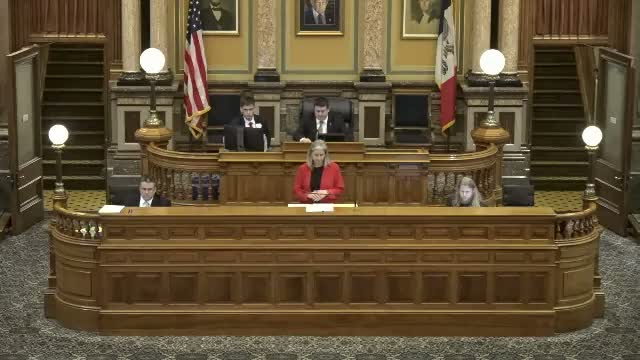
The Iowa House passed House File 2676, an omnibus health bill that packages nutrition education, school-meal changes, medication access and limits on elementary digital instruction, by a 65-30 roll call after more than an hour of debate and multiple amendments.
Representative Harris, the bill sponsor, told the chamber the measure seeks to "enhance the health and well-being of the people across our state," arguing that Iowa ranks poorly on obesity, physical activity and other health measures and that the bill would "ensure taxpayer funded programs promote" healthier options.
The bill as amended includes several notable provisions: a requirement that certain licensed medical professionals complete periodic continuing education on nutrition and metabolic health; an amendment that asks Iowa medical schools to require 40 hours of nutrition coursework prior to graduation beginning in July 2028; a provision directing the Department of Health and Human Services to repeatedly apply for a federal waiver to limit SNAP and summer EBT purchases to healthier foods if allowed; a list of food ingredients to be prohibited in school breakfasts and lunches; and enactment of an interstate psychology compact. The House also removed certificate-of-need language from the bill and added a move to seek waivers to portions of the Federal Child Nutrition Act covering sodium, whole-grain and variety requirements.
On school policy, lawmakers adopted an amendment to limit K–5 digital instruction to 60 minutes per school day with exemptions for assistive technology and students with individualized education programs. The House also adopted a separate amendment imposing minimum physical-activity expectations (including a K–5 weekly target and participation expectations for high school students).
A central point of contention was a division of the bill that would allow pharmacists to make ivermectin available without a prescription and provide civil immunity for pharmacists who dispense it. Representative Bathe urged removing that provision, saying it was unsafe and calling attention to emergency-room reports and adverse reactions: "It causes seizures, causes coma, causes liver failure, causes Stevens Johnson syndrome," Bathe said. Representative Harris and other supporters called such objections "a scare tactic," noting that several states have legalized over-the-counter access to ivermectin and arguing the bill does not require pharmacists to dispense the drug, only to allow them to do so.
The amendment to strike the ivermectin section failed on a roll call, with 35 voting aye and 60 no (5 absent), leaving the ivermectin-related provisions in the bill as it moved forward.
Other amendment votes: the Child Nutrition Act waiver language and removal of certificate-of-need provisions were adopted; an amendment to prioritize regional animal-protein products in school meals passed (ayes 67, no 27); an amendment to limit K–5 digital instruction to 60 minutes passed (ayes 92, no 2); a rule-suspension to consider extending radon testing to private schools failed (ayes 30, no 65); and a proposal to require school drinking water nitrate levels below 3 mg/L with a $10 million allocation failed (ayes 29, no 66).
Opponents argued the SNAP restrictions risked harming low-income families who rely on benefits for food access. Representative Johnson, speaking in opposition on moral grounds, urged colleagues not to "look away" from the needs of hungry Iowans and warned that restricting benefits could punish families struggling to afford food.
After final debate the House adopted the bill, the clerk recorded 65 ayes, 30 noes and 5 members absent or not voting. The bill was ordered messaged to the Senate.
What happens next: House File 2676 moves to the Senate for consideration. If enacted, the bill would change training requirements for health professionals, seek federal waivers affecting school meals and SNAP, change school-screen-time practices in early grades, and alter several other state education and health policies.
Representative Harris, the bill sponsor, told the chamber the measure seeks to "enhance the health and well-being of the people across our state," arguing that Iowa ranks poorly on obesity, physical activity and other health measures and that the bill would "ensure taxpayer funded programs promote" healthier options.
The bill as amended includes several notable provisions: a requirement that certain licensed medical professionals complete periodic continuing education on nutrition and metabolic health; an amendment that asks Iowa medical schools to require 40 hours of nutrition coursework prior to graduation beginning in July 2028; a provision directing the Department of Health and Human Services to repeatedly apply for a federal waiver to limit SNAP and summer EBT purchases to healthier foods if allowed; a list of food ingredients to be prohibited in school breakfasts and lunches; and enactment of an interstate psychology compact. The House also removed certificate-of-need language from the bill and added a move to seek waivers to portions of the Federal Child Nutrition Act covering sodium, whole-grain and variety requirements.
On school policy, lawmakers adopted an amendment to limit K–5 digital instruction to 60 minutes per school day with exemptions for assistive technology and students with individualized education programs. The House also adopted a separate amendment imposing minimum physical-activity expectations (including a K–5 weekly target and participation expectations for high school students).
A central point of contention was a division of the bill that would allow pharmacists to make ivermectin available without a prescription and provide civil immunity for pharmacists who dispense it. Representative Bathe urged removing that provision, saying it was unsafe and calling attention to emergency-room reports and adverse reactions: "It causes seizures, causes coma, causes liver failure, causes Stevens Johnson syndrome," Bathe said. Representative Harris and other supporters called such objections "a scare tactic," noting that several states have legalized over-the-counter access to ivermectin and arguing the bill does not require pharmacists to dispense the drug, only to allow them to do so.
The amendment to strike the ivermectin section failed on a roll call, with 35 voting aye and 60 no (5 absent), leaving the ivermectin-related provisions in the bill as it moved forward.
Other amendment votes: the Child Nutrition Act waiver language and removal of certificate-of-need provisions were adopted; an amendment to prioritize regional animal-protein products in school meals passed (ayes 67, no 27); an amendment to limit K–5 digital instruction to 60 minutes passed (ayes 92, no 2); a rule-suspension to consider extending radon testing to private schools failed (ayes 30, no 65); and a proposal to require school drinking water nitrate levels below 3 mg/L with a $10 million allocation failed (ayes 29, no 66).
Opponents argued the SNAP restrictions risked harming low-income families who rely on benefits for food access. Representative Johnson, speaking in opposition on moral grounds, urged colleagues not to "look away" from the needs of hungry Iowans and warned that restricting benefits could punish families struggling to afford food.
After final debate the House adopted the bill, the clerk recorded 65 ayes, 30 noes and 5 members absent or not voting. The bill was ordered messaged to the Senate.
What happens next: House File 2676 moves to the Senate for consideration. If enacted, the bill would change training requirements for health professionals, seek federal waivers affecting school meals and SNAP, change school-screen-time practices in early grades, and alter several other state education and health policies.
View the Full Meeting & All Its Details
This article offers just a summary. Unlock complete video, transcripts, and insights as a Founder Member.
✓
Watch full, unedited meeting videos
✓
Search every word spoken in unlimited transcripts
✓
AI summaries & real-time alerts (all government levels)
✓
Permanent access to expanding government content
30-day money-back guarantee
