Senate committee backs model‑policy bill for confidential informant use after overdose death prompted reform calls
March 02, 2026 | 2026 Legislature VA, Virginia
This article was created by AI summarizing key points discussed. AI makes mistakes, so for full details and context, please refer to the video of the full meeting. Please report any errors so we can fix them. Report an error »
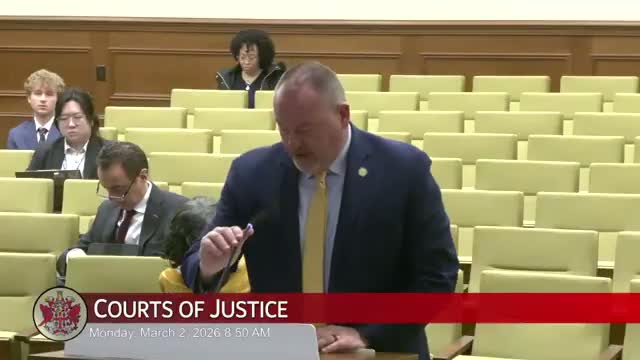
House Bill 1140 directs the Department of Criminal Justice Services to develop model policies governing confidential‑informant use to reduce risks to informants and to provide safeguards for their handling in investigations.
The measure was framed by supporters as a life‑safety effort driven by a tragic case: Donna Watson testified that her son, Troy Hallet, was placed back into situations where he relapsed and later died of a fentanyl overdose after being used as a confidential informant while on probation. Watson urged the committee to adopt policies that would prevent law‑enforcement practices that place vulnerable people into harm’s way.
Prosecutors and local criminal-justice officials voiced cautious support for the idea of model policies but raised operational concerns. They said the model policies should not preclude the practical uses of confidential informants in investigations (for example, to obtain search‑warrant information), though the record indicates many Commonwealth’s Attorneys supported measures to require probation/pretrial notification and turn‑over to supervising officers in high‑risk situations. Committee members questioned whether the bill was too prescriptive and discussed possible amendments to preserve utility while protecting informant safety.
The bill’s patron and witnesses noted the bill’s intent is not to exclude confidential informants entirely but to require better safeguards — for example, notification to pretrial or probation officers when an informant is on supervision and limits on deployment when the informant has recently failed drug tests or has active probation violations.
The committee moved to report the bill for further consideration. Supporters included advocacy groups and family members; prosecutors indicated they were neutral or open to amended language that balances investigative needs and informant safety.
The measure was framed by supporters as a life‑safety effort driven by a tragic case: Donna Watson testified that her son, Troy Hallet, was placed back into situations where he relapsed and later died of a fentanyl overdose after being used as a confidential informant while on probation. Watson urged the committee to adopt policies that would prevent law‑enforcement practices that place vulnerable people into harm’s way.
Prosecutors and local criminal-justice officials voiced cautious support for the idea of model policies but raised operational concerns. They said the model policies should not preclude the practical uses of confidential informants in investigations (for example, to obtain search‑warrant information), though the record indicates many Commonwealth’s Attorneys supported measures to require probation/pretrial notification and turn‑over to supervising officers in high‑risk situations. Committee members questioned whether the bill was too prescriptive and discussed possible amendments to preserve utility while protecting informant safety.
The bill’s patron and witnesses noted the bill’s intent is not to exclude confidential informants entirely but to require better safeguards — for example, notification to pretrial or probation officers when an informant is on supervision and limits on deployment when the informant has recently failed drug tests or has active probation violations.
The committee moved to report the bill for further consideration. Supporters included advocacy groups and family members; prosecutors indicated they were neutral or open to amended language that balances investigative needs and informant safety.
Don't Miss a Word: See the Full Meeting!
Go beyond summaries. Unlock every video, transcript, and key insight with a Founder Membership.
✓
Get instant access to full meeting videos
✓
Search and clip any phrase from complete transcripts
✓
Receive AI-powered summaries & custom alerts
✓
Enjoy lifetime, unrestricted access to government data
30-day money-back guarantee
