Virginia Senate advances dozens of House bills; several measures pass on close party-line votes
March 02, 2026 | 2026 Legislature VA, Virginia
This article was created by AI summarizing key points discussed. AI makes mistakes, so for full details and context, please refer to the video of the full meeting. Please report any errors so we can fix them. Report an error »
The Virginia Senate convened in Richmond on March 2, 2026, opened with a prayer led by the Reverend Charles R. Cowherd and routine formalities, and then moved through a lengthy calendar of House bills, adopting dozens of measures and sending many back to the House or to conference.
Senators began the day by waiving the reading of the journal and recognizing visiting guests, including students and legislative visitors, before turning to unfinished business and a long list of House measures. Many bills were considered in a block on the uncontested calendar; legislators removed a few items for separate consideration and then voted on individual measures.
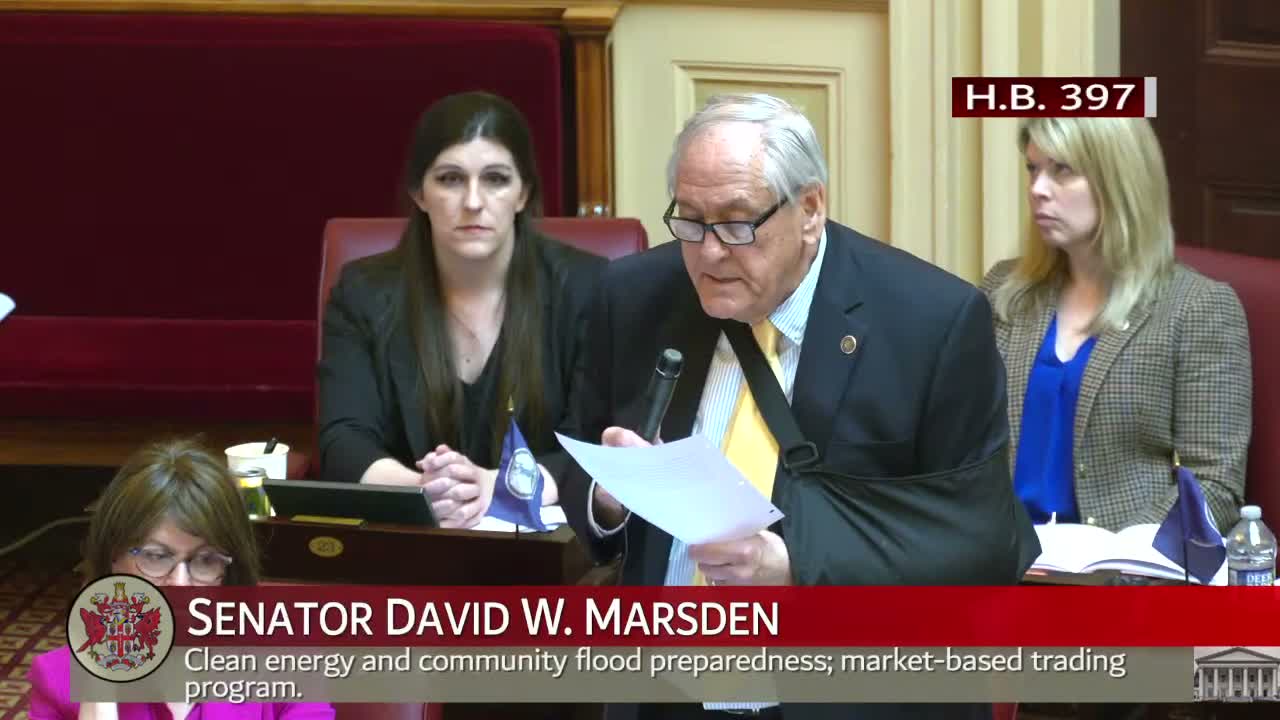
Several bills drew close roll-call votes. The junior senator from Virginia Beach moved passage of House Bill 835 (a conformity and reenactment-clause change effective Jan. 1, 2027), which passed by a 21–19 vote. On the clean-energy front, the senior senator from Fairfax described House Bill 397 as “more commonly referred to as the RGGI bill,” saying it directs the Department of Environmental Quality and the State Air Pollution Control Board to establish a market-based trading program to reduce carbon dioxide emissions from electricity-generating units; the Senate passed that bill on a 21–19 roll call.
Other measures passed with larger margins. House Bill 454 (repealing a DCJS requirement related to model addiction recovery programs) passed 39–1 after sponsors said the change reflected a Joint Commission on Healthcare recommendation. House Bill 1350, which raised the maximum civil penalty DEQ may assess in a special order from $10,000 to $3,032,500, passed 22–18.
The Senate also recorded concurrence votes where it agreed to House substitutes for Senate bills that had been returned with technical or conforming changes—several of those concurred unanimously or by lopsided margins. Not every item moved forward: the Senate declined to concur on at least one House substitute where the roll showed no ayes and 40 noes.
Votes at a glance (selected floor actions and final roll-call outcomes):
- Concurred with House substitute on Senate Bill 10 — Senate concurred (Ayes 40, Nos 0). (motion to concur moved by the senator from Roanoke)
- Concurred with House substitute on Senate Bill 88 — Senate concurred (Ayes 40, Nos 0). (senator from Mecklenburg)
- House Bill 835 — passed (Ayes 21, Nos 19). (junior senator from Virginia Beach moved passage)
- House Bill 397 (RGGI) — passed (Ayes 21, Nos 19). (senior senator from Fairfax)
- House Bill 454 (DCJS/DBHDS addiction recovery program repeal) — passed (Ayes 39, Nos 1). (senator from Western Henrico)
- House Bill 1350 (DEQ civil penalty increase) — passed (Ayes 22, Nos 18). (senior senator from Fairfax)
- Multiple uncontested House bills advanced in a block and passed by voice or roll-call as noted on the Senate calendar.
What happened next: The Senate made several procedural announcements about committee meetings and then adjourned until 12:00 p.m. the following day. Several bills moved to conference or will return to the House for further action as noted on the calendar.
Methodology and sourcing: This article summarizes actions taken on the Senate floor in Richmond on March 2, 2026, based on the official floor proceeding transcript. Quotes and attributions are taken verbatim from the transcript and are attributed to the speaking senator as recorded.
Next steps: Bills that passed the Senate will proceed according to their statutory paths — some will go to conference committees to reconcile differences with the House, and others return to the House for enrollment or execution of enacted changes. The Senate is scheduled to reconvene at noon the following day.
Senators began the day by waiving the reading of the journal and recognizing visiting guests, including students and legislative visitors, before turning to unfinished business and a long list of House measures. Many bills were considered in a block on the uncontested calendar; legislators removed a few items for separate consideration and then voted on individual measures.
Several bills drew close roll-call votes. The junior senator from Virginia Beach moved passage of House Bill 835 (a conformity and reenactment-clause change effective Jan. 1, 2027), which passed by a 21–19 vote. On the clean-energy front, the senior senator from Fairfax described House Bill 397 as “more commonly referred to as the RGGI bill,” saying it directs the Department of Environmental Quality and the State Air Pollution Control Board to establish a market-based trading program to reduce carbon dioxide emissions from electricity-generating units; the Senate passed that bill on a 21–19 roll call.
Other measures passed with larger margins. House Bill 454 (repealing a DCJS requirement related to model addiction recovery programs) passed 39–1 after sponsors said the change reflected a Joint Commission on Healthcare recommendation. House Bill 1350, which raised the maximum civil penalty DEQ may assess in a special order from $10,000 to $3,032,500, passed 22–18.
The Senate also recorded concurrence votes where it agreed to House substitutes for Senate bills that had been returned with technical or conforming changes—several of those concurred unanimously or by lopsided margins. Not every item moved forward: the Senate declined to concur on at least one House substitute where the roll showed no ayes and 40 noes.
Votes at a glance (selected floor actions and final roll-call outcomes):
- Concurred with House substitute on Senate Bill 10 — Senate concurred (Ayes 40, Nos 0). (motion to concur moved by the senator from Roanoke)
- Concurred with House substitute on Senate Bill 88 — Senate concurred (Ayes 40, Nos 0). (senator from Mecklenburg)
- House Bill 835 — passed (Ayes 21, Nos 19). (junior senator from Virginia Beach moved passage)
- House Bill 397 (RGGI) — passed (Ayes 21, Nos 19). (senior senator from Fairfax)
- House Bill 454 (DCJS/DBHDS addiction recovery program repeal) — passed (Ayes 39, Nos 1). (senator from Western Henrico)
- House Bill 1350 (DEQ civil penalty increase) — passed (Ayes 22, Nos 18). (senior senator from Fairfax)
- Multiple uncontested House bills advanced in a block and passed by voice or roll-call as noted on the Senate calendar.
What happened next: The Senate made several procedural announcements about committee meetings and then adjourned until 12:00 p.m. the following day. Several bills moved to conference or will return to the House for further action as noted on the calendar.
Methodology and sourcing: This article summarizes actions taken on the Senate floor in Richmond on March 2, 2026, based on the official floor proceeding transcript. Quotes and attributions are taken verbatim from the transcript and are attributed to the speaking senator as recorded.
Next steps: Bills that passed the Senate will proceed according to their statutory paths — some will go to conference committees to reconcile differences with the House, and others return to the House for enrollment or execution of enacted changes. The Senate is scheduled to reconvene at noon the following day.
Don't Miss a Word: See the Full Meeting!
Go beyond summaries. Unlock every video, transcript, and key insight with a Founder Membership.
✓
Get instant access to full meeting videos
✓
Search and clip any phrase from complete transcripts
✓
Receive AI-powered summaries & custom alerts
✓
Enjoy lifetime, unrestricted access to government data
30-day money-back guarantee
