Amherst Middle School presents CHAMPS classroom-management, student circles and new courses to board
March 03, 2026 | AMHERST CENTRAL SCHOOL DISTRICT, School Districts, New York
This article was created by AI summarizing key points discussed. AI makes mistakes, so for full details and context, please refer to the video of the full meeting. Please report any errors so we can fix them. Report an error »
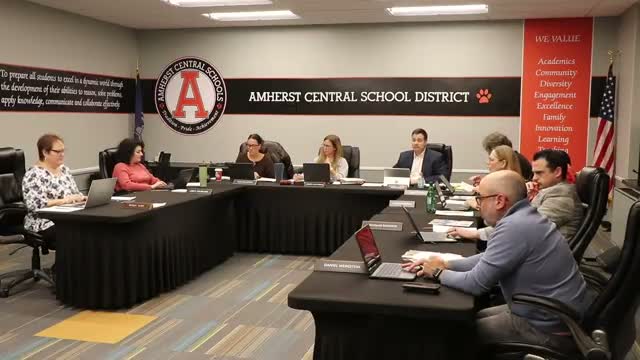
Scott Lonsay, identified in the presentation as Amherst Middle School principal, and colleagues Julie Doyle and Derek Tyson gave a multi-part update on student supports, classroom management and curricular pilots at the middle school.
Lonsay described CHAMPS (a framework of classroom routines and expectations) and the STOIC tool that guides how teachers structure classrooms. "CHAMPS is essentially a series of best practices and research practices around classroom management," he said, adding that teachers who attended summer professional development have applied the framework in teams.
Julie Doyle described the school's circle-discussion initiative: students are trained to facilitate circles during home base meetings to build connection and improve climate. Doyle said the district ran a Camp Duffield retreat on Oct. 16 that brought 140 sixth- through eighth-graders and 13 chaperones; students practiced facilitating discussions and leadership skills. A student who spoke during the presentation described circle leadership as challenging but valuable for getting quieter students to participate.
On curriculum, staff highlighted two pilots. Math Foundations is a targeted intervention intended to close gaps in basic numeracy; the district is running two sections with roughly eight students each who receive daily 42-minute foundational math support in addition to grade-level classes. Next Gen Tech, taught by the school librarian, is a 10-week seventh-grade course introducing coding, robotics and a unit on AI literacy that focuses on algorithms and bias without using external AI tools.
Administrators also highlighted extracurriculars and community partnerships: Girls in STEM (about 20'30 regular members) has taken field trips to Northrop Grumman and Cornell, and a new yarn/crochet club offers therapeutic creative work for participating students. Board members asked how the school is addressing "frequent flyers" (students with repeated referrals); Doyle said the team is using data from biweekly meetings to design creative interventions.
The presentation closed with thanks to staff and a pledge to continue data-informed work on behavior, curriculum and student engagement.
Lonsay described CHAMPS (a framework of classroom routines and expectations) and the STOIC tool that guides how teachers structure classrooms. "CHAMPS is essentially a series of best practices and research practices around classroom management," he said, adding that teachers who attended summer professional development have applied the framework in teams.
Julie Doyle described the school's circle-discussion initiative: students are trained to facilitate circles during home base meetings to build connection and improve climate. Doyle said the district ran a Camp Duffield retreat on Oct. 16 that brought 140 sixth- through eighth-graders and 13 chaperones; students practiced facilitating discussions and leadership skills. A student who spoke during the presentation described circle leadership as challenging but valuable for getting quieter students to participate.
On curriculum, staff highlighted two pilots. Math Foundations is a targeted intervention intended to close gaps in basic numeracy; the district is running two sections with roughly eight students each who receive daily 42-minute foundational math support in addition to grade-level classes. Next Gen Tech, taught by the school librarian, is a 10-week seventh-grade course introducing coding, robotics and a unit on AI literacy that focuses on algorithms and bias without using external AI tools.
Administrators also highlighted extracurriculars and community partnerships: Girls in STEM (about 20'30 regular members) has taken field trips to Northrop Grumman and Cornell, and a new yarn/crochet club offers therapeutic creative work for participating students. Board members asked how the school is addressing "frequent flyers" (students with repeated referrals); Doyle said the team is using data from biweekly meetings to design creative interventions.
The presentation closed with thanks to staff and a pledge to continue data-informed work on behavior, curriculum and student engagement.
Don't Miss a Word: See the Full Meeting!
Go beyond summaries. Unlock every video, transcript, and key insight with a Founder Membership.
✓
Get instant access to full meeting videos
✓
Search and clip any phrase from complete transcripts
✓
Receive AI-powered summaries & custom alerts
✓
Enjoy lifetime, unrestricted access to government data
30-day money-back guarantee
