Wissahickon board hears state assessment results and lays out literacy, math action steps
March 03, 2026 | Wissahickon SD, School Districts, Pennsylvania
This article was created by AI summarizing key points discussed. AI makes mistakes, so for full details and context, please refer to the video of the full meeting. Please report any errors so we can fix them. Report an error »
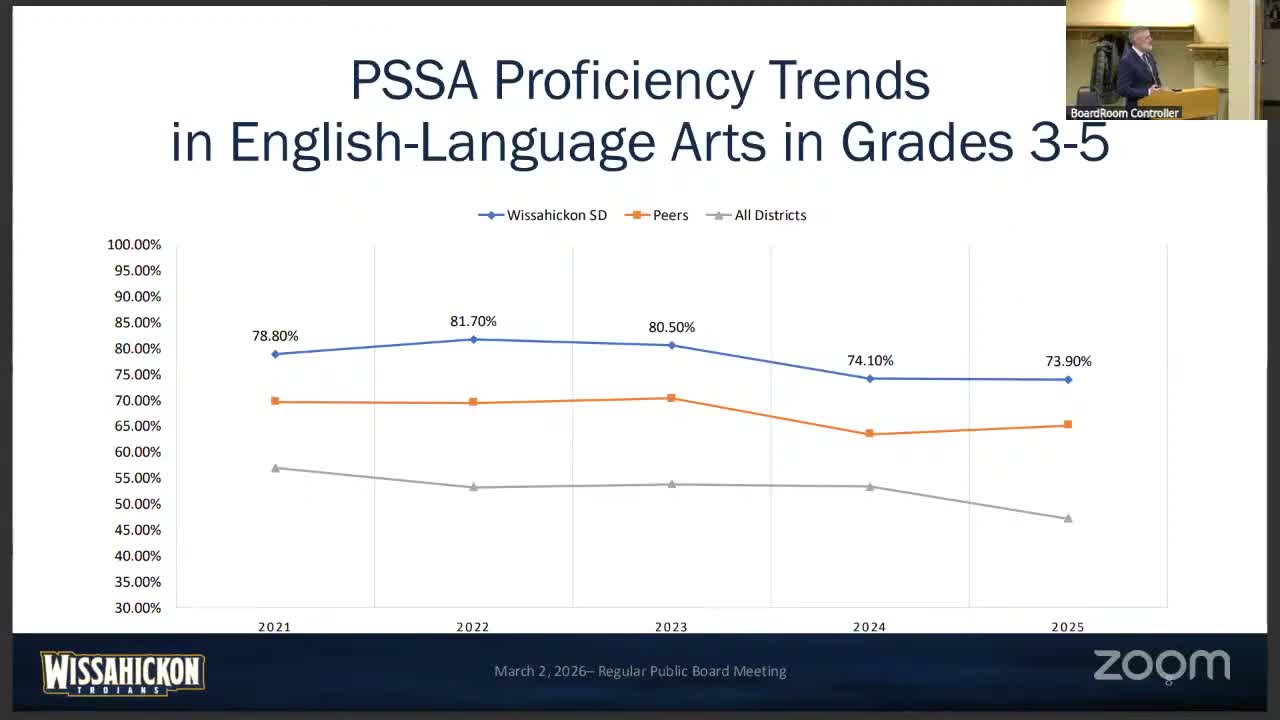
District leaders presented an annual state assessment report to the Wissahickon School District board, describing proficiency trends, pandemic-era effects and concrete action steps to improve reading and mathematics instruction.
At the meeting, presenters noted district ELA proficiency for the most recent year as 73.9% for grades 3–5; they also reported higher Keystone results and described how the state’s practice of banking Keystone scores — and exemptions granted during COVID — have distorted some multi‑year trend lines. The presenters said the district compares itself against a five‑district demographic peer group and uses multiple local measures in addition to state tests.
Dr. Gardner, the assistant superintendent, framed the strategy as a focus on the “whole child,” saying the district will pair statewide expectations with internal diagnostic and benchmark data to target supports. “We are going to be placing emphasis on systematic, explicit and evidence‑based practices in the foundational literacy skills,” Dr. Schmidt said when the presentation shifted to action steps for English language arts, listing curriculum review, multi‑tiered systems of support and strengthened instructional coaching.
On mathematics, presenters described the district’s first‑year rollout of new core resources (Illustrative Mathematics for K–5 and Amplify/Desmos for grades 6–8) and said their primary focus this year is fidelity of implementation: pacing, instructional practices, formative assessment and embedded coaching. Presenters said those changes are intended in part to address a persistent drop in proficiency between elementary and middle school math.
Board members and community speakers pressed for disaggregated data and classroom‑level diagnostics. Community member Carmina Taylor told the board that racial gaps are “much more stark” when data are disaggregated and said she would provide disaggregated figures; she added that a high share of Black eleventh graders had cumulative GPAs below 3.0. The board discussed pulling exemption‑related cases out of trend lines to provide an 'apples‑to‑apples' view and the presenters agreed to explore that analysis.
Presenters said the district will continue to use multiple assessments, refine curriculum materials and expand professional learning tied to the Pennsylvania structured literacy and PA Core standards. They also said the district’s data systems allow teachers and principals to drill down to student and classroom levels and that instructional coaches are embedded to support practice change.
The presentation closed with an invitation for additional questions; board members asked for follow‑up on several items, including a request to examine trends with and without banked/exempted Keystone scores. The district said it would return with more detailed slices of the data and described action steps schools are already taking to target supports.
The board moved from the presentation into routine business and public comment.
At the meeting, presenters noted district ELA proficiency for the most recent year as 73.9% for grades 3–5; they also reported higher Keystone results and described how the state’s practice of banking Keystone scores — and exemptions granted during COVID — have distorted some multi‑year trend lines. The presenters said the district compares itself against a five‑district demographic peer group and uses multiple local measures in addition to state tests.
Dr. Gardner, the assistant superintendent, framed the strategy as a focus on the “whole child,” saying the district will pair statewide expectations with internal diagnostic and benchmark data to target supports. “We are going to be placing emphasis on systematic, explicit and evidence‑based practices in the foundational literacy skills,” Dr. Schmidt said when the presentation shifted to action steps for English language arts, listing curriculum review, multi‑tiered systems of support and strengthened instructional coaching.
On mathematics, presenters described the district’s first‑year rollout of new core resources (Illustrative Mathematics for K–5 and Amplify/Desmos for grades 6–8) and said their primary focus this year is fidelity of implementation: pacing, instructional practices, formative assessment and embedded coaching. Presenters said those changes are intended in part to address a persistent drop in proficiency between elementary and middle school math.
Board members and community speakers pressed for disaggregated data and classroom‑level diagnostics. Community member Carmina Taylor told the board that racial gaps are “much more stark” when data are disaggregated and said she would provide disaggregated figures; she added that a high share of Black eleventh graders had cumulative GPAs below 3.0. The board discussed pulling exemption‑related cases out of trend lines to provide an 'apples‑to‑apples' view and the presenters agreed to explore that analysis.
Presenters said the district will continue to use multiple assessments, refine curriculum materials and expand professional learning tied to the Pennsylvania structured literacy and PA Core standards. They also said the district’s data systems allow teachers and principals to drill down to student and classroom levels and that instructional coaches are embedded to support practice change.
The presentation closed with an invitation for additional questions; board members asked for follow‑up on several items, including a request to examine trends with and without banked/exempted Keystone scores. The district said it would return with more detailed slices of the data and described action steps schools are already taking to target supports.
The board moved from the presentation into routine business and public comment.
View the Full Meeting & All Its Details
This article offers just a summary. Unlock complete video, transcripts, and insights as a Founder Member.
✓
Watch full, unedited meeting videos
✓
Search every word spoken in unlimited transcripts
✓
AI summaries & real-time alerts (all government levels)
✓
Permanent access to expanding government content
30-day money-back guarantee
