Pennsylvania pilots show global budgets can stabilize rural hospitals but require clearer rules and more primary‑care alignment
March 03, 2026 | Department of Health and Human Services (HHS), Executive, Federal
This article was created by AI summarizing key points discussed. AI makes mistakes, so for full details and context, please refer to the video of the full meeting. Please report any errors so we can fix them. Report an error »
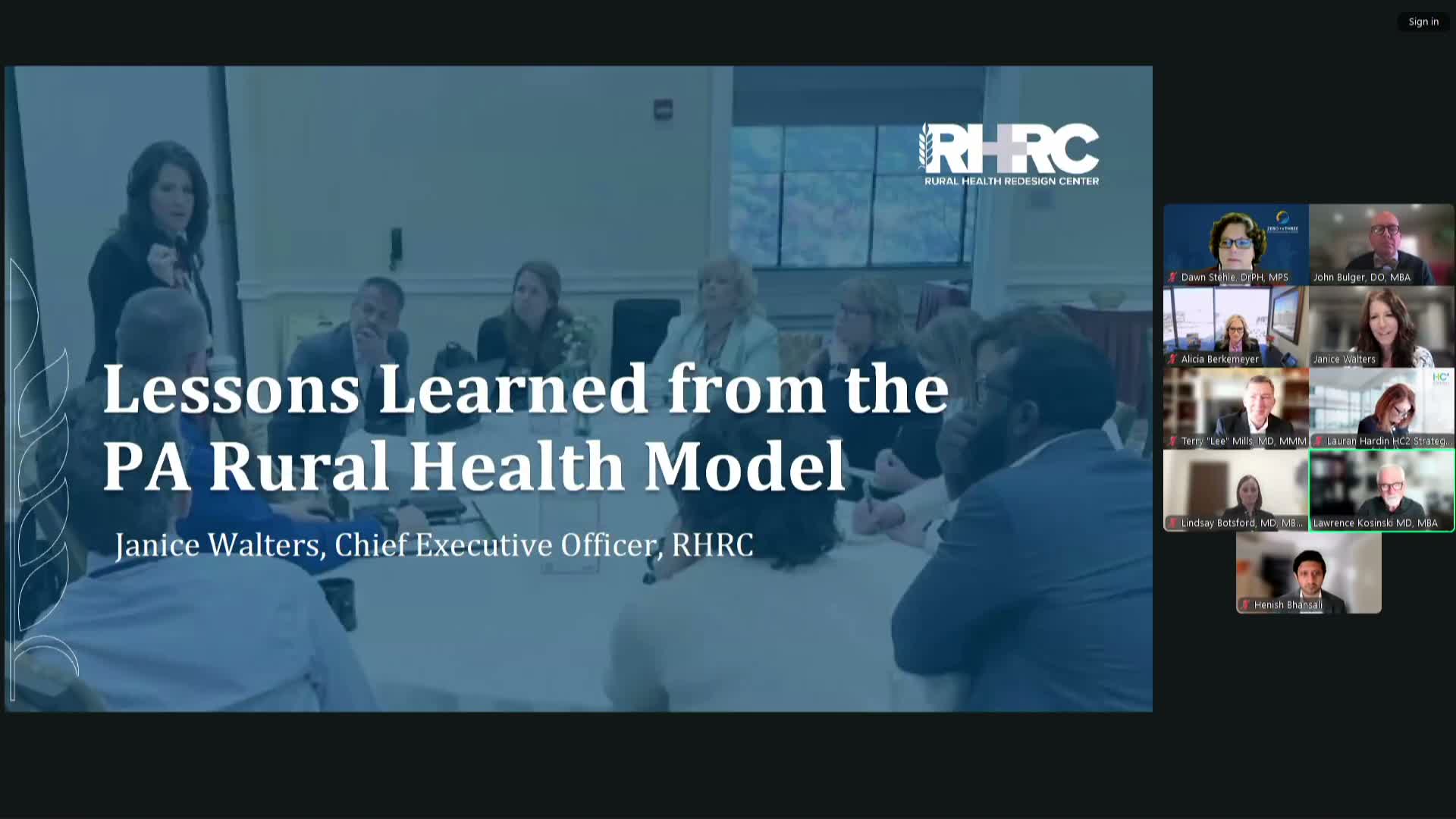
Janice Walters, chief executive officer of the Rural Health Redesign Center, and Dr. John Bulger, chief medical officer at Geisinger Health Plan, told PTAC that Pennsylvania’s rural value pilot used global hospital budgets and required transformation plans to stabilize rural hospitals and promote population‑health work.
The program’s stated objectives were to improve rural hospital financial viability, improve population health outcomes for local residents and reduce total cost of care. Walters said the model paid hospitals a fixed or global budget in exchange for transformation plans that shifted focus from volume to value. "This is a marathon, not a sprint," she said, describing the sustained stakeholder alignment and planning required to sustain change.
Program results and tradeoffs: Walters said participating hospitals and payers achieved reductions in potentially avoidable utilization across many hospital–payer relationships despite the COVID‑19 pandemic. Bulger said a notable outcome from the payer perspective was that "none of these hospitals had to close" during the demonstration, and that increased payer–hospital communication was a durable success.
But both speakers flagged program design limits. Walters and Bulger said the model’s revenue‑only approach left costs under‑accounted during recent inflationary pressures and that heavy administrative design elements and retrospective reconciliations reduced predictability. Walters said hospitals preferred straightforward prospective payments; she described a biweekly payment schedule—dividing a calculated annual budget by 26—as more predictable than a virtual cap system that relied heavily on fee‑for‑service claims and year‑end true‑ups.
Next steps and funding: Both presenters said next‑generation work will aim to preserve locally essential services, bring primary care into alignment with hospital budgets, and reduce administrative burden. Walters said the RHRC’s next‑generation planning has received seed and planning support from funders including the Appalachian Regional Commission and the Pennsylvania Senate and that implementation funding is expected to come from a rural health transformation plan specific to Pennsylvania.
Why it matters: Panelists framed the approach as a learning laboratory that kept hospitals functioning while testing value‑based approaches in rural settings. They recommended clearer, simpler payment mechanisms, transparent budget calculations, earlier inclusion of primary care in payment design and sustained funding for convening and technical assistance as conditions for scaling the approach.
The program’s stated objectives were to improve rural hospital financial viability, improve population health outcomes for local residents and reduce total cost of care. Walters said the model paid hospitals a fixed or global budget in exchange for transformation plans that shifted focus from volume to value. "This is a marathon, not a sprint," she said, describing the sustained stakeholder alignment and planning required to sustain change.
Program results and tradeoffs: Walters said participating hospitals and payers achieved reductions in potentially avoidable utilization across many hospital–payer relationships despite the COVID‑19 pandemic. Bulger said a notable outcome from the payer perspective was that "none of these hospitals had to close" during the demonstration, and that increased payer–hospital communication was a durable success.
But both speakers flagged program design limits. Walters and Bulger said the model’s revenue‑only approach left costs under‑accounted during recent inflationary pressures and that heavy administrative design elements and retrospective reconciliations reduced predictability. Walters said hospitals preferred straightforward prospective payments; she described a biweekly payment schedule—dividing a calculated annual budget by 26—as more predictable than a virtual cap system that relied heavily on fee‑for‑service claims and year‑end true‑ups.
Next steps and funding: Both presenters said next‑generation work will aim to preserve locally essential services, bring primary care into alignment with hospital budgets, and reduce administrative burden. Walters said the RHRC’s next‑generation planning has received seed and planning support from funders including the Appalachian Regional Commission and the Pennsylvania Senate and that implementation funding is expected to come from a rural health transformation plan specific to Pennsylvania.
Why it matters: Panelists framed the approach as a learning laboratory that kept hospitals functioning while testing value‑based approaches in rural settings. They recommended clearer, simpler payment mechanisms, transparent budget calculations, earlier inclusion of primary care in payment design and sustained funding for convening and technical assistance as conditions for scaling the approach.
Don't Miss a Word: See the Full Meeting!
Go beyond summaries. Unlock every video, transcript, and key insight with a Founder Membership.
✓
Get instant access to full meeting videos
✓
Search and clip any phrase from complete transcripts
✓
Receive AI-powered summaries & custom alerts
✓
Enjoy lifetime, unrestricted access to government data
30-day money-back guarantee
