HHS PTAC experts say multi‑payer alignment can improve Medicare care but scaling it is hard
March 03, 2026 | Department of Health and Human Services (HHS), Executive, Federal
This article was created by AI summarizing key points discussed. AI makes mistakes, so for full details and context, please refer to the video of the full meeting. Please report any errors so we can fix them. Report an error »
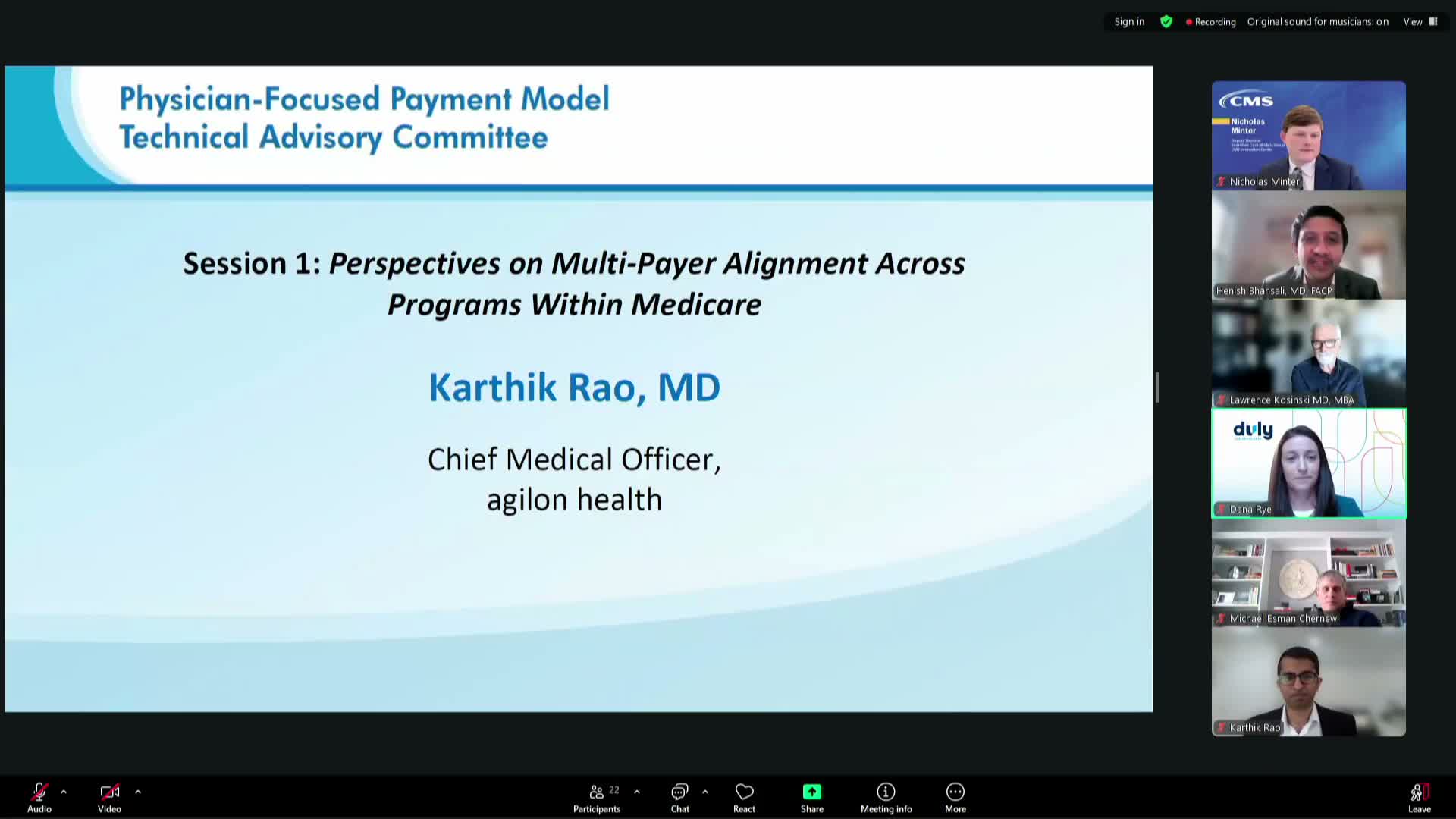
At a public meeting hosted by the U.S. Department of Health and Human Services’ Patient‑Centered Technology Council, federal and private‑sector presenters agreed that multi‑payer alignment—coordinating quality measures, payment incentives and data across insurers—can make it easier for clinicians to improve care, but that achieving it at scale will be difficult.
"Multi‑payer alignment largely refers to the coordination and collaboration among health insurance payers to meet common goals and patient outcomes," said Nicholas Mentor, deputy director of the Seamless Care Models Group at the CMS Innovation Center, describing three core alignment levers: quality measures, payment alignment and shared data. Mentor said alignment can lower cost, improve outcomes and reduce administrative burden, but noted CMS sometimes ends up supplying a disproportionate share of transformation funding when other payers do not contribute equally.
Private‑sector executives described operational benefits that can follow when payers converge. Dana Rai, president of value‑based care at Duly Health and Care, said Duly’s integrated programs—care teams embedded in clinics and “Duly at Home” services—drove measurable improvements: a 43% reduction in hospitalizations for the system’s most medically complex patients and sharp reductions in readmissions for patients seen at home. Rai attributed part of Duly’s success to consistent operations and timely data, and said Medicare Advantage plans often provide more‑timely notifications and supplemental programs that support care management.
Karthik Rao, chief medical officer at Agilon Health, described building a single Medicare line of business for seniors by integrating claims, EMR and ADT feeds to deliver point‑of‑care insights. He said Agilon’s network of community physicians has produced quality gains—consistent four‑star performance and lower readmission, admission and emergency department rates versus fee‑for‑service benchmarks—but warned that heterogeneity across dozens of Medicare Advantage plans and delayed attribution data add burdens and slow scaling.
Michael Chernew, a professor of health care policy at Harvard Medical School, framed the problem at the systems level: "It's very hard to practice medicine if a lot of different groups are telling you how to practice medicine." He argued that alignment is easier when there are fewer, better‑designed programs; recommended attention to quality‑measure alignment, modernized data flows and risk‑adjustment reform; and cautioned that over‑standardization can limit innovation.
Committee members pushed presenters on practical steps. One member asked how smaller organizations can replicate the integrated care teams Duly described; Rai said scale and investment in data and operations are required and that smaller players often need partner organizations to provide that infrastructure. Another member asked whether CMS should explicitly weave Medicare Advantage into multi‑payer alignment efforts; panelists agreed MA can be central because it often yields better attribution and timelier data, but they also emphasized MA heterogeneity and suggested focusing first on pragmatic, interoperable building blocks—timely attribution, standardized data fields and clearer expectations—rather than wholesale rewrites of MA quality programs.
On provider participation, Rai said roughly half of her provider groups’ revenue comes from risk‑based arrangements; Rao said Agilon operates with nearly all lives under full‑risk arrangements. Panelists said voluntary participation can grow if models are simpler, more stable and supported by timelier, standardized data.
The session closed with a procedural announcement that the meeting would break until 1:10 p.m. Eastern and resume with a second series of presentations on state value‑based care models. The session recording notes the meeting was produced by the Department of Health and Human Services.
"Multi‑payer alignment largely refers to the coordination and collaboration among health insurance payers to meet common goals and patient outcomes," said Nicholas Mentor, deputy director of the Seamless Care Models Group at the CMS Innovation Center, describing three core alignment levers: quality measures, payment alignment and shared data. Mentor said alignment can lower cost, improve outcomes and reduce administrative burden, but noted CMS sometimes ends up supplying a disproportionate share of transformation funding when other payers do not contribute equally.
Private‑sector executives described operational benefits that can follow when payers converge. Dana Rai, president of value‑based care at Duly Health and Care, said Duly’s integrated programs—care teams embedded in clinics and “Duly at Home” services—drove measurable improvements: a 43% reduction in hospitalizations for the system’s most medically complex patients and sharp reductions in readmissions for patients seen at home. Rai attributed part of Duly’s success to consistent operations and timely data, and said Medicare Advantage plans often provide more‑timely notifications and supplemental programs that support care management.
Karthik Rao, chief medical officer at Agilon Health, described building a single Medicare line of business for seniors by integrating claims, EMR and ADT feeds to deliver point‑of‑care insights. He said Agilon’s network of community physicians has produced quality gains—consistent four‑star performance and lower readmission, admission and emergency department rates versus fee‑for‑service benchmarks—but warned that heterogeneity across dozens of Medicare Advantage plans and delayed attribution data add burdens and slow scaling.
Michael Chernew, a professor of health care policy at Harvard Medical School, framed the problem at the systems level: "It's very hard to practice medicine if a lot of different groups are telling you how to practice medicine." He argued that alignment is easier when there are fewer, better‑designed programs; recommended attention to quality‑measure alignment, modernized data flows and risk‑adjustment reform; and cautioned that over‑standardization can limit innovation.
Committee members pushed presenters on practical steps. One member asked how smaller organizations can replicate the integrated care teams Duly described; Rai said scale and investment in data and operations are required and that smaller players often need partner organizations to provide that infrastructure. Another member asked whether CMS should explicitly weave Medicare Advantage into multi‑payer alignment efforts; panelists agreed MA can be central because it often yields better attribution and timelier data, but they also emphasized MA heterogeneity and suggested focusing first on pragmatic, interoperable building blocks—timely attribution, standardized data fields and clearer expectations—rather than wholesale rewrites of MA quality programs.
On provider participation, Rai said roughly half of her provider groups’ revenue comes from risk‑based arrangements; Rao said Agilon operates with nearly all lives under full‑risk arrangements. Panelists said voluntary participation can grow if models are simpler, more stable and supported by timelier, standardized data.
The session closed with a procedural announcement that the meeting would break until 1:10 p.m. Eastern and resume with a second series of presentations on state value‑based care models. The session recording notes the meeting was produced by the Department of Health and Human Services.
View the Full Meeting & All Its Details
This article offers just a summary. Unlock complete video, transcripts, and insights as a Founder Member.
✓
Watch full, unedited meeting videos
✓
Search every word spoken in unlimited transcripts
✓
AI summaries & real-time alerts (all government levels)
✓
Permanent access to expanding government content
30-day money-back guarantee
