PTAC lays out definition, benefits and barriers to multi‑payer alignment in value‑based care
March 03, 2026 | Department of Health and Human Services (HHS), Executive, Federal
This article was created by AI summarizing key points discussed. AI makes mistakes, so for full details and context, please refer to the video of the full meeting. Please report any errors so we can fix them. Report an error »
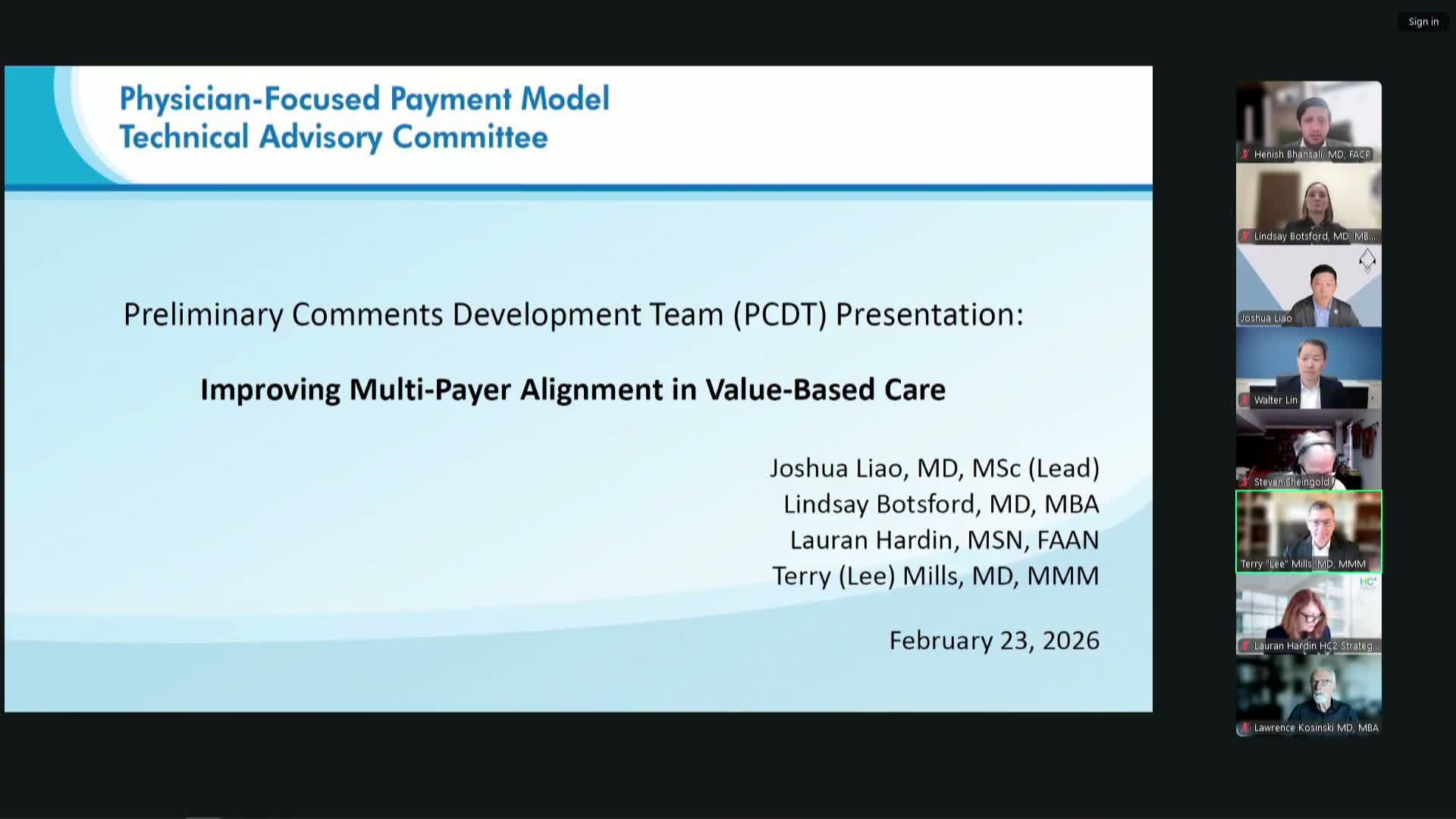
The Physician‑Focused Payment Model Technical Advisory Committee spent its opening session defining multi‑payer alignment, outlining its potential benefits and cataloguing the technical, market and legal barriers that have limited wider adoption.
Josh Lau, who led the preliminary comments development team for the meeting, read PTAC’s working definition: multi‑payer alignment is agreement among payer programs and products — including traditional Medicare, Medicare Advantage, Medicaid fee‑for‑service and managed care, commercial insurers and employers — on model areas necessary to promote value‑based care. He said alignment areas include goals and strategies, care delivery, financial incentives, quality measures and data sharing.
“Alignment is not just getting quality measurements set up or a playbook, but it is much bigger,” Lau said. He highlighted a taxonomy PTAC used in its analysis — distinguishing types of alignment (across and within payers), extent (how many payers and geographic spread) and degree (exact versus directional alignment).
Lau described potential benefits — stronger care pathways, more time for care transformation, improved data sharing and lower administrative costs — but he emphasized challenges. The team called out proprietary measure sets that impede standardization, uneven access to measures, the high cost and unclear responsibility for data aggregation, and clinician workforce shortages and churn that complicate implementation.
Lau also raised legal constraints: federal antitrust laws can limit payer collaboration, and other federal statutes such as the Anti‑Kickback Statute and the Stark law may constrain some coordination and referral practices. He noted that some state‑led initiatives have sought statutory immunities or other legal pathways to facilitate collaboration.
The presentation walked through lessons from multistate and nine state initiatives that PTAC examined. The committee found recurring success factors: a neutral convener or facilitator, a governing body to set measurable goals, data aggregation tools, and time to build trust among stakeholders. Outcomes, however, were mixed — success varied by market conditions, design specifics and the time allowed for implementation.
Committee members pressed on the practicalities. Lauren Harden, a nurse and chief integration officer at HC2 Strategies, said culture change inside payers and providers is often the hardest step once financing and measures are aligned. Retired gastroenterologist and committee member Larry Kosinski said he wants to know how many experts think voluntary efforts will suffice and whether some form of mandate might be necessary.
Chair Lee Mills reminded members that the committee’s deliberations and submitted materials will inform a report to the HHS secretary and that public comments will be accepted the following morning.
The meeting recessed for a 10:40 a.m. ET resumption; PTAC will continue expert panels and deliberations to identify practical steps to advance multi‑payer value‑based models.
Josh Lau, who led the preliminary comments development team for the meeting, read PTAC’s working definition: multi‑payer alignment is agreement among payer programs and products — including traditional Medicare, Medicare Advantage, Medicaid fee‑for‑service and managed care, commercial insurers and employers — on model areas necessary to promote value‑based care. He said alignment areas include goals and strategies, care delivery, financial incentives, quality measures and data sharing.
“Alignment is not just getting quality measurements set up or a playbook, but it is much bigger,” Lau said. He highlighted a taxonomy PTAC used in its analysis — distinguishing types of alignment (across and within payers), extent (how many payers and geographic spread) and degree (exact versus directional alignment).
Lau described potential benefits — stronger care pathways, more time for care transformation, improved data sharing and lower administrative costs — but he emphasized challenges. The team called out proprietary measure sets that impede standardization, uneven access to measures, the high cost and unclear responsibility for data aggregation, and clinician workforce shortages and churn that complicate implementation.
Lau also raised legal constraints: federal antitrust laws can limit payer collaboration, and other federal statutes such as the Anti‑Kickback Statute and the Stark law may constrain some coordination and referral practices. He noted that some state‑led initiatives have sought statutory immunities or other legal pathways to facilitate collaboration.
The presentation walked through lessons from multistate and nine state initiatives that PTAC examined. The committee found recurring success factors: a neutral convener or facilitator, a governing body to set measurable goals, data aggregation tools, and time to build trust among stakeholders. Outcomes, however, were mixed — success varied by market conditions, design specifics and the time allowed for implementation.
Committee members pressed on the practicalities. Lauren Harden, a nurse and chief integration officer at HC2 Strategies, said culture change inside payers and providers is often the hardest step once financing and measures are aligned. Retired gastroenterologist and committee member Larry Kosinski said he wants to know how many experts think voluntary efforts will suffice and whether some form of mandate might be necessary.
Chair Lee Mills reminded members that the committee’s deliberations and submitted materials will inform a report to the HHS secretary and that public comments will be accepted the following morning.
The meeting recessed for a 10:40 a.m. ET resumption; PTAC will continue expert panels and deliberations to identify practical steps to advance multi‑payer value‑based models.
Don't Miss a Word: See the Full Meeting!
Go beyond summaries. Unlock every video, transcript, and key insight with a Founder Membership.
✓
Get instant access to full meeting videos
✓
Search and clip any phrase from complete transcripts
✓
Receive AI-powered summaries & custom alerts
✓
Enjoy lifetime, unrestricted access to government data
30-day money-back guarantee
