Clemson asks lawmakers for recurring funding for natural‑resource institute and support for new veterinary program
March 03, 2026 | 2026 Legislative Meetings, South Carolina
This article was created by AI summarizing key points discussed. AI makes mistakes, so for full details and context, please refer to the video of the full meeting. Please report any errors so we can fix them. Report an error »
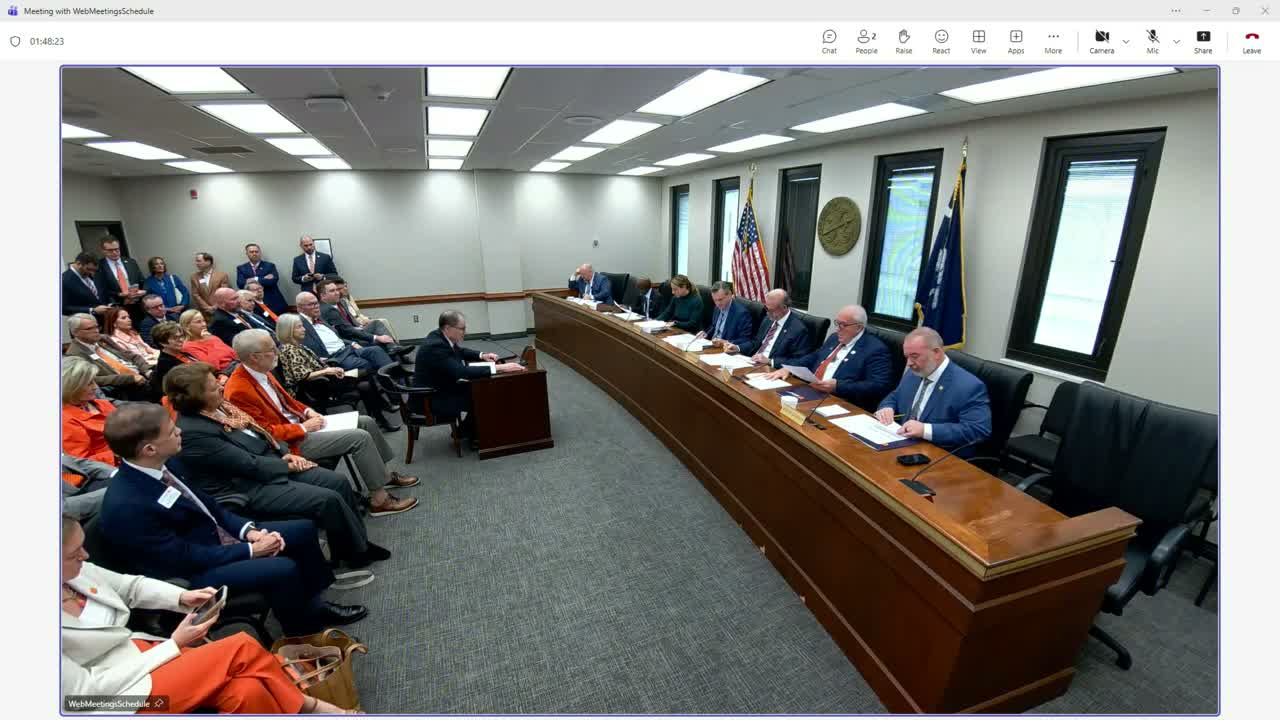
Clemson University officials asked a legislative subcommittee this morning for recurring and one‑time funding to expand research, extension and clinical capacity.
The university’s interim president told the panel the new veterinary program drew a "really strong response, 621 applicants for just 8 seats," and said private fundraising will provide partial scholarships to in‑state students to meet the institution’s land‑grant mission. Dr. Matt Holt, dean of the College of Agriculture, Forestry and Life Sciences, asked lawmakers to fund four recurring items and a linked nonrecurring package.
Holt said the university seeks $3,000,000 in recurring funds for a proposed Natural Resource Utilization and Planning institute (NREBP) that would combine economic analysis, policy insights and GIS data to help policymakers and communities make land‑use decisions; he told the committee the request would support 21 full‑time equivalents, including three faculty specialists. He also asked for $2,600,000 recurring to bolster regulatory services (including pesticide training and one FTE), $4,000,000 recurring to address critical infrastructure needs across six research and education centers (the university reported $42,000,000 in identified needs, $13,000,000 of which it classified as urgent), and $800,000 recurring for 10 extension program assistance positions.
On one‑time funding, Holt outlined an $18,000,000 package that included $1,000,000 for biosecurity enhancements, $600,000 for security and IT upgrades, $10,000,000 for maintenance projects, $400,000 for diagnostic lab equipment, and $6,000,000 for a project described in materials as “422 Crossroads.”
Senators pressed administrators on revenue sources and program administration. Senator Everest asked whether licensing and certification fee revenue would underwrite program operations; Holt said generated revenue from fees and certification programs contributes and that an internal audit had been conducted to verify financial controls. Lawmakers also asked about the effect of licensing and testing requirements on very small commercial applicators; committee members urged staff to examine whether a subclassification or alternative compliance pathway could be appropriate while noting constraints tied to federal EPA rules.
The presentation closed with committee members thanking university staff; no formal vote was taken during the session.
The university’s interim president told the panel the new veterinary program drew a "really strong response, 621 applicants for just 8 seats," and said private fundraising will provide partial scholarships to in‑state students to meet the institution’s land‑grant mission. Dr. Matt Holt, dean of the College of Agriculture, Forestry and Life Sciences, asked lawmakers to fund four recurring items and a linked nonrecurring package.
Holt said the university seeks $3,000,000 in recurring funds for a proposed Natural Resource Utilization and Planning institute (NREBP) that would combine economic analysis, policy insights and GIS data to help policymakers and communities make land‑use decisions; he told the committee the request would support 21 full‑time equivalents, including three faculty specialists. He also asked for $2,600,000 recurring to bolster regulatory services (including pesticide training and one FTE), $4,000,000 recurring to address critical infrastructure needs across six research and education centers (the university reported $42,000,000 in identified needs, $13,000,000 of which it classified as urgent), and $800,000 recurring for 10 extension program assistance positions.
On one‑time funding, Holt outlined an $18,000,000 package that included $1,000,000 for biosecurity enhancements, $600,000 for security and IT upgrades, $10,000,000 for maintenance projects, $400,000 for diagnostic lab equipment, and $6,000,000 for a project described in materials as “422 Crossroads.”
Senators pressed administrators on revenue sources and program administration. Senator Everest asked whether licensing and certification fee revenue would underwrite program operations; Holt said generated revenue from fees and certification programs contributes and that an internal audit had been conducted to verify financial controls. Lawmakers also asked about the effect of licensing and testing requirements on very small commercial applicators; committee members urged staff to examine whether a subclassification or alternative compliance pathway could be appropriate while noting constraints tied to federal EPA rules.
The presentation closed with committee members thanking university staff; no formal vote was taken during the session.
View the Full Meeting & All Its Details
This article offers just a summary. Unlock complete video, transcripts, and insights as a Founder Member.
✓
Watch full, unedited meeting videos
✓
Search every word spoken in unlimited transcripts
✓
AI summaries & real-time alerts (all government levels)
✓
Permanent access to expanding government content
30-day money-back guarantee
