Subcommittee hears split testimony on bills to bar swipe fees on sales-tax portion and improve chargeback transparency
March 03, 2026 | 2026 Legislative Meetings, South Carolina
This article was created by AI summarizing key points discussed. AI makes mistakes, so for full details and context, please refer to the video of the full meeting. Please report any errors so we can fix them. Report an error »
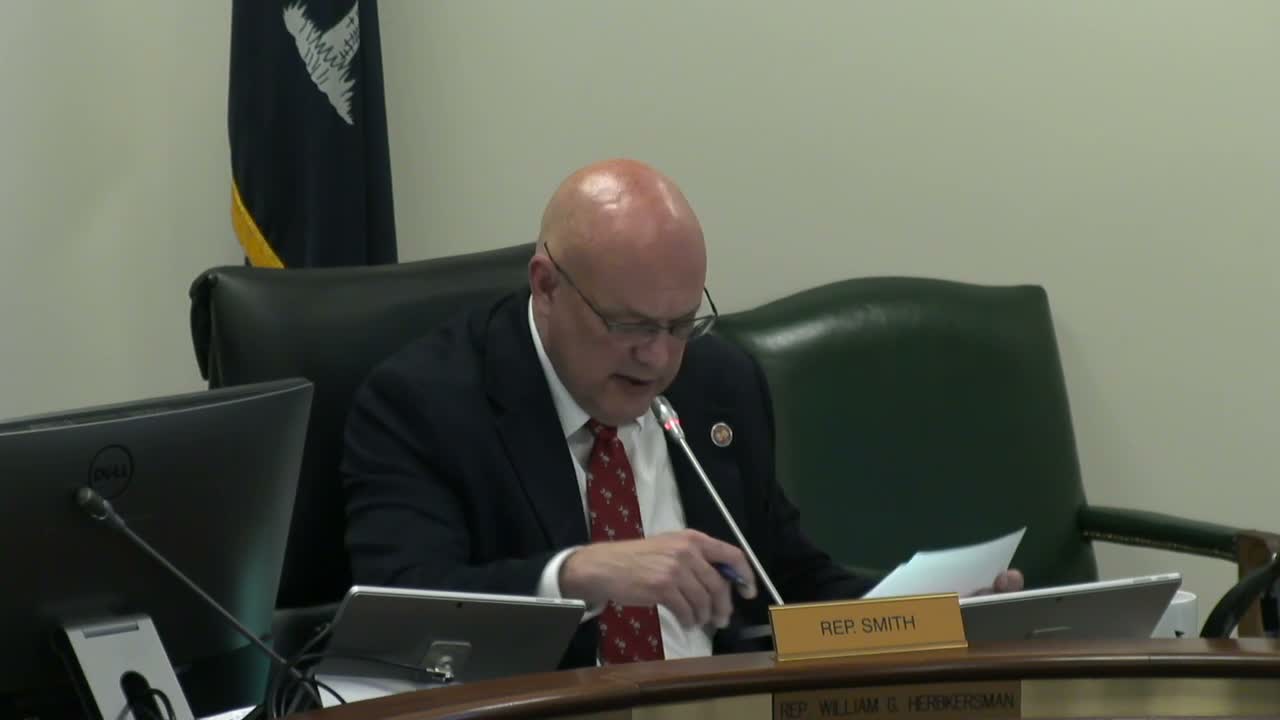
The Business and Commerce Subcommittee on March 3 took testimony on House Bills H.4613 and H.4614, measures aimed at limiting card-processing fees merchants pay on the sales-tax portion of transactions and increasing transparency during chargeback disputes. The panel did not vote on the measures during this session.
Representative Remus, sponsor of both bills, said H.4613 would stop credit-card companies from charging swipe fees on the sales-tax portion that merchants collect and remit to the state. "We are required by law to collect the sales tax and send it into the government," Remus said; he asked why merchants should then also pay a fee on that collected tax.
Merchant advocates and processors testified in favor. Ken Glasson, owner of Semper Aegis Mercatus, argued the current tax code can result in a third-party pass-through credit-card fee effectively being taxed and urged the committee to carve that fee out of taxable gross proceeds. Krista Henson, executive director of the South Carolina Retail Association, said retailers paid an estimated $133,000,000 in 2024 in fees on the sales-tax portion of transactions and asked the committee to continue conversations about remedies.
The payments industry and financial institutions opposed the bills. Christie Ellerbee of the Electronic Transactions Association warned that H.4613 "would impose a state mandate that fundamentally alters how electronic payments are processed," potentially requiring South Carolina to redesign transaction processing, reconciliation and settlement in a way that diverges from national systems; she noted Illinois' similar statute has prompted costly litigation now before the Seventh Circuit. Neil Rash, general counsel for the bankers association, and Michael Beam of Palmetto Citizens Federal Credit Union said interchange fees fund fraud prevention, security and operational costs and cautioned that forcing a change in who absorbs those costs could push expenses onto consumers or reduce services.
Committee members asked technical questions about which fees are taxable today, how processors reconcile fees, where the money flows and whether a state carve-out could be implemented without disrupting national networks. Witnesses offered competing remedies, from merchant credits and documentation-based reimbursements to caution that regulatory or statutory changes could have unintended consequences.
No subcommittee vote was taken on H.4613 or H.4614 during this meeting; chairman Smith adjourned the session after the last scheduled witness presented.
Representative Remus, sponsor of both bills, said H.4613 would stop credit-card companies from charging swipe fees on the sales-tax portion that merchants collect and remit to the state. "We are required by law to collect the sales tax and send it into the government," Remus said; he asked why merchants should then also pay a fee on that collected tax.
Merchant advocates and processors testified in favor. Ken Glasson, owner of Semper Aegis Mercatus, argued the current tax code can result in a third-party pass-through credit-card fee effectively being taxed and urged the committee to carve that fee out of taxable gross proceeds. Krista Henson, executive director of the South Carolina Retail Association, said retailers paid an estimated $133,000,000 in 2024 in fees on the sales-tax portion of transactions and asked the committee to continue conversations about remedies.
The payments industry and financial institutions opposed the bills. Christie Ellerbee of the Electronic Transactions Association warned that H.4613 "would impose a state mandate that fundamentally alters how electronic payments are processed," potentially requiring South Carolina to redesign transaction processing, reconciliation and settlement in a way that diverges from national systems; she noted Illinois' similar statute has prompted costly litigation now before the Seventh Circuit. Neil Rash, general counsel for the bankers association, and Michael Beam of Palmetto Citizens Federal Credit Union said interchange fees fund fraud prevention, security and operational costs and cautioned that forcing a change in who absorbs those costs could push expenses onto consumers or reduce services.
Committee members asked technical questions about which fees are taxable today, how processors reconcile fees, where the money flows and whether a state carve-out could be implemented without disrupting national networks. Witnesses offered competing remedies, from merchant credits and documentation-based reimbursements to caution that regulatory or statutory changes could have unintended consequences.
No subcommittee vote was taken on H.4613 or H.4614 during this meeting; chairman Smith adjourned the session after the last scheduled witness presented.
View the Full Meeting & All Its Details
This article offers just a summary. Unlock complete video, transcripts, and insights as a Founder Member.
✓
Watch full, unedited meeting videos
✓
Search every word spoken in unlimited transcripts
✓
AI summaries & real-time alerts (all government levels)
✓
Permanent access to expanding government content
30-day money-back guarantee
