Commerce City council approves expansion of Flock Safety contract amid privacy concerns
March 03, 2026 | Commerce City, Adams County, Colorado
This article was created by AI summarizing key points discussed. AI makes mistakes, so for full details and context, please refer to the video of the full meeting. Please report any errors so we can fix them. Report an error »
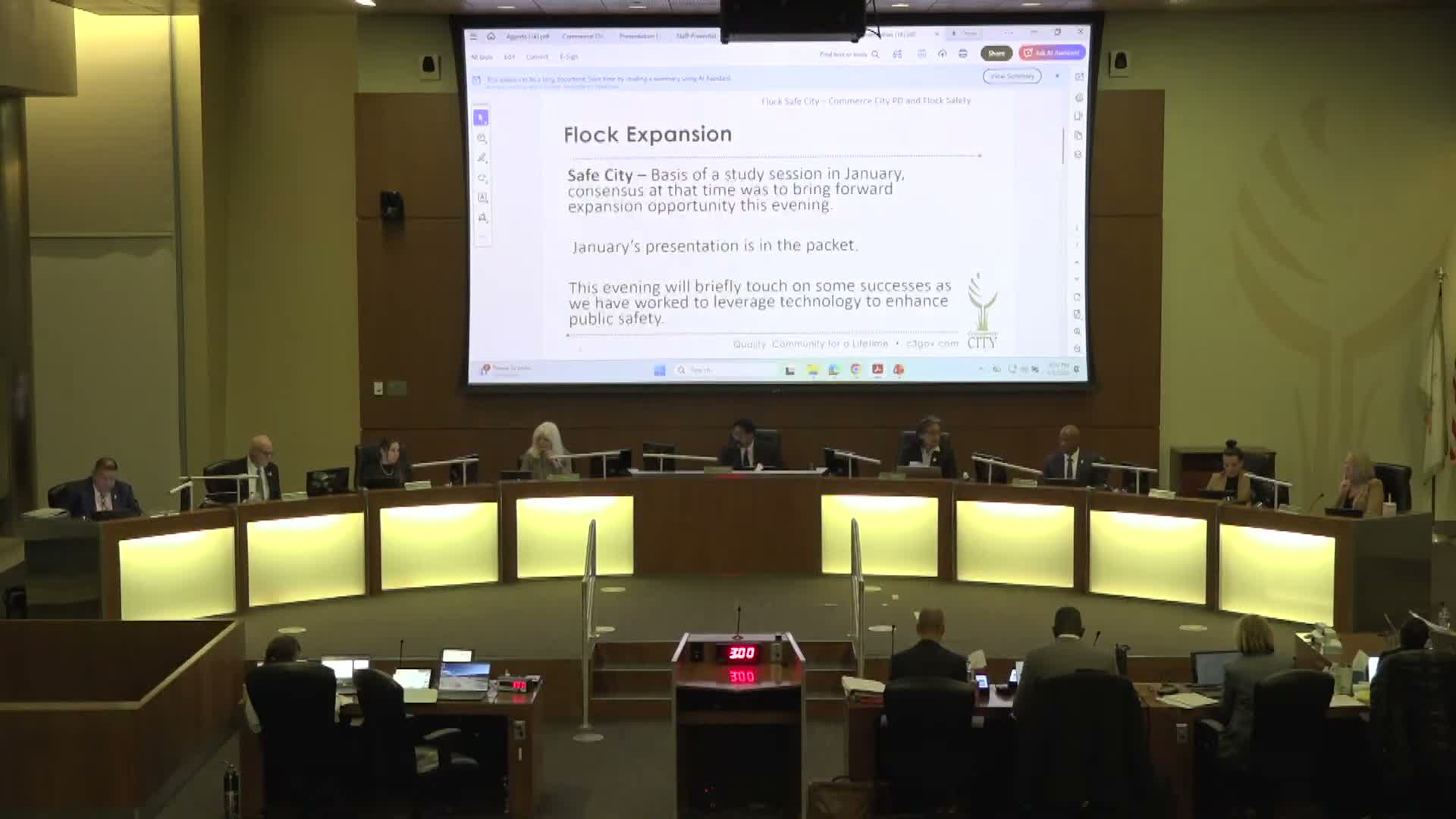
Commerce City council voted to introduce an ordinance to expand the city’s contract with Flock Safety and to amend the 2026 budget to fund the expansion, following an extended public conversation about privacy, data sharing and public‑safety benefits.
The council’s action on ordinance 27‑55, to approve a long‑term lease and operating license for license‑plate readers, drones and other equipment, passed on first reading by a 6–3 recorded vote; a separate ordinance, 27‑56, to recognize $608,900 of additional 2026 funding for the expansion also passed 6–3. Both measures were introduced and approved on first reading; further steps and final approvals will follow the ordinance process.
Why it mattered: City staff and police officials presented data from a pilot area where the existing Flock system operated from July 2024 through June 2025, saying recoveries of stolen vehicles were concentrated inside the core 3.5‑square‑mile area covered by license‑plate readers and gunshot detection. “Of the 426 recovered stolen vehicles in the city, over half — 53.7% or 229 — were recovered in the area where we had Flock LPR and gunshot detection,” the police chief said during the presentation. Staff framed expansion as adding coverage across a wider area plus additional capabilities (drones, gunshot detection and a real‑time crime center) intended to aid investigations and response.
Residents and advocacy groups pressed for stronger oversight and transparency. Carmen Medrano, representing a coalition of local and statewide advocacy groups, told council the contract “encroaches on the safety, freedom, and privacy of everyone who lives and works throughout Commerce City” and demanded a public audit of surveillance contracts and fuller disclosures of past data sharing. “We demand Commerce City elected leaders turn off the Flock cameras and direct city staff to perform a long overdue full public audit of all city surveillance contracts,” she said.
City staff and the contract vendor disputed assertions that Flock routinely shares Commerce City data with federal immigration‑enforcement agencies and highlighted contractual safeguards. The city’s deputy attorney explained contract provisions that state the city owns the data, require Flock to follow an attached data‑policy exhibit, and obligate the company to notify the city if it receives legal requests for data. Trevor Chandler, the vendor representative, said the company had made technical changes and training to limit unauthorized sharing. “We have completely shut off access outside of the state of California,” he said in describing changes that aim to restrict cross‑jurisdictional lookups.
Data security and oversight: Councilmembers probed where data is stored and how access is controlled. The vendor said data would be stored on an AWS GovCloud environment and that Flock uses CJIS‑level encryption and SOC 2 auditing; the city’s IT director confirmed data encryption at rest and in transit to CJIS standards. The deputy city attorney said the contract included remedies and audit rights and described a protocol for responding to subpoenas or outside requests.
Funding and scale: Residents and some councilmembers questioned the cost and the timeline for expansion. One resident, speaking during public comment, said the proposed contract equaled roughly $4.5 million over five years and called for a clearer accounting of benefits tied to that expense. City staff said the present baseline budget includes a $274,800 allocation for the existing program and that roughly $609,000 of additional non‑recurring funding would be needed in 2026 to expand coverage, producing a year‑one expansion cost shown in materials as about $912,095.
Council response and next steps: Several councilmembers who supported the measure said the technology has produced recoveries and regional outcomes and stressed equity of service across neighborhoods; others said the city should require an audit and codified city policies before expanding. Mayor Pro Tem referenced a constituent poll showing strong opposition in her ward and urged additional safeguards. The council voted to introduce both ordinances on first reading; the measures will return for subsequent readings and final votes in later meetings. Staff said further public engagement and policy work — including the potential for a city‑level data‑sharing policy and a public audit — remain possible follow‑up steps.
Votes at a glance: Ordinance 27‑55 (approve Flock Group agreement) — motion introduced and approved on first reading, vote 6–3. Ordinance 27‑56 (2026 budget amendment for Flock expansion) — introduced and approved on first reading, vote 6–3.
What comes next: The ordinances were introduced on first reading; subsequent council meetings will include final readings and any further conditions, and city staff said they will return with contract execution steps and could bring additional policy recommendations or audit options for council consideration.
The council’s action on ordinance 27‑55, to approve a long‑term lease and operating license for license‑plate readers, drones and other equipment, passed on first reading by a 6–3 recorded vote; a separate ordinance, 27‑56, to recognize $608,900 of additional 2026 funding for the expansion also passed 6–3. Both measures were introduced and approved on first reading; further steps and final approvals will follow the ordinance process.
Why it mattered: City staff and police officials presented data from a pilot area where the existing Flock system operated from July 2024 through June 2025, saying recoveries of stolen vehicles were concentrated inside the core 3.5‑square‑mile area covered by license‑plate readers and gunshot detection. “Of the 426 recovered stolen vehicles in the city, over half — 53.7% or 229 — were recovered in the area where we had Flock LPR and gunshot detection,” the police chief said during the presentation. Staff framed expansion as adding coverage across a wider area plus additional capabilities (drones, gunshot detection and a real‑time crime center) intended to aid investigations and response.
Residents and advocacy groups pressed for stronger oversight and transparency. Carmen Medrano, representing a coalition of local and statewide advocacy groups, told council the contract “encroaches on the safety, freedom, and privacy of everyone who lives and works throughout Commerce City” and demanded a public audit of surveillance contracts and fuller disclosures of past data sharing. “We demand Commerce City elected leaders turn off the Flock cameras and direct city staff to perform a long overdue full public audit of all city surveillance contracts,” she said.
City staff and the contract vendor disputed assertions that Flock routinely shares Commerce City data with federal immigration‑enforcement agencies and highlighted contractual safeguards. The city’s deputy attorney explained contract provisions that state the city owns the data, require Flock to follow an attached data‑policy exhibit, and obligate the company to notify the city if it receives legal requests for data. Trevor Chandler, the vendor representative, said the company had made technical changes and training to limit unauthorized sharing. “We have completely shut off access outside of the state of California,” he said in describing changes that aim to restrict cross‑jurisdictional lookups.
Data security and oversight: Councilmembers probed where data is stored and how access is controlled. The vendor said data would be stored on an AWS GovCloud environment and that Flock uses CJIS‑level encryption and SOC 2 auditing; the city’s IT director confirmed data encryption at rest and in transit to CJIS standards. The deputy city attorney said the contract included remedies and audit rights and described a protocol for responding to subpoenas or outside requests.
Funding and scale: Residents and some councilmembers questioned the cost and the timeline for expansion. One resident, speaking during public comment, said the proposed contract equaled roughly $4.5 million over five years and called for a clearer accounting of benefits tied to that expense. City staff said the present baseline budget includes a $274,800 allocation for the existing program and that roughly $609,000 of additional non‑recurring funding would be needed in 2026 to expand coverage, producing a year‑one expansion cost shown in materials as about $912,095.
Council response and next steps: Several councilmembers who supported the measure said the technology has produced recoveries and regional outcomes and stressed equity of service across neighborhoods; others said the city should require an audit and codified city policies before expanding. Mayor Pro Tem referenced a constituent poll showing strong opposition in her ward and urged additional safeguards. The council voted to introduce both ordinances on first reading; the measures will return for subsequent readings and final votes in later meetings. Staff said further public engagement and policy work — including the potential for a city‑level data‑sharing policy and a public audit — remain possible follow‑up steps.
Votes at a glance: Ordinance 27‑55 (approve Flock Group agreement) — motion introduced and approved on first reading, vote 6–3. Ordinance 27‑56 (2026 budget amendment for Flock expansion) — introduced and approved on first reading, vote 6–3.
What comes next: The ordinances were introduced on first reading; subsequent council meetings will include final readings and any further conditions, and city staff said they will return with contract execution steps and could bring additional policy recommendations or audit options for council consideration.
View the Full Meeting & All Its Details
This article offers just a summary. Unlock complete video, transcripts, and insights as a Founder Member.
✓
Watch full, unedited meeting videos
✓
Search every word spoken in unlimited transcripts
✓
AI summaries & real-time alerts (all government levels)
✓
Permanent access to expanding government content
30-day money-back guarantee
