St. Pete Beach planners review proposal to allow standalone multifamily in Coquina West
February 27, 2026 | St. Pete Beach, Pinellas County, Florida
This article was created by AI summarizing key points discussed. AI makes mistakes, so for full details and context, please refer to the video of the full meeting. Please report any errors so we can fix them. Report an error »
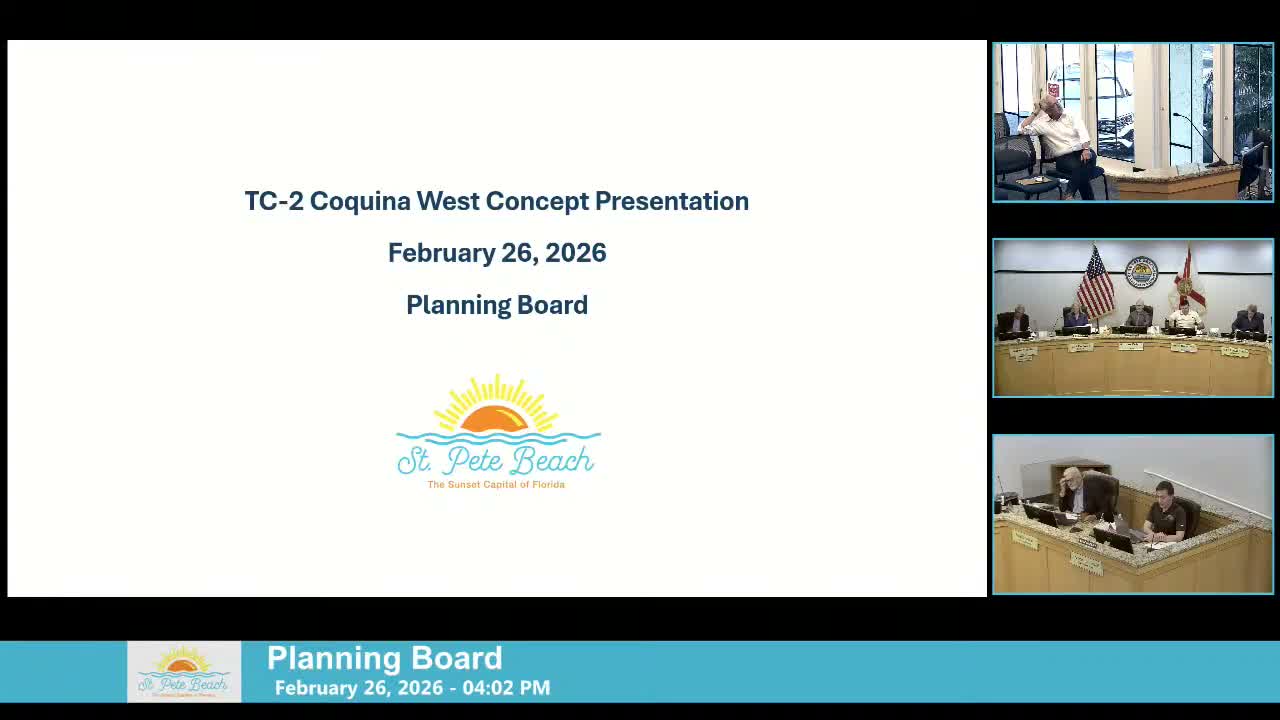
City planning staff on Feb. 26 presented the St. Pete Beach Planning Board with a package of proposed changes to the Town Center 2 (Coquina West) zoning code that would allow standalone multifamily development, permit certain existing lodging to redevelop as standalone uses, and lower the land consolidation threshold for mixed‑use projects.
Brandon Berry, who led the presentation, said the changes are intended to help property owners recover and rebuild after recent storms while preserving the area’s scale and preventing an increase in overall district intensity. “We have three major use modifications that are being proposed under this cover,” Berry said, outlining proposals that focus on height, density and living‑area standards.
Under staff’s draft concepts, standalone multifamily would be allowed as a use category limited to multifamily buildings (duplexes and single‑family would remain prohibited). Staff proposed a base right of 18 units per acre for standalone multifamily on single parcels; the city’s existing residential redevelopment entitlement is 24 units per acre. Berry said the standalone lodging concept would let existing pre‑storm lodging properties (for example, the Bella Serena Inn and the Widewaters Motel) redevelop as standalone lodging uses, but would not permit new standalone lodging. Proposed lodging limits include a maximum of three stories, a density cap of 30 units per acre (or the existing unit count, whichever is greater), and floor area limited to the existing average plus 20 percent.
Staff also proposed easing the requirement that a developer assemble an entire block before pursuing mixed‑use redevelopment. The draft would allow a half‑block (about one acre) option with development limits — roughly 50 feet above base flood elevation, stepbacks above two stories and an expectation of regular rectangular parcel shapes — to make smaller‑scale redevelopment feasible without large property consolidation.
Height and flood considerations were central to the discussion. Berry described typical site constraints: most parcels in Coquina West are in AE10/AE11 flood zones and living floors would likely be set about 6.5 to 9.5 feet above grade to meet minimum flood‑resiliency requirements. Staff said a 30‑foot height limit measured from base flood elevation would align the district with nearby residential neighborhoods and likely permit two living stories, while 35 feet could allow three living stories.
The proposal also raised questions about unit size. Staff floated an 800‑square‑foot cap on living area per unit as a way to keep new units in line with existing district patterns and to encourage smaller, potentially rental units. Berry said the mayor had expressed concern that an 800‑square‑foot cap could unduly limit economically viable redevelopment but that 800 sqft would make most properties “whole” while allowing existing units to redevelop with their current living square footage plus 20 percent. Berry noted county and statewide survey data showing multifamily averages near 1,000 square feet statewide and much larger averages in recent Barrier Island projects. He pointed to a local pending project at 100 Passagrel Way proposing six new units averaging about 714 square feet.
Board members’ responses ranged from technical questions about parking and buildability to broader process concerns. One board member said the presentation felt like “putting the chicken before the egg,” arguing the board was being asked to comment on standards before the city’s long‑range vision for the area was clear. Another member urged that removing an 800‑square‑foot cap could be acceptable if balanced by a reasonable height allowance that lets developers build larger, better‑designed units rather than many tiny apartments.
Berry replied that the proposal is intentionally narrow — to allow modest options for individual property owners who cannot consolidate a whole block — and that staff plans a workshop or hybrid public forum in March or April to gather broader community input and return with draft code language.
The planning board offered preliminary conceptual input but did not take formal action on code amendments; staff said it will return with draft ordinance language and public engagement opportunities later this spring.
Brandon Berry, who led the presentation, said the changes are intended to help property owners recover and rebuild after recent storms while preserving the area’s scale and preventing an increase in overall district intensity. “We have three major use modifications that are being proposed under this cover,” Berry said, outlining proposals that focus on height, density and living‑area standards.
Under staff’s draft concepts, standalone multifamily would be allowed as a use category limited to multifamily buildings (duplexes and single‑family would remain prohibited). Staff proposed a base right of 18 units per acre for standalone multifamily on single parcels; the city’s existing residential redevelopment entitlement is 24 units per acre. Berry said the standalone lodging concept would let existing pre‑storm lodging properties (for example, the Bella Serena Inn and the Widewaters Motel) redevelop as standalone lodging uses, but would not permit new standalone lodging. Proposed lodging limits include a maximum of three stories, a density cap of 30 units per acre (or the existing unit count, whichever is greater), and floor area limited to the existing average plus 20 percent.
Staff also proposed easing the requirement that a developer assemble an entire block before pursuing mixed‑use redevelopment. The draft would allow a half‑block (about one acre) option with development limits — roughly 50 feet above base flood elevation, stepbacks above two stories and an expectation of regular rectangular parcel shapes — to make smaller‑scale redevelopment feasible without large property consolidation.
Height and flood considerations were central to the discussion. Berry described typical site constraints: most parcels in Coquina West are in AE10/AE11 flood zones and living floors would likely be set about 6.5 to 9.5 feet above grade to meet minimum flood‑resiliency requirements. Staff said a 30‑foot height limit measured from base flood elevation would align the district with nearby residential neighborhoods and likely permit two living stories, while 35 feet could allow three living stories.
The proposal also raised questions about unit size. Staff floated an 800‑square‑foot cap on living area per unit as a way to keep new units in line with existing district patterns and to encourage smaller, potentially rental units. Berry said the mayor had expressed concern that an 800‑square‑foot cap could unduly limit economically viable redevelopment but that 800 sqft would make most properties “whole” while allowing existing units to redevelop with their current living square footage plus 20 percent. Berry noted county and statewide survey data showing multifamily averages near 1,000 square feet statewide and much larger averages in recent Barrier Island projects. He pointed to a local pending project at 100 Passagrel Way proposing six new units averaging about 714 square feet.
Board members’ responses ranged from technical questions about parking and buildability to broader process concerns. One board member said the presentation felt like “putting the chicken before the egg,” arguing the board was being asked to comment on standards before the city’s long‑range vision for the area was clear. Another member urged that removing an 800‑square‑foot cap could be acceptable if balanced by a reasonable height allowance that lets developers build larger, better‑designed units rather than many tiny apartments.
Berry replied that the proposal is intentionally narrow — to allow modest options for individual property owners who cannot consolidate a whole block — and that staff plans a workshop or hybrid public forum in March or April to gather broader community input and return with draft code language.
The planning board offered preliminary conceptual input but did not take formal action on code amendments; staff said it will return with draft ordinance language and public engagement opportunities later this spring.
View the Full Meeting & All Its Details
This article offers just a summary. Unlock complete video, transcripts, and insights as a Founder Member.
✓
Watch full, unedited meeting videos
✓
Search every word spoken in unlimited transcripts
✓
AI summaries & real-time alerts (all government levels)
✓
Permanent access to expanding government content
30-day money-back guarantee
