State rule limits city turf bans; St. Pete Beach planners weigh local controls for non‑residential sites
February 27, 2026 | St. Pete Beach, Pinellas County, Florida
This article was created by AI summarizing key points discussed. AI makes mistakes, so for full details and context, please refer to the video of the full meeting. Please report any errors so we can fix them. Report an error »
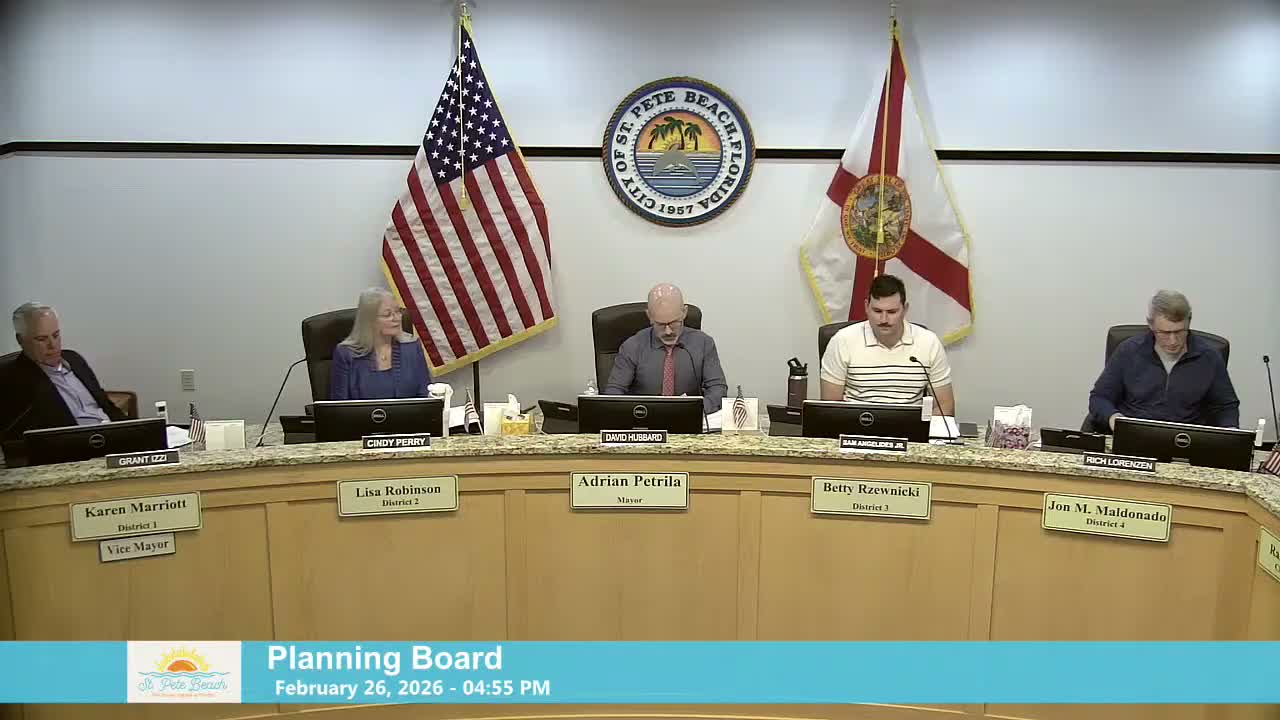
Planning staff briefed the board on a recently proposed Florida Department of Environmental Protection (FDEP) rule and state preemption that curtail local regulation of synthetic turf on most single‑family lots.
Brandon Berry summarized the rule’s key limits: synthetic turf would be prohibited in dunes, in swales, within 10 feet of the mean high water line where no seawall exists (and allowed to the seawall cap where a seawall is present), and within the drip line of mature trees unless an arborist certifies the turf will not adversely affect the tree. The rule applies to single‑family lots under one acre — which the planner said covers virtually all local single‑family parcels in St. Pete Beach.
Berry said the rule leaves two regulatory elements to local control: maximum subgrade permeability/porosity (for example, a city could set a standard such as 10 inches per hour) and the type of infill material used (silica sand, rock shell or other natural materials). "There are two things within this rule that cities can still regulate," he said, noting those levers could address runoff and plastic infill concerns.
Staff recommended retaining existing local regulations for multifamily and commercial properties, including a suggested limit of synthetic turf to about 20 percent of required permeable area and continuing to require vegetative ground cover where appropriate. Board members expressed frustration that extensive local research on best practices might be overridden by the state rule and urged staff to wait for the final rule text or any administrative challenges before drafting final local ordinances.
Several members raised environmental and maintenance concerns; staff cited studies that show engineered turf can reach high surface temperatures and noted underdrain maintenance is necessary to preserve porosity. Berry said staff will draft ordinance language for items still under local control once the FDEP rule is finalized and return to the board for comment.
Brandon Berry summarized the rule’s key limits: synthetic turf would be prohibited in dunes, in swales, within 10 feet of the mean high water line where no seawall exists (and allowed to the seawall cap where a seawall is present), and within the drip line of mature trees unless an arborist certifies the turf will not adversely affect the tree. The rule applies to single‑family lots under one acre — which the planner said covers virtually all local single‑family parcels in St. Pete Beach.
Berry said the rule leaves two regulatory elements to local control: maximum subgrade permeability/porosity (for example, a city could set a standard such as 10 inches per hour) and the type of infill material used (silica sand, rock shell or other natural materials). "There are two things within this rule that cities can still regulate," he said, noting those levers could address runoff and plastic infill concerns.
Staff recommended retaining existing local regulations for multifamily and commercial properties, including a suggested limit of synthetic turf to about 20 percent of required permeable area and continuing to require vegetative ground cover where appropriate. Board members expressed frustration that extensive local research on best practices might be overridden by the state rule and urged staff to wait for the final rule text or any administrative challenges before drafting final local ordinances.
Several members raised environmental and maintenance concerns; staff cited studies that show engineered turf can reach high surface temperatures and noted underdrain maintenance is necessary to preserve porosity. Berry said staff will draft ordinance language for items still under local control once the FDEP rule is finalized and return to the board for comment.
Don't Miss a Word: See the Full Meeting!
Go beyond summaries. Unlock every video, transcript, and key insight with a Founder Membership.
✓
Get instant access to full meeting videos
✓
Search and clip any phrase from complete transcripts
✓
Receive AI-powered summaries & custom alerts
✓
Enjoy lifetime, unrestricted access to government data
30-day money-back guarantee
