Charter review commission asks staff for clearer initiative rules, recommends 10% signature threshold
February 27, 2026 | Everett, Snohomish County, Washington
This article was created by AI summarizing key points discussed. AI makes mistakes, so for full details and context, please refer to the video of the full meeting. Please report any errors so we can fix them. Report an error »
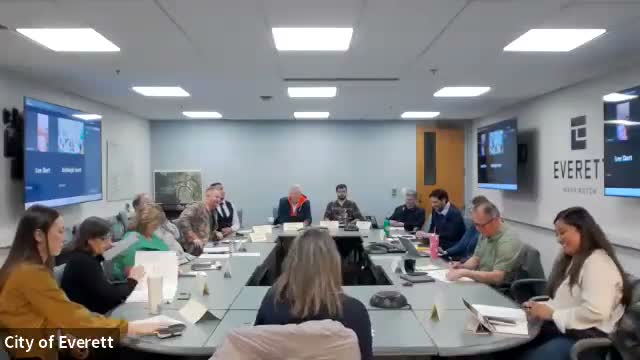
The Everett Charter Review Commission voted to ask city staff and the city attorney to draft clarifying language for Charter section 11.2.D and to include a recommended numeric threshold of 10% for qualifying citizen initiatives.
A committee member (Speaker 1) moved that staff prepare clearer language on how initiative petition thresholds are calculated and to propose a recommended percentage; Committee member (Speaker 13) seconded the motion. City staffer Jennifer (Speaker 10) told the commission that Everett’s current charter sets a 5% threshold measured as a percentage of votes cast in the last general city election, language that staff said has been ambiguous in past reviews and required legal interpretation when multiple initiatives qualified in 2024. Jennifer said many peer cities set higher thresholds — typically 10% or more — and that the county’s comparable threshold is 7% of votes cast in a recent statewide contest.
Commission members debated trade-offs: those favoring a higher threshold argued a larger percentage would ensure initiatives represent broader support and reduce the risk that narrowly organized efforts place complex or costly measures on the ballot without broader public vetting. As one commissioner (Speaker 9) put it, low thresholds have previously led to costly legal contests and “we’ve spent money and time” addressing the consequences of quickly advanced initiatives. Members urging caution said raising the bar could make direct democracy harder for grassroots efforts and recommended staff present alternatives for the group to consider.
The commission then considered a formal recommendation to ask staff to return a drafted text that would clarify the metric (which election to use and the calculation) and to propose a 10% threshold. A proposed amendment to set the recommendation at 7% was moved and put to a vote; the amendment failed and the body approved the original motion directing staff to prepare clarifying language reflecting the commission’s 10% recommendation. The motion will return to the commission for formal consideration and a vote on the precise language before any recommendation goes to the council or voters.
The commission did not adopt charter text itself at the meeting; members asked staff to bring back draft language, legal analysis, and alternative thresholds so the commission can vote later on a final recommendation. Jennifer said staff would prepare options and an explanatory cover memo for the commission to review.
The commission is required to deliver its final report by June 1 (date noted in the meeting); any formal charter amendment would follow the city’s process for council referral and, ultimately, a voter ballot if council approves.
A committee member (Speaker 1) moved that staff prepare clearer language on how initiative petition thresholds are calculated and to propose a recommended percentage; Committee member (Speaker 13) seconded the motion. City staffer Jennifer (Speaker 10) told the commission that Everett’s current charter sets a 5% threshold measured as a percentage of votes cast in the last general city election, language that staff said has been ambiguous in past reviews and required legal interpretation when multiple initiatives qualified in 2024. Jennifer said many peer cities set higher thresholds — typically 10% or more — and that the county’s comparable threshold is 7% of votes cast in a recent statewide contest.
Commission members debated trade-offs: those favoring a higher threshold argued a larger percentage would ensure initiatives represent broader support and reduce the risk that narrowly organized efforts place complex or costly measures on the ballot without broader public vetting. As one commissioner (Speaker 9) put it, low thresholds have previously led to costly legal contests and “we’ve spent money and time” addressing the consequences of quickly advanced initiatives. Members urging caution said raising the bar could make direct democracy harder for grassroots efforts and recommended staff present alternatives for the group to consider.
The commission then considered a formal recommendation to ask staff to return a drafted text that would clarify the metric (which election to use and the calculation) and to propose a 10% threshold. A proposed amendment to set the recommendation at 7% was moved and put to a vote; the amendment failed and the body approved the original motion directing staff to prepare clarifying language reflecting the commission’s 10% recommendation. The motion will return to the commission for formal consideration and a vote on the precise language before any recommendation goes to the council or voters.
The commission did not adopt charter text itself at the meeting; members asked staff to bring back draft language, legal analysis, and alternative thresholds so the commission can vote later on a final recommendation. Jennifer said staff would prepare options and an explanatory cover memo for the commission to review.
The commission is required to deliver its final report by June 1 (date noted in the meeting); any formal charter amendment would follow the city’s process for council referral and, ultimately, a voter ballot if council approves.
View the Full Meeting & All Its Details
This article offers just a summary. Unlock complete video, transcripts, and insights as a Founder Member.
✓
Watch full, unedited meeting videos
✓
Search every word spoken in unlimited transcripts
✓
AI summaries & real-time alerts (all government levels)
✓
Permanent access to expanding government content
30-day money-back guarantee
