Senate subcommittee adopts narrower monument and memorial protection amendment
March 03, 2026 | 2026 Legislative Meetings, South Carolina
This article was created by AI summarizing key points discussed. AI makes mistakes, so for full details and context, please refer to the video of the full meeting. Please report any errors so we can fix them. Report an error »
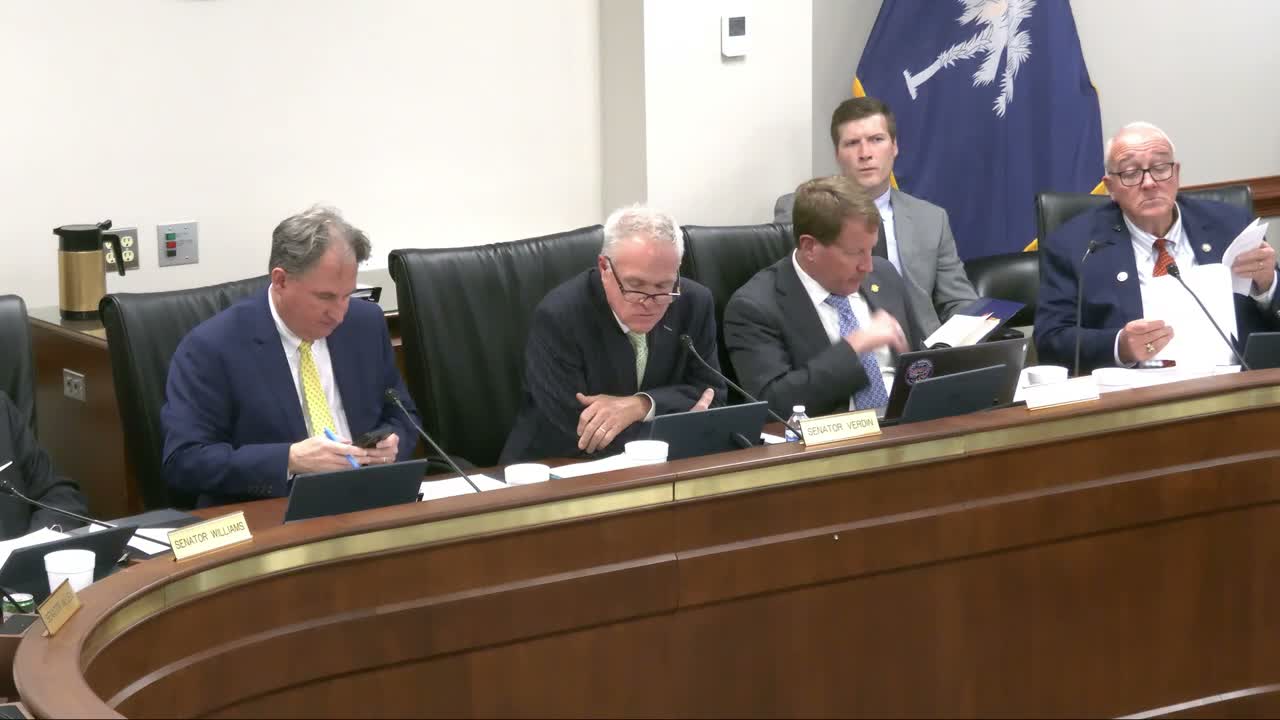
The Senate committee adopted an amendment to a bill updating the state’s 26‑year‑old monument and memorial statute, advancing the measure to the full committee as amended.
Chair (speaker 1) framed the proposal as “respect[ing] history” while responding to concerns raised in subcommittee and at full committee. Mr. Gibson (speaker 2), who summarized the amendment, said the changes strip the original bill’s “public figure” language in favor of the narrower phrase “historic group or people,” remove a provision that would have withheld local government funds for violations, and add provisions governing relocation and custody of monuments when property transfers occur. The amendment requires that, if the real property beneath a monument is sold or transferred to a private entity, the monument or memorial must be relocated first to public property with “equal or greater prominence and visibility within the same municipality.” The amendment also added temporary‑move language to accommodate infrastructure work and incorporated language provided by the Department of Transportation for road projects.
Committee members pressed for clarification about scope. A committee member asked whether the measure affects naming and building dedications; the chair and Mr. Gibson said the amendment is focused on monuments and memorials on public property and preserves protections for names on buildings and structures on state property and political subdivisions. Senator Mori (speaker 5) and others supported narrowing the bill and asked staff to draft final wording to make the geographic boundary language—municipality or county—clearer.
The committee also directed archives and history to draft regulations to establish a process for affinity organizations or other custodians to maintain monuments and memorials. The amendment’s authors said those regulations would help resolve gray areas as cases arise.
After discussion, the subcommittee voted by voice to adopt the amended language and gave the bill a favorable report to the full committee as amended.
The measure now moves to the full committee with the adopted amendment; the record shows a voice vote in favor but does not record a roll‑call tally or names of movers and seconders.
Chair (speaker 1) framed the proposal as “respect[ing] history” while responding to concerns raised in subcommittee and at full committee. Mr. Gibson (speaker 2), who summarized the amendment, said the changes strip the original bill’s “public figure” language in favor of the narrower phrase “historic group or people,” remove a provision that would have withheld local government funds for violations, and add provisions governing relocation and custody of monuments when property transfers occur. The amendment requires that, if the real property beneath a monument is sold or transferred to a private entity, the monument or memorial must be relocated first to public property with “equal or greater prominence and visibility within the same municipality.” The amendment also added temporary‑move language to accommodate infrastructure work and incorporated language provided by the Department of Transportation for road projects.
Committee members pressed for clarification about scope. A committee member asked whether the measure affects naming and building dedications; the chair and Mr. Gibson said the amendment is focused on monuments and memorials on public property and preserves protections for names on buildings and structures on state property and political subdivisions. Senator Mori (speaker 5) and others supported narrowing the bill and asked staff to draft final wording to make the geographic boundary language—municipality or county—clearer.
The committee also directed archives and history to draft regulations to establish a process for affinity organizations or other custodians to maintain monuments and memorials. The amendment’s authors said those regulations would help resolve gray areas as cases arise.
After discussion, the subcommittee voted by voice to adopt the amended language and gave the bill a favorable report to the full committee as amended.
The measure now moves to the full committee with the adopted amendment; the record shows a voice vote in favor but does not record a roll‑call tally or names of movers and seconders.
View the Full Meeting & All Its Details
This article offers just a summary. Unlock complete video, transcripts, and insights as a Founder Member.
✓
Watch full, unedited meeting videos
✓
Search every word spoken in unlimited transcripts
✓
AI summaries & real-time alerts (all government levels)
✓
Permanent access to expanding government content
30-day money-back guarantee
