Subcommittee advances bill letting homeowners replace manufactured homes despite zoning changes
March 03, 2026 | 2026 Legislative Meetings, South Carolina
This article was created by AI summarizing key points discussed. AI makes mistakes, so for full details and context, please refer to the video of the full meeting. Please report any errors so we can fix them. Report an error »
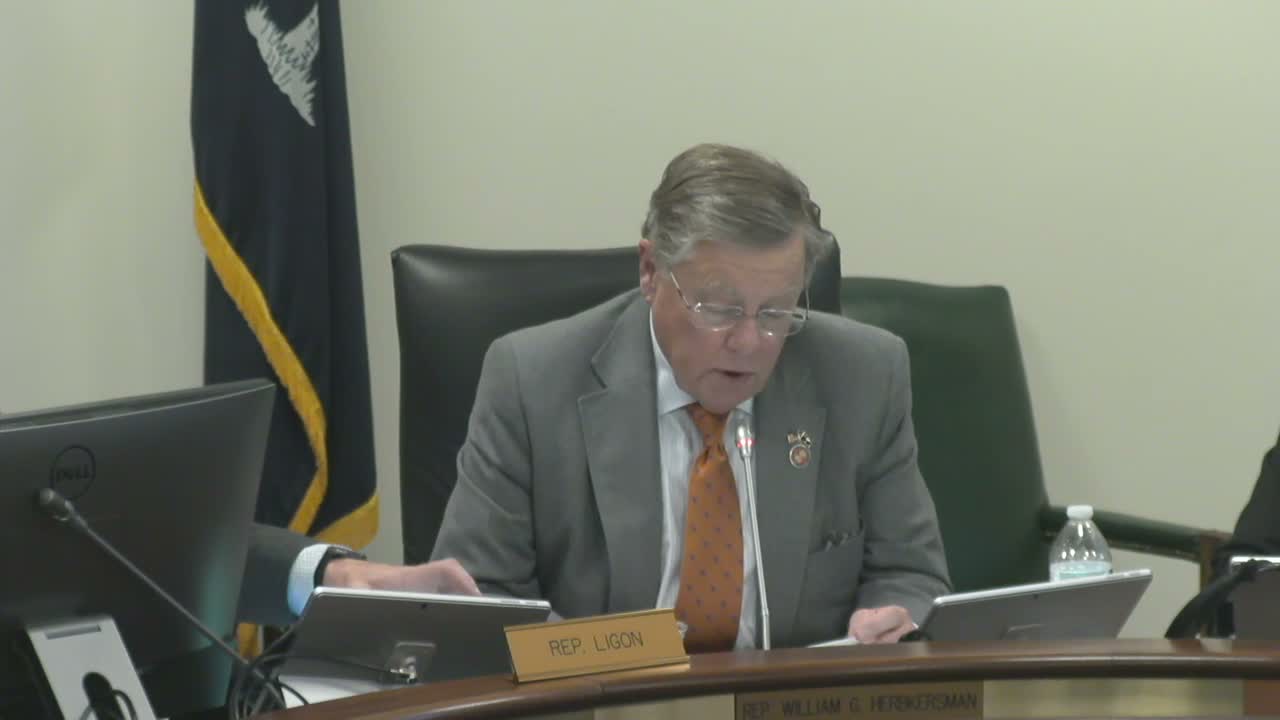
Representative Gary Brewer’s bill H.5113, which would let homeowners replace a manufactured home on their land even if local zoning later prohibits manufactured homes, advanced from a legislative subcommittee on a voice/show-of-hands vote Thursday.
Brewer framed the measure as a property-rights and housing-stability bill that would allow families to replace older manufactured homes after fire, flood or other loss. "This bill gives South Carolina citizens the right to replace their existing manufactured home with a new home on their own property," Brewer said during his opening remarks, asking the committee to hear testimony supporting the proposal.
Proponents from the manufactured-housing industry told the panel the bill would expand options and raise safety and tax revenue. Charleston Laughlin, representing the Manufacturing Housing Institute, said the measure removes outdated appearance rules and an arbitrary five-year display limit in state code and asked members to support H.5113. "It does three things in our bill: it gives the homeowner the right to replace, regardless of the change in zoning; it removes outdated appearance standards in section 23-43-85(A); and it removes an arbitrary five-year time limit on the display of models," Laughlin said.
Stephen Magyar, general manager of Oakwood Homes in Lexington, urged passage and described the local market: "One in five South Carolinians live in a manufactured home," he said, and noted the median price for a new manufactured home is about $150,000 compared with roughly $350,000 for a site-built house. Magyar asked the committee to "vote in favor for H.5113 and in favor of fairness and opportunity for all homeowners."
The Municipal Association of South Carolina opposed the bill, saying it would preempt local zoning authority and that its language is ambiguous. Webster Hall, speaking for the association, told the committee: "We respectfully oppose H.5,113 on the grounds of preemption. It restricts the municipality's ability to provide for the termination of a nonconforming use of modular homes." Hall said local comprehensive plans and zoning rules vary and a statewide rule could override local judgment.
Committee members pressed proponents on several points. A member asked whether the bill would cover mobile homes on rented land or lease-purchase transactions; proponents said the bill is intended to protect homeowners on their own property, but committee members noted the text may need clarification to cover some lease-purchase situations where title has not yet transferred. Another member asked whether the bill's design-language would allow modern styles such as flat roofs despite a 5/12 minimum roof pitch in the cited code; industry witnesses said replacements must meet applicable codes and standards.
The chair introduced Amendment 1 to H.5113 to adjust terminology and clarify the five-year measure referenced in the bill. Proponents explained the age limit would be measured from titling/manufacture date so that slightly used models can be sold and replaced rather than excluded by an arbitrary cutoff. Mr. Kirby moved to approve the amendment, which the committee adopted by voice/show-of-hands with one recorded opposition (Representative Guffey).
After adopting the amendment, the subcommittee voted to pass H.5113 out to the full committee; the chair reported there was no further opposition recorded on the floor of the subcommittee. The sponsor and witnesses thanked the committee and the meeting was adjourned.
The bill now moves to consideration by the full committee, where members may further edit or debate the measure.
Brewer framed the measure as a property-rights and housing-stability bill that would allow families to replace older manufactured homes after fire, flood or other loss. "This bill gives South Carolina citizens the right to replace their existing manufactured home with a new home on their own property," Brewer said during his opening remarks, asking the committee to hear testimony supporting the proposal.
Proponents from the manufactured-housing industry told the panel the bill would expand options and raise safety and tax revenue. Charleston Laughlin, representing the Manufacturing Housing Institute, said the measure removes outdated appearance rules and an arbitrary five-year display limit in state code and asked members to support H.5113. "It does three things in our bill: it gives the homeowner the right to replace, regardless of the change in zoning; it removes outdated appearance standards in section 23-43-85(A); and it removes an arbitrary five-year time limit on the display of models," Laughlin said.
Stephen Magyar, general manager of Oakwood Homes in Lexington, urged passage and described the local market: "One in five South Carolinians live in a manufactured home," he said, and noted the median price for a new manufactured home is about $150,000 compared with roughly $350,000 for a site-built house. Magyar asked the committee to "vote in favor for H.5113 and in favor of fairness and opportunity for all homeowners."
The Municipal Association of South Carolina opposed the bill, saying it would preempt local zoning authority and that its language is ambiguous. Webster Hall, speaking for the association, told the committee: "We respectfully oppose H.5,113 on the grounds of preemption. It restricts the municipality's ability to provide for the termination of a nonconforming use of modular homes." Hall said local comprehensive plans and zoning rules vary and a statewide rule could override local judgment.
Committee members pressed proponents on several points. A member asked whether the bill would cover mobile homes on rented land or lease-purchase transactions; proponents said the bill is intended to protect homeowners on their own property, but committee members noted the text may need clarification to cover some lease-purchase situations where title has not yet transferred. Another member asked whether the bill's design-language would allow modern styles such as flat roofs despite a 5/12 minimum roof pitch in the cited code; industry witnesses said replacements must meet applicable codes and standards.
The chair introduced Amendment 1 to H.5113 to adjust terminology and clarify the five-year measure referenced in the bill. Proponents explained the age limit would be measured from titling/manufacture date so that slightly used models can be sold and replaced rather than excluded by an arbitrary cutoff. Mr. Kirby moved to approve the amendment, which the committee adopted by voice/show-of-hands with one recorded opposition (Representative Guffey).
After adopting the amendment, the subcommittee voted to pass H.5113 out to the full committee; the chair reported there was no further opposition recorded on the floor of the subcommittee. The sponsor and witnesses thanked the committee and the meeting was adjourned.
The bill now moves to consideration by the full committee, where members may further edit or debate the measure.
View the Full Meeting & All Its Details
This article offers just a summary. Unlock complete video, transcripts, and insights as a Founder Member.
✓
Watch full, unedited meeting videos
✓
Search every word spoken in unlimited transcripts
✓
AI summaries & real-time alerts (all government levels)
✓
Permanent access to expanding government content
30-day money-back guarantee
