Springfield Township SD finance committee reviews 3.5% first-look tax increase, $1.2M budget gap
March 02, 2026 | Springfield Township SD, School Districts, Pennsylvania
This article was created by AI summarizing key points discussed. AI makes mistakes, so for full details and context, please refer to the video of the full meeting. Please report any errors so we can fix them. Report an error »
Miss Green, the district finance presenter, told the finance committee on Feb. 26 that the district’s first-look 2026–27 budget assumes a 3.5% real-estate tax increase that would generate roughly $1.8 million and that anticipated expenditures total about $78.6 million against projected revenues of about $77.4 million, leaving a roughly $1,200,000 gap to be covered from fund balance.
The budget presentation combined a year-to-date finance update with the first-look numbers. "We are at about 62,400,000 or 83.4% of our revenues have been collected," Miss Green said, and she noted the district has expended about $44,400,000, or approximately 58.5% of the budget to date. She emphasized the timing mismatch between tax collections (heavy August–December) and personnel costs that begin when teachers return in September.
Why it matters: the district begins the coming fiscal year with a sizable fund balance (Miss Green noted it was "almost at $20,000,000") but is aiming to reduce reliance on those reserves. Dr. Yannacone, a district administrator, said the finance team’s goal is to bring projected fund-balance use below $1,000,000 before the finance committee’s April 16 proposed-final presentation through departmental scrubbing and attritional savings.
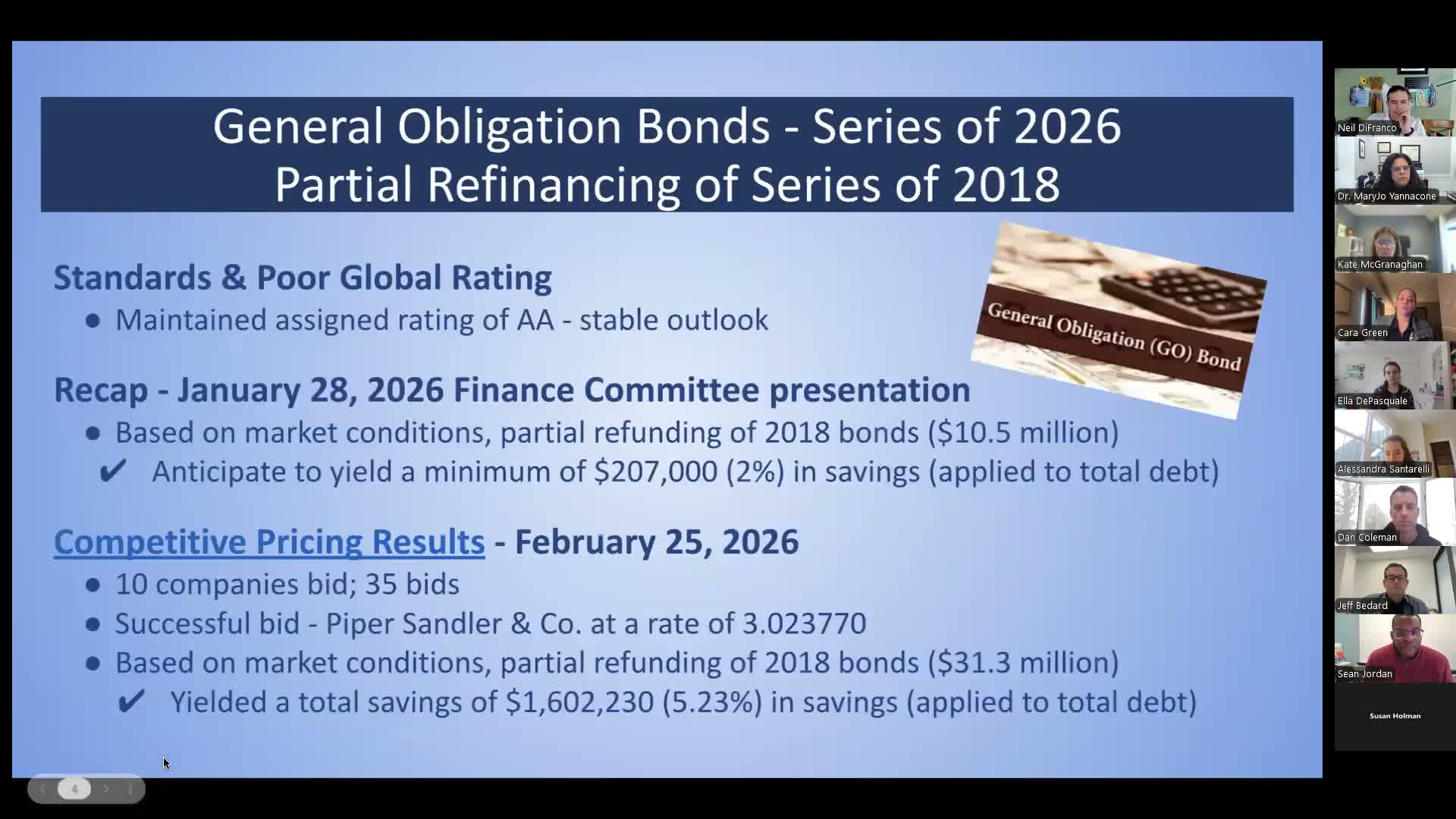
Bond refunding and debt-service impact: Miss Green reported the district ran a competitive sale to refund callable 2018 bonds and expanded the refunding scope from $10.5 million to $31.3 million because bids were favorable. "The successful bid was Piper and Sandler and Company at a rate of 3.02377," she said, and the refinancing yielded total estimated savings of about $1.6 million (roughly 5.23%). She explained that the district will "smooth" the savings over the life of the bonds rather than take a one-time credit; $382,000 of the savings was applied to the 2025–26 year to reduce annual debt-service costs this fiscal year.
Board members asked how that refunding and the district’s upcoming new-money borrowing for the middle-school project interact. Miss Green said the presented debt-service number (about $558,000 additional debt-service budgeted) did not yet reflect the 2018 refunding savings and was based on earlier budgeted figures; she said she expects some reductions once final numbers from the recent transactions are available. The district also plans a final $10 million borrowing for the middle-school renovation; staff said that new borrowing will increase long-term debt service even with the refunding savings.
Programs, personnel and other assumptions: Dr. Yannacone outlined modest program changes and new costs baked into the first-look budget: one middle-school volleyball coach, moving several high-school volunteer roles to paid stipends, a "gap year" for device refreshes to allow infrastructure work, replacement desktop and TV-studio equipment, a cybersecurity platform (Varonis) for data-loss prevention, and a planned K–8 math curriculum review for purchase in 2026–27 and implementation in 2027–28. He also described a policy to raise substitute pay and consolidate substitute-service contracts, which improved substitute fill rates but raised substitute costs from about $800,000 to nearly $1,000,000 annually—an increase of roughly $200,000.
State and federal revenue assumptions: Miss Green said the district is budgeting conservatively on state aid and is not yet including a $164,000 increase reflected in the governor’s proposed budget because the state picture remains uncertain. She also said Title I funding has been restored after prior conservatism, while Title II/III/IV allocations are budgeted at zero and some title funds can be rolled into Title I to support Title I salaries.
Next steps: staff will return to the finance committee on April 16 with the proposed final budget that must be posted 30 days before the full-board vote. Miss Green and Dr. Yannacone said they will continue to look for attritional savings and departmental reductions to tighten the numbers and reduce the proposed use of fund balance.
The finance committee did not take a final vote; the proposed final budget will go to the full board after the April 16 finance committee meeting and the district expects a final budget vote on June 16 after the required 30-day public posting.
The budget presentation combined a year-to-date finance update with the first-look numbers. "We are at about 62,400,000 or 83.4% of our revenues have been collected," Miss Green said, and she noted the district has expended about $44,400,000, or approximately 58.5% of the budget to date. She emphasized the timing mismatch between tax collections (heavy August–December) and personnel costs that begin when teachers return in September.
Why it matters: the district begins the coming fiscal year with a sizable fund balance (Miss Green noted it was "almost at $20,000,000") but is aiming to reduce reliance on those reserves. Dr. Yannacone, a district administrator, said the finance team’s goal is to bring projected fund-balance use below $1,000,000 before the finance committee’s April 16 proposed-final presentation through departmental scrubbing and attritional savings.
Bond refunding and debt-service impact: Miss Green reported the district ran a competitive sale to refund callable 2018 bonds and expanded the refunding scope from $10.5 million to $31.3 million because bids were favorable. "The successful bid was Piper and Sandler and Company at a rate of 3.02377," she said, and the refinancing yielded total estimated savings of about $1.6 million (roughly 5.23%). She explained that the district will "smooth" the savings over the life of the bonds rather than take a one-time credit; $382,000 of the savings was applied to the 2025–26 year to reduce annual debt-service costs this fiscal year.
Board members asked how that refunding and the district’s upcoming new-money borrowing for the middle-school project interact. Miss Green said the presented debt-service number (about $558,000 additional debt-service budgeted) did not yet reflect the 2018 refunding savings and was based on earlier budgeted figures; she said she expects some reductions once final numbers from the recent transactions are available. The district also plans a final $10 million borrowing for the middle-school renovation; staff said that new borrowing will increase long-term debt service even with the refunding savings.
Programs, personnel and other assumptions: Dr. Yannacone outlined modest program changes and new costs baked into the first-look budget: one middle-school volleyball coach, moving several high-school volunteer roles to paid stipends, a "gap year" for device refreshes to allow infrastructure work, replacement desktop and TV-studio equipment, a cybersecurity platform (Varonis) for data-loss prevention, and a planned K–8 math curriculum review for purchase in 2026–27 and implementation in 2027–28. He also described a policy to raise substitute pay and consolidate substitute-service contracts, which improved substitute fill rates but raised substitute costs from about $800,000 to nearly $1,000,000 annually—an increase of roughly $200,000.
State and federal revenue assumptions: Miss Green said the district is budgeting conservatively on state aid and is not yet including a $164,000 increase reflected in the governor’s proposed budget because the state picture remains uncertain. She also said Title I funding has been restored after prior conservatism, while Title II/III/IV allocations are budgeted at zero and some title funds can be rolled into Title I to support Title I salaries.
Next steps: staff will return to the finance committee on April 16 with the proposed final budget that must be posted 30 days before the full-board vote. Miss Green and Dr. Yannacone said they will continue to look for attritional savings and departmental reductions to tighten the numbers and reduce the proposed use of fund balance.
The finance committee did not take a final vote; the proposed final budget will go to the full board after the April 16 finance committee meeting and the district expects a final budget vote on June 16 after the required 30-day public posting.
View the Full Meeting & All Its Details
This article offers just a summary. Unlock complete video, transcripts, and insights as a Founder Member.
✓
Watch full, unedited meeting videos
✓
Search every word spoken in unlimited transcripts
✓
AI summaries & real-time alerts (all government levels)
✓
Permanent access to expanding government content
30-day money-back guarantee
