Flower Mound council adopts state-driven zoning and home-business changes, removes daytime office‑retail noise limit
March 02, 2026 | Flower Mound, Denton County, Texas
This article was created by AI summarizing key points discussed. AI makes mistakes, so for full details and context, please refer to the video of the full meeting. Please report any errors so we can fix them. Report an error »
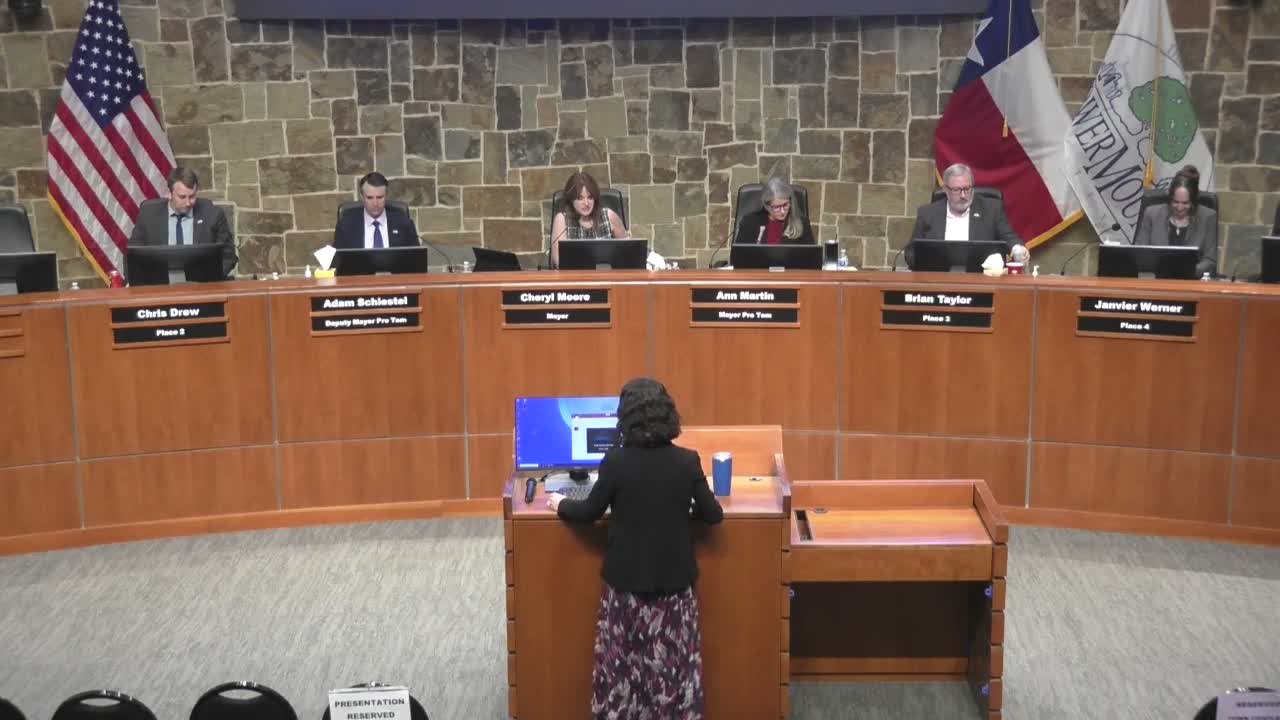
Flower Mound — The Town Council unanimously approved a package of state legislative updates and corresponding local Land Development Regulation (LDR) amendments that change how the town handles comprehensive zoning amendments, home‑based businesses and some noise standards.
Staff explained the statutory changes and how staff updated local code to reflect them. Among the state-level shifts, protest thresholds for certain comprehensive zoning amendments were raised: where a proposed change increases residential density as defined by the statute, a written protest signed by owners of at least 60% of the area of lots immediately adjoining the change will trigger a requirement that the amendment become effective only upon a favorable vote of a majority of all council members. Staff said the change is unlikely to be material in Flower Mound based on past practice but that it clarifies notice procedures.
On home‑based businesses, the legislature created a 'no‑impact' home‑based business category and limited municipal ability to regulate eligible operations. Staff recommended updating local language to align with the new state definitions — for example, removing previous square‑footage and fixed-patron-count limits while preserving prohibitions on visibly commercial, noisy or parking‑generating activities. Town legal counsel (Bryn) advised that the new law preempts local regulation for businesses that meet the state's no‑impact criteria and that enforcement would therefore focus on objective measures (occupancy limits, visibility, parking and noise) and municipal codes such as the noise ordinance.
Noise standards were also updated in the draft code. Council debated whether to keep a new daytime office/retail decibel limit; after discussion they removed that daytime office‑retail limit while retaining other proposed updates (including nighttime standards and commercial decibel thresholds). Council members said they did not want to unintentionally limit restaurants and mixed‑use patios or impose a standard that would be difficult to enforce absent a demonstrated problem.
Council voted unanimously to adopt the state legislative updates and the LDR amendments as modified by the council’s instruction to remove the daytime office‑retail noise limit.
What’s next: Staff will publish the updated code language and will monitor enforcement and community feedback; council members asked staff to revisit matters if enforcement proves problematic or community concerns arise.
Staff explained the statutory changes and how staff updated local code to reflect them. Among the state-level shifts, protest thresholds for certain comprehensive zoning amendments were raised: where a proposed change increases residential density as defined by the statute, a written protest signed by owners of at least 60% of the area of lots immediately adjoining the change will trigger a requirement that the amendment become effective only upon a favorable vote of a majority of all council members. Staff said the change is unlikely to be material in Flower Mound based on past practice but that it clarifies notice procedures.
On home‑based businesses, the legislature created a 'no‑impact' home‑based business category and limited municipal ability to regulate eligible operations. Staff recommended updating local language to align with the new state definitions — for example, removing previous square‑footage and fixed-patron-count limits while preserving prohibitions on visibly commercial, noisy or parking‑generating activities. Town legal counsel (Bryn) advised that the new law preempts local regulation for businesses that meet the state's no‑impact criteria and that enforcement would therefore focus on objective measures (occupancy limits, visibility, parking and noise) and municipal codes such as the noise ordinance.
Noise standards were also updated in the draft code. Council debated whether to keep a new daytime office/retail decibel limit; after discussion they removed that daytime office‑retail limit while retaining other proposed updates (including nighttime standards and commercial decibel thresholds). Council members said they did not want to unintentionally limit restaurants and mixed‑use patios or impose a standard that would be difficult to enforce absent a demonstrated problem.
Council voted unanimously to adopt the state legislative updates and the LDR amendments as modified by the council’s instruction to remove the daytime office‑retail noise limit.
What’s next: Staff will publish the updated code language and will monitor enforcement and community feedback; council members asked staff to revisit matters if enforcement proves problematic or community concerns arise.
View the Full Meeting & All Its Details
This article offers just a summary. Unlock complete video, transcripts, and insights as a Founder Member.
✓
Watch full, unedited meeting videos
✓
Search every word spoken in unlimited transcripts
✓
AI summaries & real-time alerts (all government levels)
✓
Permanent access to expanding government content
30-day money-back guarantee
