Zoning board approves variances to convert historic Hamilton Street building into 10 apartments
March 02, 2026 | Allentown City, Lehigh County, Pennsylvania
This article was created by AI summarizing key points discussed. AI makes mistakes, so for full details and context, please refer to the video of the full meeting. Please report any errors so we can fix them. Report an error »
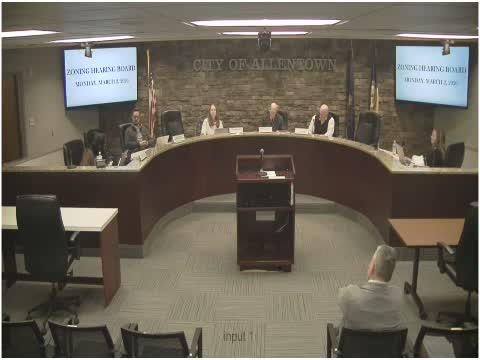
The Zoning Hearing Board on a voice vote approved dimensional variances that allow Bridal Partners LP to convert a historic Hamilton Street building into 10 apartments, granting relief for three units the applicant said were undersized because of the property’s historic layout and structural constraints.
Eric Schock, attorney for Bridal Partners LP, opened the presentation and said the applicant would call witnesses and had provided exhibits. Kasey Keller, a commercial real estate broker with Feinberg Real Estate Advisors, told the board the current owner bought the property at auction in 2014, remediated mechanical and utility systems, marketed the building for about a year and found stronger interest in residential conversion than office use. “The property also has a very large parking lot in the back, which as we know is very hard to come by in Allentown,” Keller said.
Lucia Entebia Sedoli, principal architect with Artifact Incorporated, testified that the project preserves most historic details while fitting apartments into the existing envelope. She reviewed the demo and finished plans, explaining that many units exceed the code minimums but three units were constrained by existing stair locations, a mansard roof and balloon‑framed construction. “About 99%” of the building’s character would be retained, Sedoli said, adding that the only removals would be unsafe secondary stairs and minimal interventions to create bathrooms and kitchens.
Board members and staff clarified a typographical error in the public notice that misnumbered the units and reviewed the applicable dimensional standards under the 2010 code cited at the hearing: studios/efficiencies 500 sq ft, one‑bedrooms 500 sq ft, two‑bedrooms 700 sq ft. The parties confirmed the specific units requiring variances and the reasons: Unit 101 (main floor), and two upper‑floor units constrained by roofline, hallway/egress placement and historic fabric.
During deliberations a board member said the unit count and overall density were not at issue and that the undersized units resulted from the building’s historic form, not from an intent to circumvent code. The motion to grant the requested relief was moved by a board member and seconded; the board approved the variances by voice vote. The board recorded no public objectors to the application during the hearing.
The approval is tied to the record of testimony and the applicant’s exhibits; no additional conditions unrelated to the variances were imposed. The board’s action allows the applicant to proceed with the conversion subject to standard permitting and code review processes.
Eric Schock, attorney for Bridal Partners LP, opened the presentation and said the applicant would call witnesses and had provided exhibits. Kasey Keller, a commercial real estate broker with Feinberg Real Estate Advisors, told the board the current owner bought the property at auction in 2014, remediated mechanical and utility systems, marketed the building for about a year and found stronger interest in residential conversion than office use. “The property also has a very large parking lot in the back, which as we know is very hard to come by in Allentown,” Keller said.
Lucia Entebia Sedoli, principal architect with Artifact Incorporated, testified that the project preserves most historic details while fitting apartments into the existing envelope. She reviewed the demo and finished plans, explaining that many units exceed the code minimums but three units were constrained by existing stair locations, a mansard roof and balloon‑framed construction. “About 99%” of the building’s character would be retained, Sedoli said, adding that the only removals would be unsafe secondary stairs and minimal interventions to create bathrooms and kitchens.
Board members and staff clarified a typographical error in the public notice that misnumbered the units and reviewed the applicable dimensional standards under the 2010 code cited at the hearing: studios/efficiencies 500 sq ft, one‑bedrooms 500 sq ft, two‑bedrooms 700 sq ft. The parties confirmed the specific units requiring variances and the reasons: Unit 101 (main floor), and two upper‑floor units constrained by roofline, hallway/egress placement and historic fabric.
During deliberations a board member said the unit count and overall density were not at issue and that the undersized units resulted from the building’s historic form, not from an intent to circumvent code. The motion to grant the requested relief was moved by a board member and seconded; the board approved the variances by voice vote. The board recorded no public objectors to the application during the hearing.
The approval is tied to the record of testimony and the applicant’s exhibits; no additional conditions unrelated to the variances were imposed. The board’s action allows the applicant to proceed with the conversion subject to standard permitting and code review processes.
Don't Miss a Word: See the Full Meeting!
Go beyond summaries. Unlock every video, transcript, and key insight with a Founder Membership.
✓
Get instant access to full meeting videos
✓
Search and clip any phrase from complete transcripts
✓
Receive AI-powered summaries & custom alerts
✓
Enjoy lifetime, unrestricted access to government data
30-day money-back guarantee
