Regional water authority urges coordinated wastewater plan to avoid capacity limits; High Point faces significant long‑term costs
March 03, 2026 | High Point, Guilford County, North Carolina
This article was created by AI summarizing key points discussed. AI makes mistakes, so for full details and context, please refer to the video of the full meeting. Please report any errors so we can fix them. Report an error »
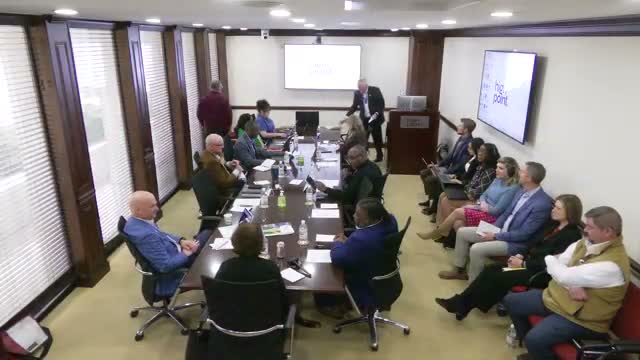
At a March 2 special meeting, Assistant City Manager Damon Decain introduced a regionalization study briefing from the Piedmont Triad Regional Water Authority. PTRWA Executive Director Greg Florey and consultant Darren Thomas of Raftelis presented study findings that concluded existing local agreements and infrastructure are insufficient to meet projected demand and regulatory requirements across Guilford and Randolph counties.
Florey told council members PTRWA was chartered in 1986 as a wholesale water provider and that the authority is pursuing an "enhanced regionalization and master planning effort" to address growth in the Carolina Core and large development sites. "If we just maintain the status quo, what's gonna happen? Capacity constraints and development impacts," Florey said, warning that under a go‑it‑alone scenario High Point could face wastewater capacity limits in the 2040s that would constrain residential and commercial growth.
Florey outlined current capital work: a design‑build expansion to 26.7 (unit in transcript) is underway and a 60% guaranteed‑maximum price awarded in October came in near $84,000,000 to be split among participating members; advanced treatment using reverse osmosis was selected to address emerging contaminants but creates a concentrated waste stream that the authority still must resolve. Florey gave estimated advanced‑treatment capital needs of roughly $125–$150 million for the first phases and said High Point would be responsible for approximately 19 percent of the cost for the first 12 million (unit in transcript) of advanced treatment.
Darren Thomas summarized the study's rate modeling and funding scenarios. He said the study estimated a full regionalized water and wastewater price tag of about $4 billion–$4.5 billion and recommended that roughly $1.1 billion of state or federal support would be required to keep projected household rate increases moderate. "This right now represents about a 5 and a half percent annual increase for High Point between now and 2050," Thomas said as a modeling example; he cautioned that without outside support the projected rate impacts would be substantially larger.
Florey said the board passed a January resolution endorsing implementation and identifying "alternative 4" as the preferred path because it minimizes the number of new facilities; he emphasized that the authority needs member governments' participation and that any change to the joint governmental agreement would require member approval. "Who's in? Can we hold the coalition together?" Florey asked, framing the governance and funding coalition as the next challenge.
Council members asked clarifying questions about the timing of potential bond issuance, whether individual members could decline to participate, and the timing of capacity limits for High Point. Florey and Thomas said financing and engineering work remain, and that membership dues or small initial contributions could help fund preliminary engineering and PERs before larger revenue bonds would be considered.
Florey said staff will likely bring a council resolution in the next month asking High Point to support moving forward on a regional wastewater solution; any governance or revenue changes would require the appropriate approvals and, for major governance changes, unanimous consent from member governments.
Florey told council members PTRWA was chartered in 1986 as a wholesale water provider and that the authority is pursuing an "enhanced regionalization and master planning effort" to address growth in the Carolina Core and large development sites. "If we just maintain the status quo, what's gonna happen? Capacity constraints and development impacts," Florey said, warning that under a go‑it‑alone scenario High Point could face wastewater capacity limits in the 2040s that would constrain residential and commercial growth.
Florey outlined current capital work: a design‑build expansion to 26.7 (unit in transcript) is underway and a 60% guaranteed‑maximum price awarded in October came in near $84,000,000 to be split among participating members; advanced treatment using reverse osmosis was selected to address emerging contaminants but creates a concentrated waste stream that the authority still must resolve. Florey gave estimated advanced‑treatment capital needs of roughly $125–$150 million for the first phases and said High Point would be responsible for approximately 19 percent of the cost for the first 12 million (unit in transcript) of advanced treatment.
Darren Thomas summarized the study's rate modeling and funding scenarios. He said the study estimated a full regionalized water and wastewater price tag of about $4 billion–$4.5 billion and recommended that roughly $1.1 billion of state or federal support would be required to keep projected household rate increases moderate. "This right now represents about a 5 and a half percent annual increase for High Point between now and 2050," Thomas said as a modeling example; he cautioned that without outside support the projected rate impacts would be substantially larger.
Florey said the board passed a January resolution endorsing implementation and identifying "alternative 4" as the preferred path because it minimizes the number of new facilities; he emphasized that the authority needs member governments' participation and that any change to the joint governmental agreement would require member approval. "Who's in? Can we hold the coalition together?" Florey asked, framing the governance and funding coalition as the next challenge.
Council members asked clarifying questions about the timing of potential bond issuance, whether individual members could decline to participate, and the timing of capacity limits for High Point. Florey and Thomas said financing and engineering work remain, and that membership dues or small initial contributions could help fund preliminary engineering and PERs before larger revenue bonds would be considered.
Florey said staff will likely bring a council resolution in the next month asking High Point to support moving forward on a regional wastewater solution; any governance or revenue changes would require the appropriate approvals and, for major governance changes, unanimous consent from member governments.
View the Full Meeting & All Its Details
This article offers just a summary. Unlock complete video, transcripts, and insights as a Founder Member.
✓
Watch full, unedited meeting videos
✓
Search every word spoken in unlimited transcripts
✓
AI summaries & real-time alerts (all government levels)
✓
Permanent access to expanding government content
30-day money-back guarantee
