Stakeholders debate density bonuses, overlays and water constraints for workforce housing
March 02, 2026 | San Miguel County, Colorado
This article was created by AI summarizing key points discussed. AI makes mistakes, so for full details and context, please refer to the video of the full meeting. Please report any errors so we can fix them. Report an error »
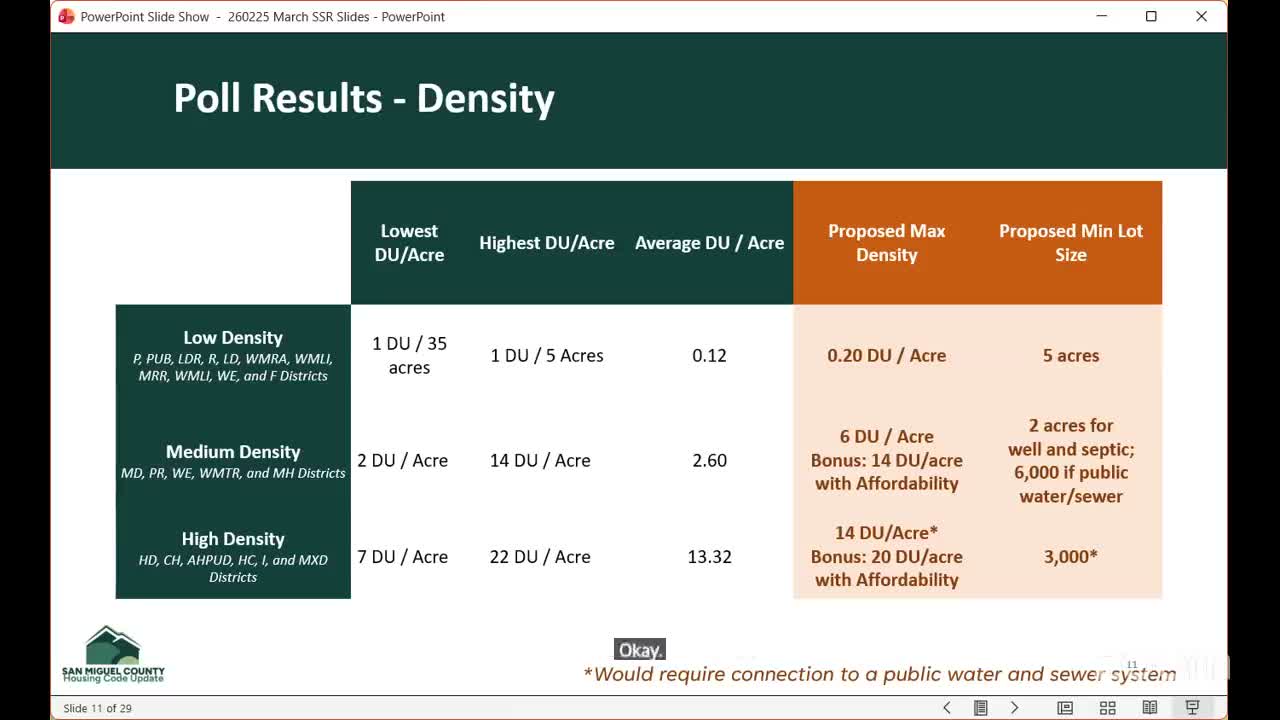
San Miguel County stakeholders spent substantial time on March 2 weighing whether density increases should be applied countywide or restricted to deed-restricted workforce housing via an overlay. Presenters and participants repeatedly emphasized a preference to keep base densities low and to reserve density increases (and accelerated review benefits) for projects that deliver deed-restricted workforce units.
Nick Farko (S11) and multiple participants urged an overlay approach mapped to zone districts rather than a blanket countywide increase. "The idea of having the overlay, mapped to zone districts, because zone districts are what we care about, is a concept I'd just like to consider," Farko said, arguing that an overlay allows focused, logistical application without unintentionally boosting base market-rate development.
Several participants probed numeric triggers for administrative, one-step, two-step and PUD review tracks, recommending triggers based on both number of units and total project acreage. Lee (S9), identified as the planning commission chair, and others suggested that project magnitude—total units or acres—should determine the level of public participation so that small fourplexes can have streamlined review while larger multiacre developments follow multi-step and PUD procedures.
Water supply and state water-rights rules shaped much of the feasibility discussion. County staff (S1) described domestic well permitting limits: domestic well rules typically limit multiple-dwelling domestic well permits to 35-acre parcels (three dwelling units under domestic well permits; parcels below 35 acres often require connection to a water system or an exempt residential well if created prior to 1972). Several speakers warned that converting surface irrigation rights or obtaining augmentation requires water court or augmentation plans that can be lengthy and costly—one participant said water court can proceed in "10‑year increments"—which constrains where higher-density, well‑based development is practically achievable.
Participants proposed pragmatic alternatives to countywide rezoning to reconcile water and infrastructure realities: (a) a targeted overlay or mapped bonus tied to deed restrictions and workforce requirements; (b) allowing limited additional units on existing 35‑acre domestic well permits (for example permitting a third dwelling in exchange for deed restriction); and (c) minor‑subdivision and small‑project thresholds (up to four lots) to fast-track small, feasible developments without eliminating PUD review for major projects.
The group also discussed form-based approaches (focusing on mass/scale design rather than strict DU/acre measures) and specific typologies—cottage clusters, small-lot subdivisions, fourplexes, duplexes and small apartments—with participants asking staff to return with zone‑specific numerical recommendations for unit caps, acreage triggers and definitions of "small‑scale" developments for administrative review.
Next steps: staff will draft zone‑district amendments and a matrix of triggers (units/acre/size) for the March 26 work session; the group agreed to keep base densities conservative and channel density increases toward deed‑restricted workforce housing delivered via overlay or targeted incentives.
Nick Farko (S11) and multiple participants urged an overlay approach mapped to zone districts rather than a blanket countywide increase. "The idea of having the overlay, mapped to zone districts, because zone districts are what we care about, is a concept I'd just like to consider," Farko said, arguing that an overlay allows focused, logistical application without unintentionally boosting base market-rate development.
Several participants probed numeric triggers for administrative, one-step, two-step and PUD review tracks, recommending triggers based on both number of units and total project acreage. Lee (S9), identified as the planning commission chair, and others suggested that project magnitude—total units or acres—should determine the level of public participation so that small fourplexes can have streamlined review while larger multiacre developments follow multi-step and PUD procedures.
Water supply and state water-rights rules shaped much of the feasibility discussion. County staff (S1) described domestic well permitting limits: domestic well rules typically limit multiple-dwelling domestic well permits to 35-acre parcels (three dwelling units under domestic well permits; parcels below 35 acres often require connection to a water system or an exempt residential well if created prior to 1972). Several speakers warned that converting surface irrigation rights or obtaining augmentation requires water court or augmentation plans that can be lengthy and costly—one participant said water court can proceed in "10‑year increments"—which constrains where higher-density, well‑based development is practically achievable.
Participants proposed pragmatic alternatives to countywide rezoning to reconcile water and infrastructure realities: (a) a targeted overlay or mapped bonus tied to deed restrictions and workforce requirements; (b) allowing limited additional units on existing 35‑acre domestic well permits (for example permitting a third dwelling in exchange for deed restriction); and (c) minor‑subdivision and small‑project thresholds (up to four lots) to fast-track small, feasible developments without eliminating PUD review for major projects.
The group also discussed form-based approaches (focusing on mass/scale design rather than strict DU/acre measures) and specific typologies—cottage clusters, small-lot subdivisions, fourplexes, duplexes and small apartments—with participants asking staff to return with zone‑specific numerical recommendations for unit caps, acreage triggers and definitions of "small‑scale" developments for administrative review.
Next steps: staff will draft zone‑district amendments and a matrix of triggers (units/acre/size) for the March 26 work session; the group agreed to keep base densities conservative and channel density increases toward deed‑restricted workforce housing delivered via overlay or targeted incentives.
View the Full Meeting & All Its Details
This article offers just a summary. Unlock complete video, transcripts, and insights as a Founder Member.
✓
Watch full, unedited meeting videos
✓
Search every word spoken in unlimited transcripts
✓
AI summaries & real-time alerts (all government levels)
✓
Permanent access to expanding government content
30-day money-back guarantee
