State regulators, industry, labor and cities debate autonomous‑vehicle safety, data and jobs at Washington work session
March 02, 2026 | Legislative Sessions, Washington
This article was created by AI summarizing key points discussed. AI makes mistakes, so for full details and context, please refer to the video of the full meeting. Please report any errors so we can fix them. Report an error »
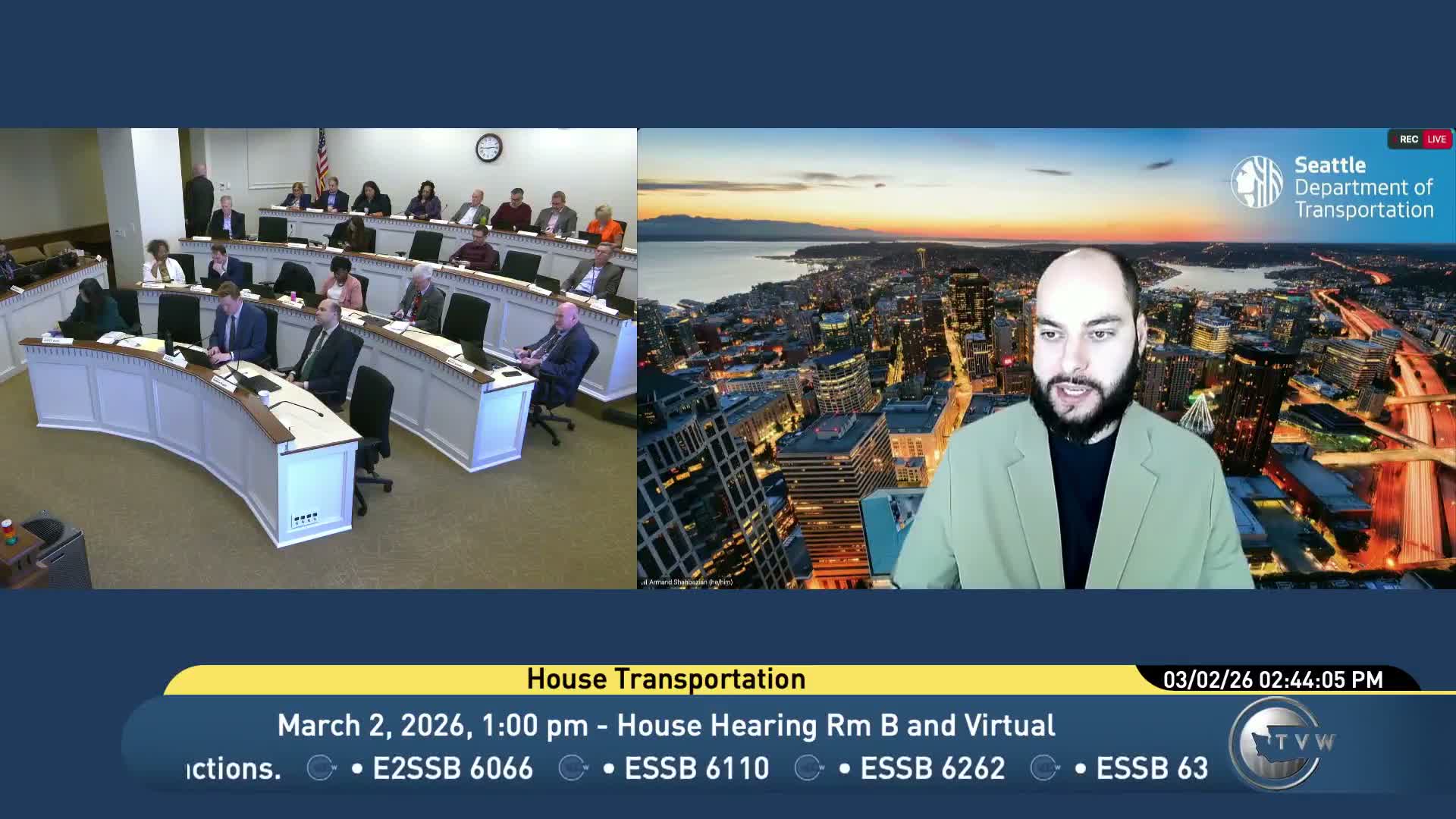
The Washington State House Transportation Committee spent two hours hearing testimony on autonomous vehicles (AVs), where state regulators, companies and local officials outlined competing priorities for safety, data and jobs.
Rima Griffith, executive director of the Washington State Transportation Commission, opened with a summary of a five‑year AV work group that produced a “roadmap to the future” and 29 recommendations. Griffith said the work highlighted gaps in agency readiness and recommended continued collaboration across safety, equity, workforce and testing, noting the Commission and work group had helped move several recommendations into law, including a higher liability threshold for testing operators.
California and Arizona regulators described their operating frameworks. “We track crashes and incidents occurring on public roads and investigate each one,” said Miguel Acosta, chief of autonomous vehicles at the California Department of Motor Vehicles. Acosta said California has staged permit pathways — testing with a safety driver, driverless testing and deployment — and is preparing a final rulemaking package; he told the committee the department had no fatalities “attributed to an autonomous vehicle” on record but is aligning state crash reporting with federal standards.
Arizona’s representative on the panel said the state relies more on self‑certification and law‑enforcement interaction plans and that companies typically meet with the state before driverless operations proceed.
Industry speakers pushed for a state framework that enables predictable deployment. Aden Ali Sullivan, head of Waymo’s Western US public policy, described the company’s sensor suite and operations, and cited company data he said showed lower injury‑causing crashes in like‑for‑like miles. Paul Escobar of Zoox urged a statewide pathway to provide certainty for investment, saying inconsistent local rules make commercial service difficult to scale. Katie Timmons of the Autonomous Vehicle Industry Association stressed the industry’s desire to work with regulators and first responders and said members collectively have driven hundreds of millions of autonomous miles in the U.S.
Labor and public safety speakers urged tighter controls. Brenda Wiest, speaking for the Teamsters, warned that driverless deployment risks large job losses among truck drivers and other driving occupations and urged requirements for safety operators and workforce transition programs. Nick Gullickson of the Washington State Council of Firefighters described instances where AVs interfered with emergency scenes and urged protocols that enable first responders to manage dynamic incidents.
Seattle Department of Transportation officials asked that any statewide framework require open data standards such as the Open Mobility Foundation’s Mobility Data Specification (MDS), so cities can verify company performance and respond quickly to incidents. “By the time data trickles out of company self‑reporting, the impacts are already felt,” said Arman Shehbazian of Seattle DOT.
Committee members pressed presenters on several recurring issues: how manufacturers will be held accountable for moving violations (California noted newly authorized citations to manufacturers in state law), how data reporting and minimum testing mileages will be set, and what consumer‑facing outreach companies will perform to educate pedestrians and other road users.
No final policy was adopted at the work session; the committee moved from testimony to an executive session that considered a package of transportation bills and amendments.
The committee adjourned after adopting amendments and moving multiple bills out of committee with do‑pass recommendations; roll‑call results were recorded for each measure.
Rima Griffith, executive director of the Washington State Transportation Commission, opened with a summary of a five‑year AV work group that produced a “roadmap to the future” and 29 recommendations. Griffith said the work highlighted gaps in agency readiness and recommended continued collaboration across safety, equity, workforce and testing, noting the Commission and work group had helped move several recommendations into law, including a higher liability threshold for testing operators.
California and Arizona regulators described their operating frameworks. “We track crashes and incidents occurring on public roads and investigate each one,” said Miguel Acosta, chief of autonomous vehicles at the California Department of Motor Vehicles. Acosta said California has staged permit pathways — testing with a safety driver, driverless testing and deployment — and is preparing a final rulemaking package; he told the committee the department had no fatalities “attributed to an autonomous vehicle” on record but is aligning state crash reporting with federal standards.
Arizona’s representative on the panel said the state relies more on self‑certification and law‑enforcement interaction plans and that companies typically meet with the state before driverless operations proceed.
Industry speakers pushed for a state framework that enables predictable deployment. Aden Ali Sullivan, head of Waymo’s Western US public policy, described the company’s sensor suite and operations, and cited company data he said showed lower injury‑causing crashes in like‑for‑like miles. Paul Escobar of Zoox urged a statewide pathway to provide certainty for investment, saying inconsistent local rules make commercial service difficult to scale. Katie Timmons of the Autonomous Vehicle Industry Association stressed the industry’s desire to work with regulators and first responders and said members collectively have driven hundreds of millions of autonomous miles in the U.S.
Labor and public safety speakers urged tighter controls. Brenda Wiest, speaking for the Teamsters, warned that driverless deployment risks large job losses among truck drivers and other driving occupations and urged requirements for safety operators and workforce transition programs. Nick Gullickson of the Washington State Council of Firefighters described instances where AVs interfered with emergency scenes and urged protocols that enable first responders to manage dynamic incidents.
Seattle Department of Transportation officials asked that any statewide framework require open data standards such as the Open Mobility Foundation’s Mobility Data Specification (MDS), so cities can verify company performance and respond quickly to incidents. “By the time data trickles out of company self‑reporting, the impacts are already felt,” said Arman Shehbazian of Seattle DOT.
Committee members pressed presenters on several recurring issues: how manufacturers will be held accountable for moving violations (California noted newly authorized citations to manufacturers in state law), how data reporting and minimum testing mileages will be set, and what consumer‑facing outreach companies will perform to educate pedestrians and other road users.
No final policy was adopted at the work session; the committee moved from testimony to an executive session that considered a package of transportation bills and amendments.
The committee adjourned after adopting amendments and moving multiple bills out of committee with do‑pass recommendations; roll‑call results were recorded for each measure.
Don't Miss a Word: See the Full Meeting!
Go beyond summaries. Unlock every video, transcript, and key insight with a Founder Membership.
✓
Get instant access to full meeting videos
✓
Search and clip any phrase from complete transcripts
✓
Receive AI-powered summaries & custom alerts
✓
Enjoy lifetime, unrestricted access to government data
30-day money-back guarantee
