Students, colleges urge restoration of Washington College Grant funding in Appropriations hearing
March 02, 2026 | Legislative Sessions, Washington
This article was created by AI summarizing key points discussed. AI makes mistakes, so for full details and context, please refer to the video of the full meeting. Please report any errors so we can fix them. Report an error »
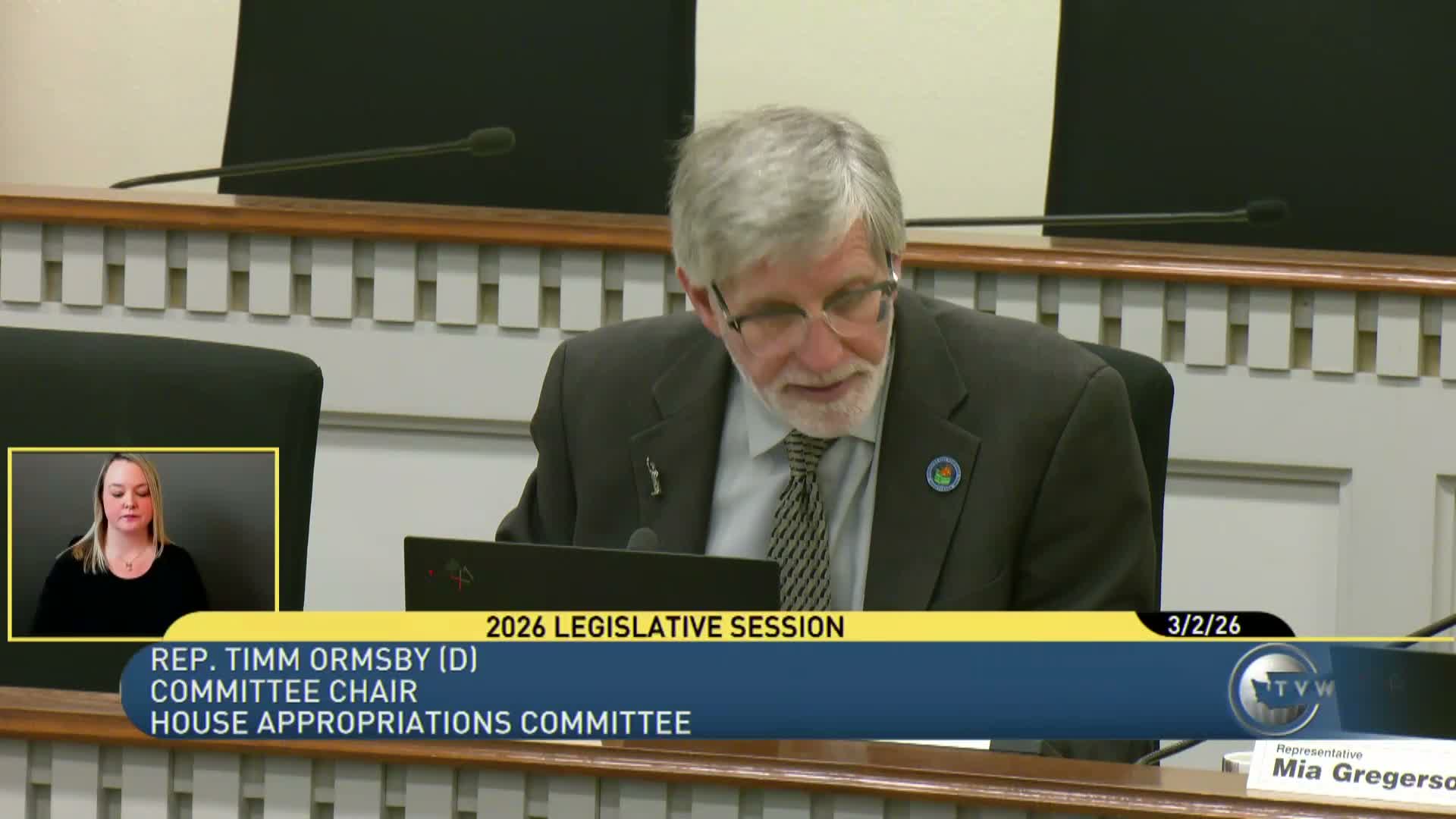
Staff to the committee Briefed the committee on substitute Senate Bill 58 28, explaining that the bill would change how Washington College Grant and College Bound awards are calculated for private, not‑for‑profit four‑year institutions. Kate Henry, staff to the committee, said the substitute would calculate private nonprofit awards at 90% of the regional and state college rate rather than 50% of the research rate and cited the bill's fiscal estimate: "The fiscal impact of the bill before you was $3,300,000 in fiscal year 27 and $18,600,000 in GF0 over the 4 year," she said.
The committee then heard public testimony from campus leaders and student speakers who said the cuts enacted last session made private colleges unaffordable for many recipients of the college grant and college bound scholarship. Alan Belton, president of Pacific Lutheran University, told the committee: "There is a clear path for the legislature to restore the cuts to student financial aid without picking winners or losers or raising taxes." Belton said PLU covers remaining tuition costs for college‑bound students and that, without restored state aid, the institution's fixed tuition guarantee and support for those students becomes unsustainable.
Student speakers described the personal effect of last year's reductions. Carla Navarro, a fourth‑year political science student at Seattle Pacific University, said the changes would "disproportionately impact 7,000 students who are students of color" and argued the reductions undermine students' ability to choose the institution that fits them. Christopher Rosenquist, representing students at Western Washington University, said he does not oppose the bill for private institutions but called for restoring cuts to public‑school awards, noting a "40% loss in award amounts" for public students in the 2025‑27 biennial budget.
Members of the committee asked clarifying questions about whether the substitute would make students already promised aid whole and whether the bill should also reverse cuts for public institutions. The staff memo and testimony noted the Senate budget would fully fund the substitute's estimated cost.
The Appropriations Committee later considered an amendment (Henry 154/155) to add eligibility criteria for certain branch campuses and accepted a corrected technical fix. By the end of the session, the committee reported substitute Senate Bill 58 28 out of committee with a due‑pass recommendation.
Why it matters: The Washington College Grant and College Bound scholarship are among the state's main tools for increasing postsecondary access for low‑income and first‑generation students. Restoring or reshaping awards affects which institutions students can afford and how state appropriations are allocated.
What's next: The bill was reported from the Appropriations Committee with a due‑pass recommendation and will move to the House floor for further consideration.
The committee then heard public testimony from campus leaders and student speakers who said the cuts enacted last session made private colleges unaffordable for many recipients of the college grant and college bound scholarship. Alan Belton, president of Pacific Lutheran University, told the committee: "There is a clear path for the legislature to restore the cuts to student financial aid without picking winners or losers or raising taxes." Belton said PLU covers remaining tuition costs for college‑bound students and that, without restored state aid, the institution's fixed tuition guarantee and support for those students becomes unsustainable.
Student speakers described the personal effect of last year's reductions. Carla Navarro, a fourth‑year political science student at Seattle Pacific University, said the changes would "disproportionately impact 7,000 students who are students of color" and argued the reductions undermine students' ability to choose the institution that fits them. Christopher Rosenquist, representing students at Western Washington University, said he does not oppose the bill for private institutions but called for restoring cuts to public‑school awards, noting a "40% loss in award amounts" for public students in the 2025‑27 biennial budget.
Members of the committee asked clarifying questions about whether the substitute would make students already promised aid whole and whether the bill should also reverse cuts for public institutions. The staff memo and testimony noted the Senate budget would fully fund the substitute's estimated cost.
The Appropriations Committee later considered an amendment (Henry 154/155) to add eligibility criteria for certain branch campuses and accepted a corrected technical fix. By the end of the session, the committee reported substitute Senate Bill 58 28 out of committee with a due‑pass recommendation.
Why it matters: The Washington College Grant and College Bound scholarship are among the state's main tools for increasing postsecondary access for low‑income and first‑generation students. Restoring or reshaping awards affects which institutions students can afford and how state appropriations are allocated.
What's next: The bill was reported from the Appropriations Committee with a due‑pass recommendation and will move to the House floor for further consideration.
Don't Miss a Word: See the Full Meeting!
Go beyond summaries. Unlock every video, transcript, and key insight with a Founder Membership.
✓
Get instant access to full meeting videos
✓
Search and clip any phrase from complete transcripts
✓
Receive AI-powered summaries & custom alerts
✓
Enjoy lifetime, unrestricted access to government data
30-day money-back guarantee
