IT lays out $47.8M recommended budget, proposes multi-year ERP and CRM investments under new TIP
September 14, 2024 | Minneapolis City, Hennepin County, Minnesota
This article was created by AI summarizing key points discussed. AI makes mistakes, so for full details and context, please refer to the video of the full meeting. Please report any errors so we can fix them. Report an error »
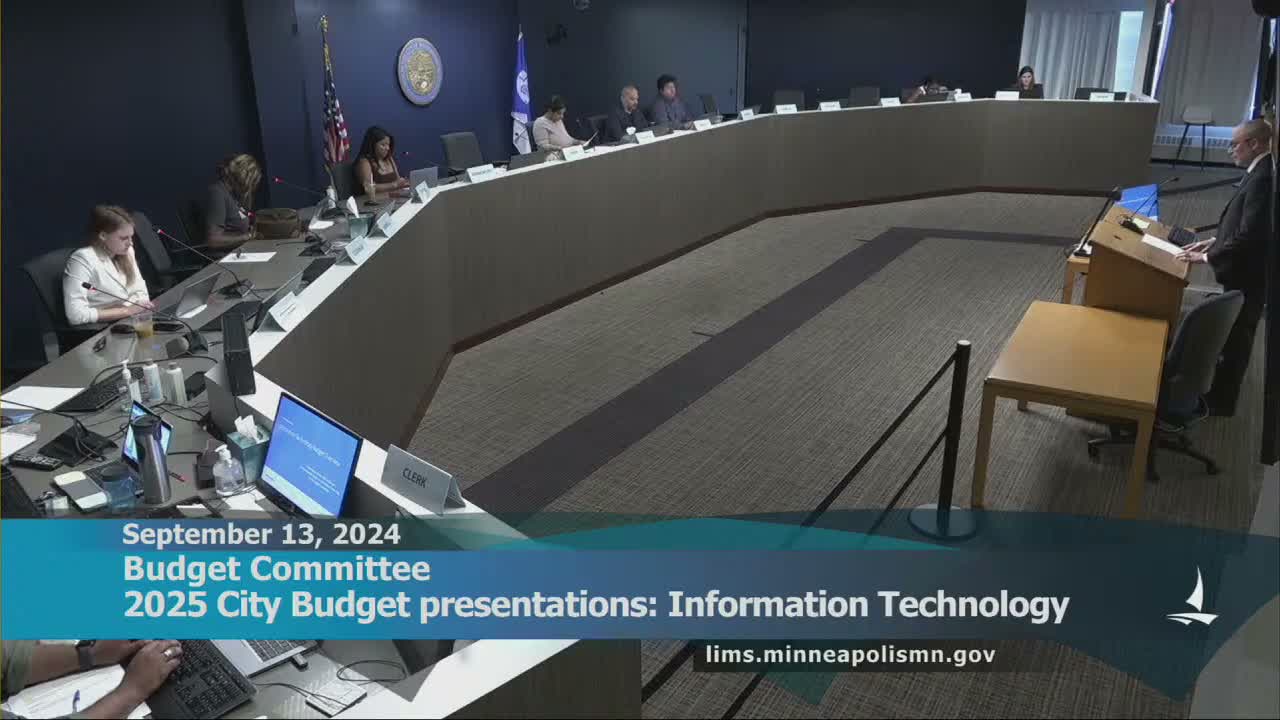
Paul Cameron, the city's Chief Information Officer, presented the Information Technology department's recommended 2025 budget to the Minneapolis Budget Committee on Sept. 13, highlighting the creation of a Technology Improvement Plan (TIP) and several multi-year technology projects.
Cameron said the IT department is proposed at 108 FTEs in 2025 with 12 current vacancies and put the recommended 2025 budget for IT at approximately $47,800,000. He framed three priority objectives: maintain system health, strengthen cybersecurity posture and promote enterprise platform adoption to reduce duplication across departments.
TIP projects highlighted
- A new CRM for 3-1-1: Cameron said the team has started planning and stakeholder engagement, with an RFP targeted for 2025. He said the TIP request for this initiative is $1,250,000 in 2025, about $3,000,000 in 2026 and $1,580,000 in 2027 to cover licensing and implementation costs.
- ERP replacement (COMET): Cameron described a multi-year ERP replacement to modernize HR, payroll and finance systems. The TIP asks for $5,000,000 in 2025, $6,000,000 in 2026 and $3,000,000 in 2027 for implementation and licensing. He said vendor demos involved more than 50 city employees and that implementation planning is under way with a goal to begin implementation in 2025.
- Conference room modernization: a technology and FTE component; Cameron said the FTE cost in 2025 would be approximately $121,246 from the general fund (shifting to the IT internal service fund in 2026).
- Microsoft Copilot and AI governance: Cameron proposed phased licensing and governance funds (roughly $300,000 in 2025, rising to $500,000 by 2027) to enable secure enterprise use of AI productivity tools.
- Enterprise engagement platform and regulatory software: requests included $250,000 in 2025 for an engagement tool and Tolimi building blocks software for Regulatory Services ($89,125 in 2025; $71,000 in 2026). Cameron also presented a proposal to fund Loring Greenway infrastructure rehabilitation ($1,500,000 in 2027) through the permanent improvement levy as part of TIP.
Cameron discussed accomplishments and risks: IT refreshed more than 700 computers, replaced switches and access points, rolled out multi-factor authentication and increased automation of repetitive tasks; he flagged attracting and retaining talent and evolving cybersecurity threats as ongoing risks.
On integration and data strategy Cameron explained the city's preference for integrating systems to a centralized data repository (analytics hub) rather than a web of point-to-point system integrations. Asked about policy-management tools, he said the Minneapolis Police Department pursued a specialized tool for settlement-agreement needs; that tool could be leveraged enterprise-wide but would require substantial expansion in scope and cost.
On ERP costs Cameron responded to council questions about accuracy and scope. He said initial RFP responses suggested licensing could be "north of $2,000,000 a year" based on comparable examples, and he also explained that licensing should be viewed as a portion of total software costs. He described a planning range where ongoing licensing might translate to roughly 10-20% of total software cost, which he characterized in different ways during the exchange to explain uncertainty while negotiations and the RFP process proceed: "implementing a new ERP system is probably one of the most difficult things that an enterprise can do," he said, adding that the city will have a clearer timeline once an implementation partner is selected.
Why it matters: The TIP establishes a multi-year financing and governance path for major city technology projects. The ERP and CRM items have citywide reach—affecting payroll, HR, finance, constituent services and interdepartmental workflows—and carry significant implementation complexity and recurring costs.
Next steps: Council members requested the TIP scoring rubric, documentation of scoring results, and administrative follow-up on which projects were evaluated and why some requests were moved to operational budgets. Staff said they would provide the rubric and additional documentation. No TIP projects were adopted at the meeting; staff will return with further details as budget adoption approaches.
Ending: The committee filed the presentations and adjourned after asking staff for follow-up material on costs, scopes, and the rubric used to evaluate TIP requests.
Cameron said the IT department is proposed at 108 FTEs in 2025 with 12 current vacancies and put the recommended 2025 budget for IT at approximately $47,800,000. He framed three priority objectives: maintain system health, strengthen cybersecurity posture and promote enterprise platform adoption to reduce duplication across departments.
TIP projects highlighted
- A new CRM for 3-1-1: Cameron said the team has started planning and stakeholder engagement, with an RFP targeted for 2025. He said the TIP request for this initiative is $1,250,000 in 2025, about $3,000,000 in 2026 and $1,580,000 in 2027 to cover licensing and implementation costs.
- ERP replacement (COMET): Cameron described a multi-year ERP replacement to modernize HR, payroll and finance systems. The TIP asks for $5,000,000 in 2025, $6,000,000 in 2026 and $3,000,000 in 2027 for implementation and licensing. He said vendor demos involved more than 50 city employees and that implementation planning is under way with a goal to begin implementation in 2025.
- Conference room modernization: a technology and FTE component; Cameron said the FTE cost in 2025 would be approximately $121,246 from the general fund (shifting to the IT internal service fund in 2026).
- Microsoft Copilot and AI governance: Cameron proposed phased licensing and governance funds (roughly $300,000 in 2025, rising to $500,000 by 2027) to enable secure enterprise use of AI productivity tools.
- Enterprise engagement platform and regulatory software: requests included $250,000 in 2025 for an engagement tool and Tolimi building blocks software for Regulatory Services ($89,125 in 2025; $71,000 in 2026). Cameron also presented a proposal to fund Loring Greenway infrastructure rehabilitation ($1,500,000 in 2027) through the permanent improvement levy as part of TIP.
Cameron discussed accomplishments and risks: IT refreshed more than 700 computers, replaced switches and access points, rolled out multi-factor authentication and increased automation of repetitive tasks; he flagged attracting and retaining talent and evolving cybersecurity threats as ongoing risks.
On integration and data strategy Cameron explained the city's preference for integrating systems to a centralized data repository (analytics hub) rather than a web of point-to-point system integrations. Asked about policy-management tools, he said the Minneapolis Police Department pursued a specialized tool for settlement-agreement needs; that tool could be leveraged enterprise-wide but would require substantial expansion in scope and cost.
On ERP costs Cameron responded to council questions about accuracy and scope. He said initial RFP responses suggested licensing could be "north of $2,000,000 a year" based on comparable examples, and he also explained that licensing should be viewed as a portion of total software costs. He described a planning range where ongoing licensing might translate to roughly 10-20% of total software cost, which he characterized in different ways during the exchange to explain uncertainty while negotiations and the RFP process proceed: "implementing a new ERP system is probably one of the most difficult things that an enterprise can do," he said, adding that the city will have a clearer timeline once an implementation partner is selected.
Why it matters: The TIP establishes a multi-year financing and governance path for major city technology projects. The ERP and CRM items have citywide reach—affecting payroll, HR, finance, constituent services and interdepartmental workflows—and carry significant implementation complexity and recurring costs.
Next steps: Council members requested the TIP scoring rubric, documentation of scoring results, and administrative follow-up on which projects were evaluated and why some requests were moved to operational budgets. Staff said they would provide the rubric and additional documentation. No TIP projects were adopted at the meeting; staff will return with further details as budget adoption approaches.
Ending: The committee filed the presentations and adjourned after asking staff for follow-up material on costs, scopes, and the rubric used to evaluate TIP requests.
View the Full Meeting & All Its Details
This article offers just a summary. Unlock complete video, transcripts, and insights as a Founder Member.
✓
Watch full, unedited meeting videos
✓
Search every word spoken in unlimited transcripts
✓
AI summaries & real-time alerts (all government levels)
✓
Permanent access to expanding government content
30-day money-back guarantee
