Falmouth board continues review of 2 Solar Way building‑permit request and composting‑toilet proposal
March 03, 2026 | Town of Falmouth, Barnstable County, Massachusetts
This article was created by AI summarizing key points discussed. AI makes mistakes, so for full details and context, please refer to the video of the full meeting. Please report any errors so we can fix them. Report an error »
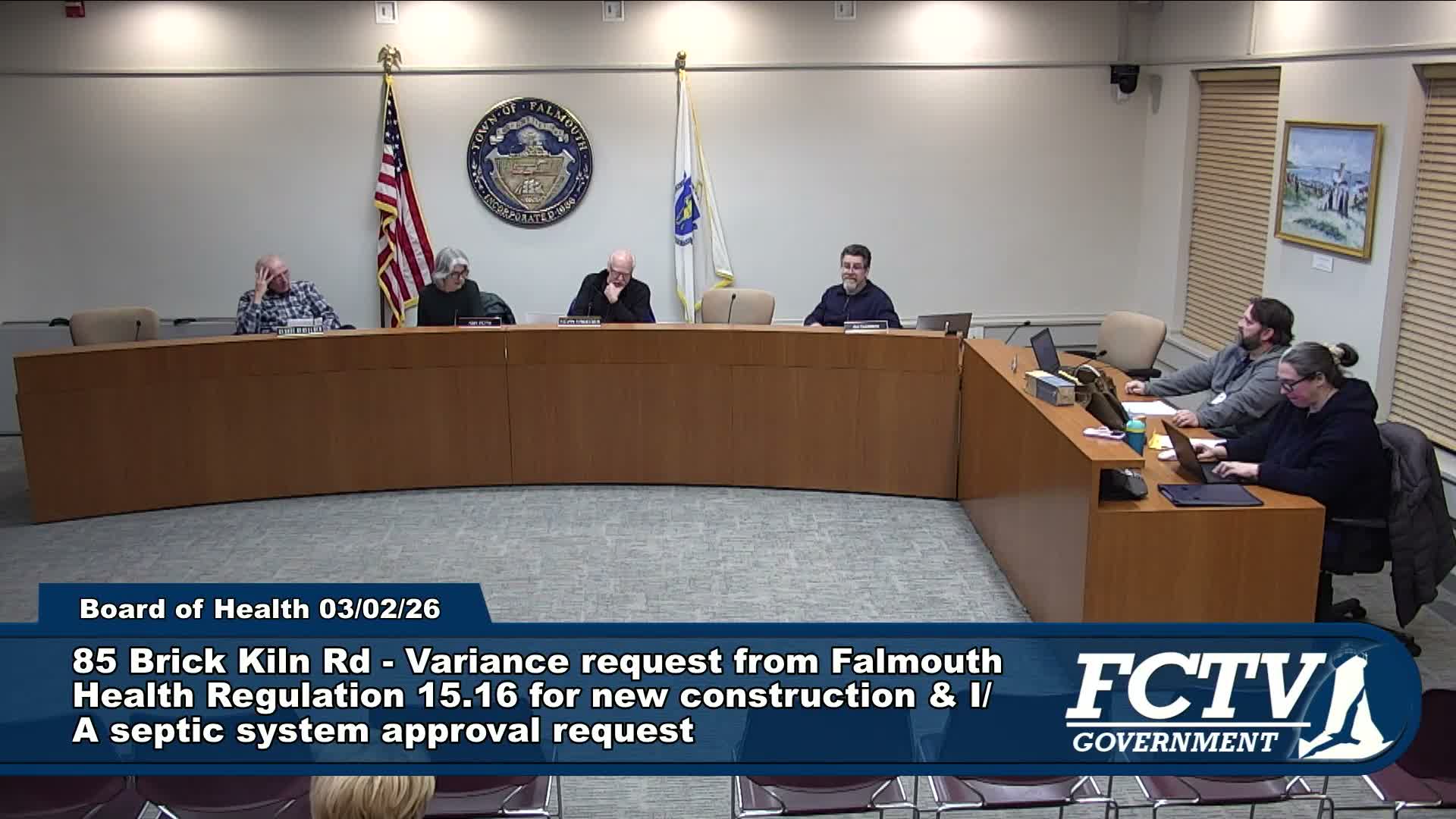
The Falmouth Board of Health continued its review of a building‑permit/room‑determination and variance request for 2 Solar Way after receiving technical briefings and noting missing documentation from the applicant. Staff and board members focused on whether a proposed composting‑toilet configuration increases nitrogen loading to the existing septic system, how liquid residuals (often called “tea”) are handled, and what monitoring or removal systems would protect local groundwater.
Staff explained that composting toilets can generate a liquid fraction that may be pumped to the septic or managed off‑site; board members asked whether that liquid currently discharges to the septic system at the property and, if so, whether the town’s mass‑loading options and monitoring would reflect that contribution. Board members repeatedly emphasized the need to know whether tea and sludge will be removed to an approved facility and whether the system will include alarms and records to ensure removal occurs.
Several members proposed collecting monitoring data at the distribution box (d‑box) and requiring at least one year of monthly certified monitoring to assess efficacy before recognizing composting systems as equivalent to technologies on the DEP banner list. The board discussed vacu‑flush or wet‑flush options and off‑site hauling and recommended clarifying plumbing details and a plan that guarantees safe disposal of residuals before the item returns.
Why it matters: Composting toilets are being considered as a low‑cost nitrogen‑reduction option, but their liquid and solid residuals raise questions about monitoring, cost and operational oversight. The board said it wants clear, verifiable practices for managing residuals before granting variances for increased flow.
The board moved and seconded a continuance; staff will follow up with plumbing‑permit documentation, the applicant’s plan for tea and sludge handling, cost estimates for off‑site removal, and assurances about monitoring and potential alarm/reporting features.
Staff explained that composting toilets can generate a liquid fraction that may be pumped to the septic or managed off‑site; board members asked whether that liquid currently discharges to the septic system at the property and, if so, whether the town’s mass‑loading options and monitoring would reflect that contribution. Board members repeatedly emphasized the need to know whether tea and sludge will be removed to an approved facility and whether the system will include alarms and records to ensure removal occurs.
Several members proposed collecting monitoring data at the distribution box (d‑box) and requiring at least one year of monthly certified monitoring to assess efficacy before recognizing composting systems as equivalent to technologies on the DEP banner list. The board discussed vacu‑flush or wet‑flush options and off‑site hauling and recommended clarifying plumbing details and a plan that guarantees safe disposal of residuals before the item returns.
Why it matters: Composting toilets are being considered as a low‑cost nitrogen‑reduction option, but their liquid and solid residuals raise questions about monitoring, cost and operational oversight. The board said it wants clear, verifiable practices for managing residuals before granting variances for increased flow.
The board moved and seconded a continuance; staff will follow up with plumbing‑permit documentation, the applicant’s plan for tea and sludge handling, cost estimates for off‑site removal, and assurances about monitoring and potential alarm/reporting features.
Don't Miss a Word: See the Full Meeting!
Go beyond summaries. Unlock every video, transcript, and key insight with a Founder Membership.
✓
Get instant access to full meeting videos
✓
Search and clip any phrase from complete transcripts
✓
Receive AI-powered summaries & custom alerts
✓
Enjoy lifetime, unrestricted access to government data
30-day money-back guarantee
