Board grants Stop & Shop variances for select plastic categories, urges continued search for alternatives
March 03, 2026 | Town of Falmouth, Barnstable County, Massachusetts
This article was created by AI summarizing key points discussed. AI makes mistakes, so for full details and context, please refer to the video of the full meeting. Please report any errors so we can fix them. Report an error »
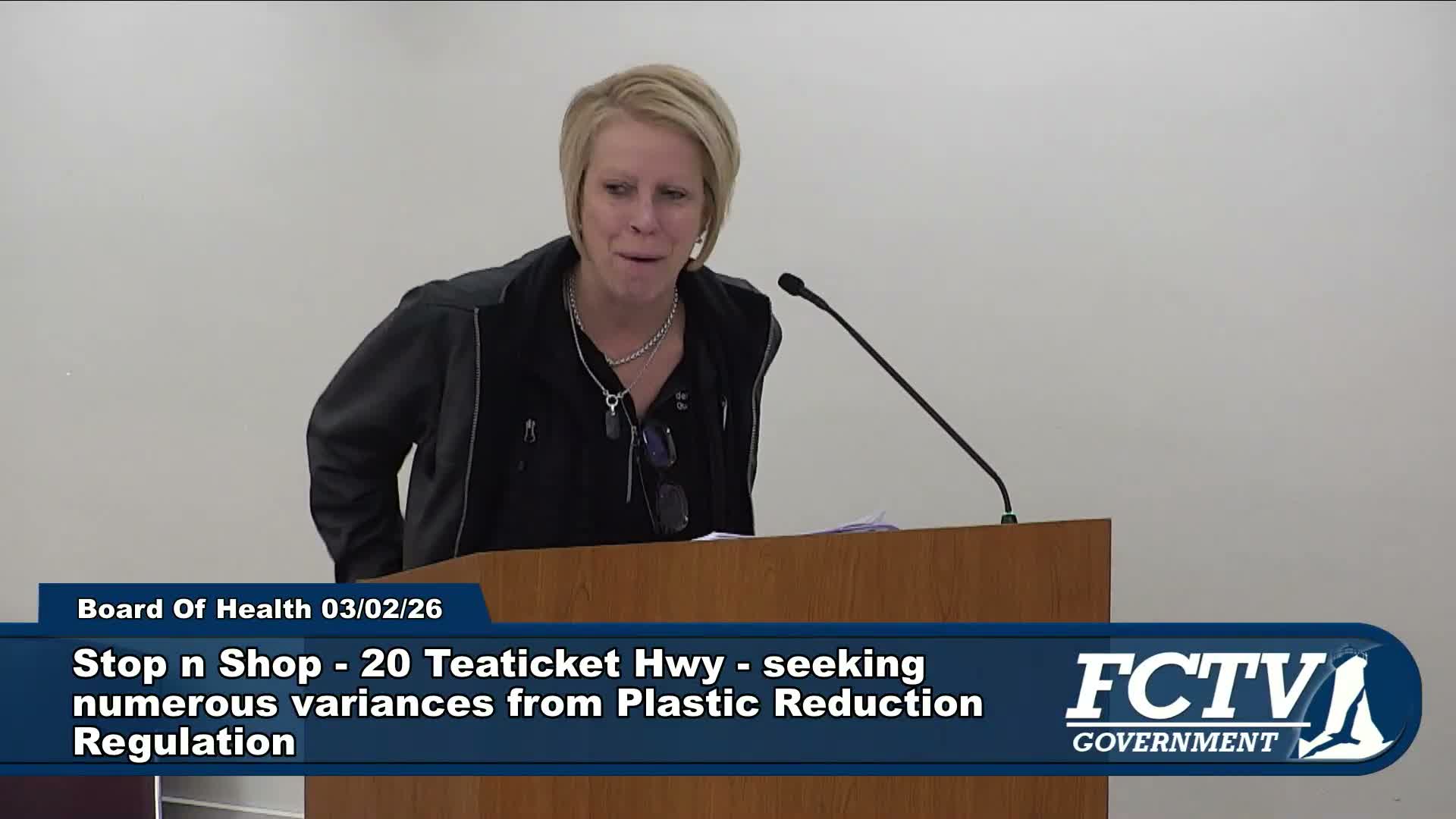
Stop & Shop presented to the Falmouth Board of Health on March 2 seeking waivers from parts of the town’s plastic‑reduction regulation for products the chain said currently have no practical substitutes at scale. Christina Dwyer, who identified herself as the company’s director of food safety, said the retailer had received internal waivers for some categories but sought board approval for other categories (notably LDPE deli bags and co‑extruded materials used for rotisserie chicken and some bakery windows).
Dwyer told the board that Stop & Shop and its supply teams were researching alternatives but that some items require hot‑holding characteristics and longer shelf life, which limits available substitutes: "We try to look at it at things more globally to try to look at alternatives" she said, explaining the difficulty of changing packaging across a 360‑store chain. Board members pressed about specific alternatives (cardboard clamshells with windows, PET substitution for foam trays) and flagged black plastic as a recycling problem because optical sorters cannot detect it.
After deliberation the board voted to grant variances for the LDPE deli bags (category 4) and co‑extruded materials (category 7), finding Stop & Shop had demonstrated efforts to identify substitutes and that immediate alternatives were limited for those product types. Members also asked the company to continue seeking alternatives (including non‑black colors) and to report back on progress.
Why it matters: The decision balances town environmental goals with practical food‑safety and shelf‑life constraints cited by a large retailer. The board’s variance is narrowly tailored to specific material categories and urges continued supplier engagement and substitution where feasible.
The board recorded the motion, second and vote in the meeting; staff will document the variances and monitor the company’s progress on substitutes.
Dwyer told the board that Stop & Shop and its supply teams were researching alternatives but that some items require hot‑holding characteristics and longer shelf life, which limits available substitutes: "We try to look at it at things more globally to try to look at alternatives" she said, explaining the difficulty of changing packaging across a 360‑store chain. Board members pressed about specific alternatives (cardboard clamshells with windows, PET substitution for foam trays) and flagged black plastic as a recycling problem because optical sorters cannot detect it.
After deliberation the board voted to grant variances for the LDPE deli bags (category 4) and co‑extruded materials (category 7), finding Stop & Shop had demonstrated efforts to identify substitutes and that immediate alternatives were limited for those product types. Members also asked the company to continue seeking alternatives (including non‑black colors) and to report back on progress.
Why it matters: The decision balances town environmental goals with practical food‑safety and shelf‑life constraints cited by a large retailer. The board’s variance is narrowly tailored to specific material categories and urges continued supplier engagement and substitution where feasible.
The board recorded the motion, second and vote in the meeting; staff will document the variances and monitor the company’s progress on substitutes.
Don't Miss a Word: See the Full Meeting!
Go beyond summaries. Unlock every video, transcript, and key insight with a Founder Membership.
✓
Get instant access to full meeting videos
✓
Search and clip any phrase from complete transcripts
✓
Receive AI-powered summaries & custom alerts
✓
Enjoy lifetime, unrestricted access to government data
30-day money-back guarantee
