Defense urges Court of Appeals to reverse juror strike in Robert Clifton appeal; state disputes racial‑bias claim
March 03, 2026 | Legislative Ethics Board, Legislative Agencies, Legislative Sessions, Washington
This article was created by AI summarizing key points discussed. AI makes mistakes, so for full details and context, please refer to the video of the full meeting. Please report any errors so we can fix them. Report an error »
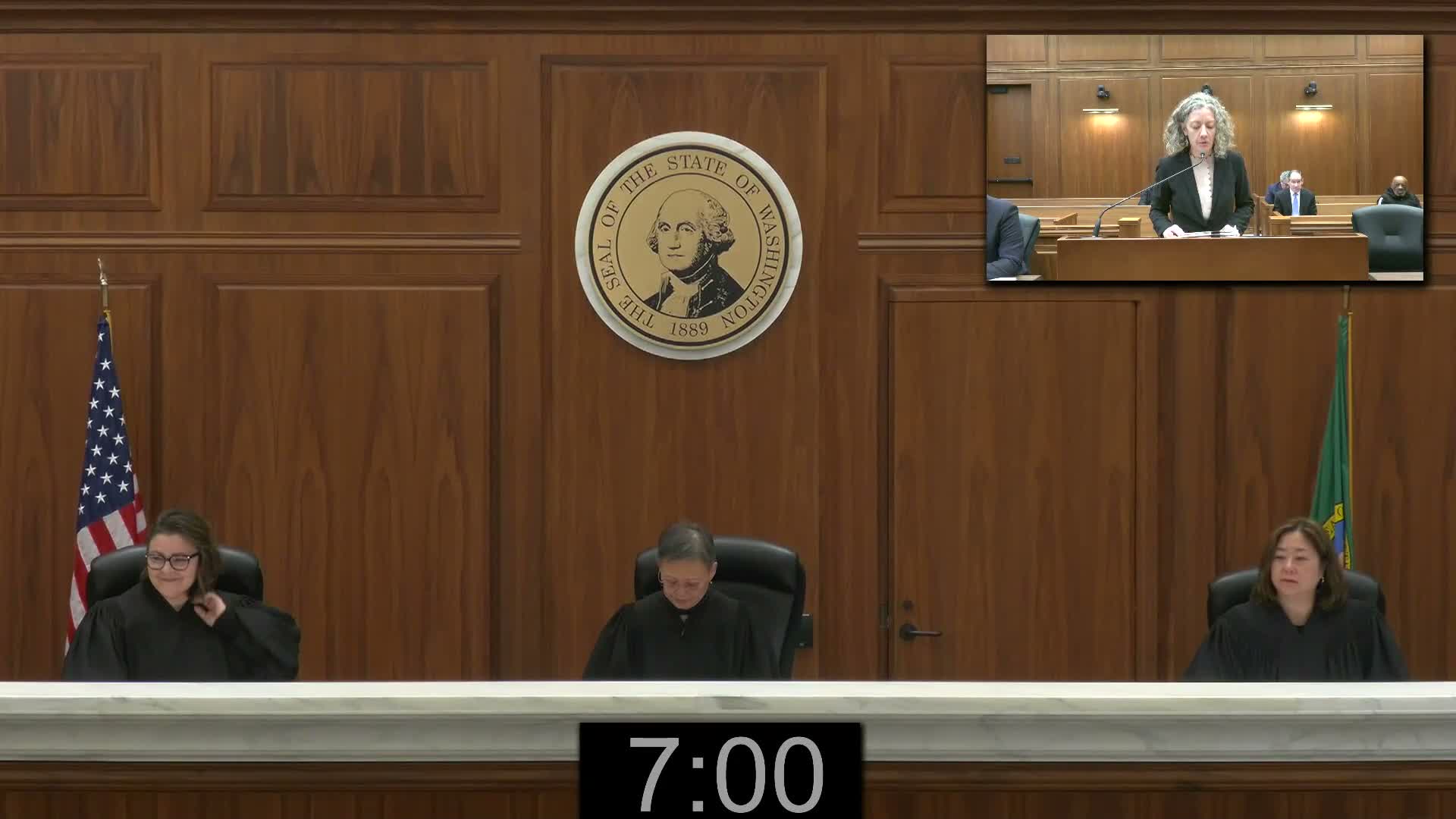
At oral argument before the Court of Appeals Division 1, defense attorney Aaron Moody asked the panel to reverse a trial court ruling under GR 37, saying the prosecutor’s peremptory strike of juror 104 had the effect of excluding perspectives needed to ensure equal protection. "Mr. Clifton is a black man accused of [redacted] assaulting a white woman," Moody said, urging the court to apply the GR 37 objective‑observer standard and review the totality of voir dire.
Moody told the court the record shows the prosecutor relied on juror 104’s status as an attorney as a race‑neutral reason, but argued that reason was pretextual given the voir dire exchanges and the composition of the seated panel. He pointed to officers’ testimony and body‑camera recordings introduced at trial, and said those facts made jurors’ attitudes toward law enforcement central to jury selection in this case.
The state, through Gabriel Jacobs, countered that the record does not support a finding of purposeful or effectual racial exclusion. "The state only used 1 of 8 peremptory challenges on any juror of color," Jacobs said, and noted that several jurors of color ultimately deliberated in the case. Jacobs argued the prosecutor had legitimate reasons to prefer jurors who, based on their voir dire answers, were unlikely to accept the defense theory that the allegations were fabricated. He cited voir dire statements from jurors 21 and 90 indicating strong tendencies to credit the victim’s account.
The panel questioned counsel about whether the prosecutor followed up with juror 104 about litigation experience and control of deliberations, and about the significance of other jurors’ answers. A panel judge pointed out that juror 85 — who said, "I think cops are [expletive] people" — served on the jury, asking whether that undermined the state’s explanation that attitudes about police were not a primary selection factor. Jacobs responded that much of the officers’ testimony was captured on video and that the record showed the prosecutor’s concern was juror receptiveness to the defense theory rather than race.
Moody pressed that the practical effect mattered under GR 37: the seated jury, he said, was "devoid of any person at all who disclosed any meaningful personal experience with law enforcement" and lacked persons of color who expressed skepticism about police — an outcome he said demonstrated the discriminatory effect GR 37 guards against. The defense argued prior case law requires the court to treat certain stated reasons as presumptively invalid when they function to exclude protected groups.
After further exchanges on precedent and the meaning of GR 37’s listed factors, both sides rested their arguments and the court announced the matter was submitted.
The court did not announce a decision at the hearing; it took the GR 37 challenge under submission for later disposition.
Moody told the court the record shows the prosecutor relied on juror 104’s status as an attorney as a race‑neutral reason, but argued that reason was pretextual given the voir dire exchanges and the composition of the seated panel. He pointed to officers’ testimony and body‑camera recordings introduced at trial, and said those facts made jurors’ attitudes toward law enforcement central to jury selection in this case.
The state, through Gabriel Jacobs, countered that the record does not support a finding of purposeful or effectual racial exclusion. "The state only used 1 of 8 peremptory challenges on any juror of color," Jacobs said, and noted that several jurors of color ultimately deliberated in the case. Jacobs argued the prosecutor had legitimate reasons to prefer jurors who, based on their voir dire answers, were unlikely to accept the defense theory that the allegations were fabricated. He cited voir dire statements from jurors 21 and 90 indicating strong tendencies to credit the victim’s account.
The panel questioned counsel about whether the prosecutor followed up with juror 104 about litigation experience and control of deliberations, and about the significance of other jurors’ answers. A panel judge pointed out that juror 85 — who said, "I think cops are [expletive] people" — served on the jury, asking whether that undermined the state’s explanation that attitudes about police were not a primary selection factor. Jacobs responded that much of the officers’ testimony was captured on video and that the record showed the prosecutor’s concern was juror receptiveness to the defense theory rather than race.
Moody pressed that the practical effect mattered under GR 37: the seated jury, he said, was "devoid of any person at all who disclosed any meaningful personal experience with law enforcement" and lacked persons of color who expressed skepticism about police — an outcome he said demonstrated the discriminatory effect GR 37 guards against. The defense argued prior case law requires the court to treat certain stated reasons as presumptively invalid when they function to exclude protected groups.
After further exchanges on precedent and the meaning of GR 37’s listed factors, both sides rested their arguments and the court announced the matter was submitted.
The court did not announce a decision at the hearing; it took the GR 37 challenge under submission for later disposition.
View the Full Meeting & All Its Details
This article offers just a summary. Unlock complete video, transcripts, and insights as a Founder Member.
✓
Watch full, unedited meeting videos
✓
Search every word spoken in unlimited transcripts
✓
AI summaries & real-time alerts (all government levels)
✓
Permanent access to expanding government content
30-day money-back guarantee
