Orange County reviews infrastructure surtax plan after Trust for Public Land polling; no consensus to advance in 2026
March 03, 2026 | Orange County, Florida
This article was created by AI summarizing key points discussed. AI makes mistakes, so for full details and context, please refer to the video of the full meeting. Please report any errors so we can fix them. Report an error »
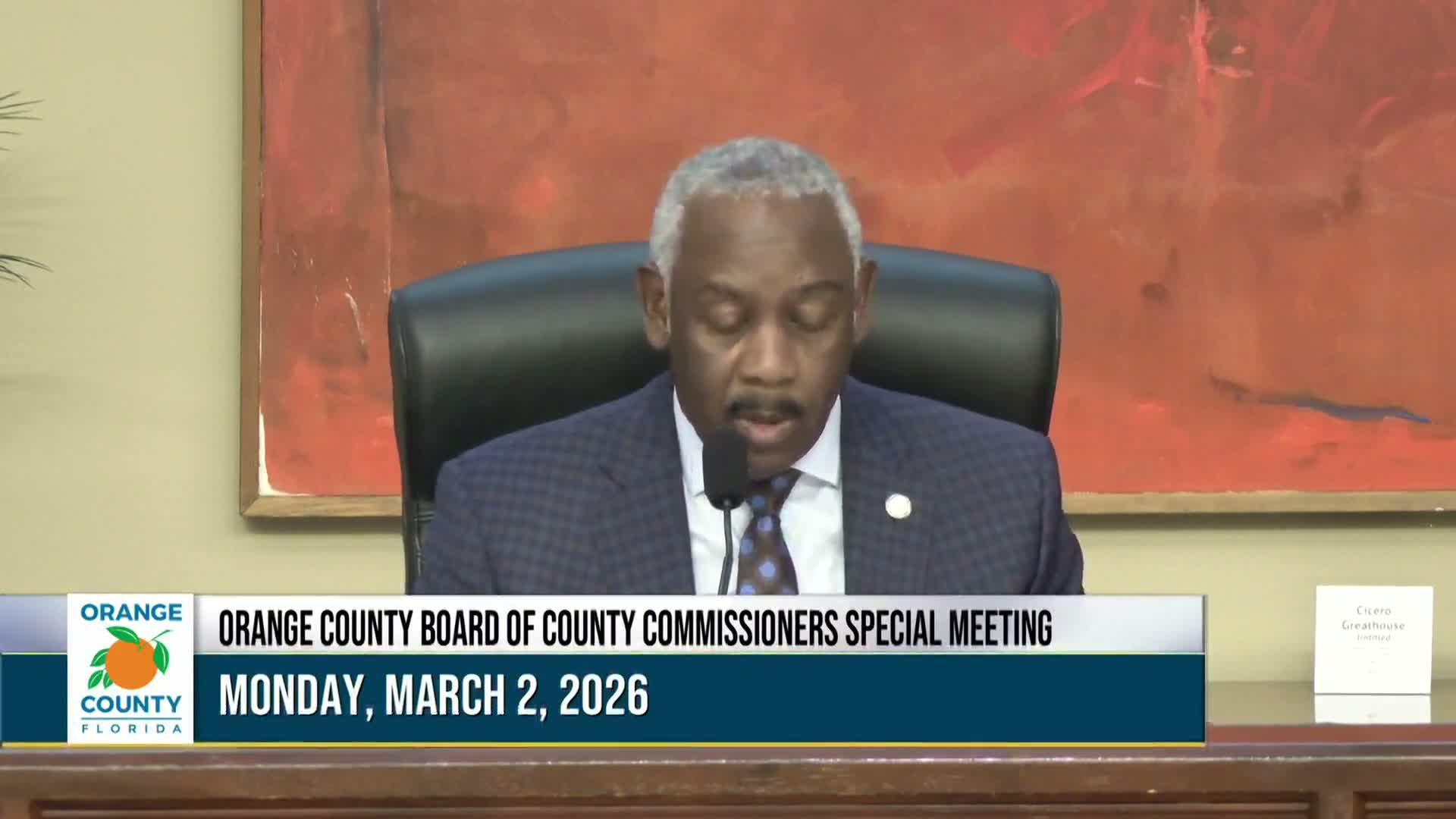
Orange County commissioners heard a detailed presentation on a proposed local infrastructure surtax on March 2, as staff and a Trust for Public Land consultant outlined projected revenue, voter polling and possible uses ranging from conservation land and stormwater to transit improvements.
The county administrator, Byron Brooks, opened the staff briefing and turned the presentation over to a Trust for Public Land representative, who said a feasibility study and a poll of roughly 800 Orange County voters showed broad support for some surtax uses. The consultant said a full 1% sales surtax would raise an estimated $758 million a year in Orange County while a half-cent would be roughly $379 million a year; the analysis estimated residents would pay about 11% of revenue, with an average household bearing about $169 a year for a 1% levy and about $85 a year for a half-cent levy.
Why it matters: the surtax—if approved by voters—would create a dedicated revenue source the county could use for capital projects such as water-quality and stormwater improvements, parks and land conservation, road resurfacing and transit capital. Staff emphasized that ballot language, duration and the choice between a half‑cent and full cent will shape both how much can be done and how voters perceive the proposal.
The presentation covered polling details and voting scenarios. The Trust for Public Land representative described the firm’s methodology (live phone and text-to-web interviews in English and Spanish) and said the half-cent option tested strongest (about 62% support in the poll reported). He also read a draft 75‑word ballot summary that included acquisition and protection of land for water quality and recreation, repairing roads, supporting rail and transit projects, funding affordable‑housing land acquisition and other authorized infrastructure uses. He noted that Florida statute 212.0552(d)(3) requires certain economic-development language if the surtax is to be used for some affordable‑housing or transit-operational purposes.
Commissioners pressed staff on key details. Mayor Demings and multiple commissioners asked how much of the surtax would be paid by visitors and nonresidents; staff said the county’s last estimate of nonresident share was about 50% but that the Trust for Public Land poll did not directly apportion revenue by visitors. Legal and staff advisers clarified that acquiring land for affordable housing is permitted without invoking the economic‑development language, but building housing or covering some operations would typically require that statutory phrasing.
Board concerns centered on timing and accountability. Several commissioners urged a shorter, narrowly framed measure focused on conservation and parks—citing Orange County’s track record of voter support for land‑protection measures—while others argued the county should include broader transportation and housing uses to reach more voters. Commissioners also flagged rising construction costs, the substantial capital needs presented by staff (estimates in the billions across categories), and the effect of possible state property‑tax reforms on voter appetite and county budgeting.
No final vote; next steps uncertain. After extended discussion about rate (half‑cent vs. full cent), duration (10–30 years), local oversight and campaign requirements (independent audits, citizen oversight and a funded campaign effort), the mayor concluded the board did not have sufficient consensus to move forward for the 2026 schedule and asked staff to pause further drafting. Commissioners agreed to consider additional community outreach, more detailed project lists by district, and the possibility of revisiting the matter for a future election cycle.
Quotable: Trust for Public Land on resident cost estimates—“The average household, a 1% of the tax is about a $169 per year. Half a cent is about half of that, $85.” (Trust for Public Land representative). Mayor Demings framed the political challenge: “We have to say what we mean and mean what we say, when we're talking to the members of the public.”
What remains unresolved: the board did not adopt final ballot language or a rate/duration, and legal counsel and staff said any measure would also need to address required statutory language, municipal shares (about 30% of surtax revenue by statute), and the Office of Program Policy Analysis and Government Accountability (OPPAGA) audit and reporting schedule that drives the May milestone for a 2026 referendum.
The board adjourned after the discussion with direction to staff to pause and return with further analysis and community engagement options if commissioners want to revive the measure for a later ballot.
The county administrator, Byron Brooks, opened the staff briefing and turned the presentation over to a Trust for Public Land representative, who said a feasibility study and a poll of roughly 800 Orange County voters showed broad support for some surtax uses. The consultant said a full 1% sales surtax would raise an estimated $758 million a year in Orange County while a half-cent would be roughly $379 million a year; the analysis estimated residents would pay about 11% of revenue, with an average household bearing about $169 a year for a 1% levy and about $85 a year for a half-cent levy.
Why it matters: the surtax—if approved by voters—would create a dedicated revenue source the county could use for capital projects such as water-quality and stormwater improvements, parks and land conservation, road resurfacing and transit capital. Staff emphasized that ballot language, duration and the choice between a half‑cent and full cent will shape both how much can be done and how voters perceive the proposal.
The presentation covered polling details and voting scenarios. The Trust for Public Land representative described the firm’s methodology (live phone and text-to-web interviews in English and Spanish) and said the half-cent option tested strongest (about 62% support in the poll reported). He also read a draft 75‑word ballot summary that included acquisition and protection of land for water quality and recreation, repairing roads, supporting rail and transit projects, funding affordable‑housing land acquisition and other authorized infrastructure uses. He noted that Florida statute 212.0552(d)(3) requires certain economic-development language if the surtax is to be used for some affordable‑housing or transit-operational purposes.
Commissioners pressed staff on key details. Mayor Demings and multiple commissioners asked how much of the surtax would be paid by visitors and nonresidents; staff said the county’s last estimate of nonresident share was about 50% but that the Trust for Public Land poll did not directly apportion revenue by visitors. Legal and staff advisers clarified that acquiring land for affordable housing is permitted without invoking the economic‑development language, but building housing or covering some operations would typically require that statutory phrasing.
Board concerns centered on timing and accountability. Several commissioners urged a shorter, narrowly framed measure focused on conservation and parks—citing Orange County’s track record of voter support for land‑protection measures—while others argued the county should include broader transportation and housing uses to reach more voters. Commissioners also flagged rising construction costs, the substantial capital needs presented by staff (estimates in the billions across categories), and the effect of possible state property‑tax reforms on voter appetite and county budgeting.
No final vote; next steps uncertain. After extended discussion about rate (half‑cent vs. full cent), duration (10–30 years), local oversight and campaign requirements (independent audits, citizen oversight and a funded campaign effort), the mayor concluded the board did not have sufficient consensus to move forward for the 2026 schedule and asked staff to pause further drafting. Commissioners agreed to consider additional community outreach, more detailed project lists by district, and the possibility of revisiting the matter for a future election cycle.
Quotable: Trust for Public Land on resident cost estimates—“The average household, a 1% of the tax is about a $169 per year. Half a cent is about half of that, $85.” (Trust for Public Land representative). Mayor Demings framed the political challenge: “We have to say what we mean and mean what we say, when we're talking to the members of the public.”
What remains unresolved: the board did not adopt final ballot language or a rate/duration, and legal counsel and staff said any measure would also need to address required statutory language, municipal shares (about 30% of surtax revenue by statute), and the Office of Program Policy Analysis and Government Accountability (OPPAGA) audit and reporting schedule that drives the May milestone for a 2026 referendum.
The board adjourned after the discussion with direction to staff to pause and return with further analysis and community engagement options if commissioners want to revive the measure for a later ballot.
View the Full Meeting & All Its Details
This article offers just a summary. Unlock complete video, transcripts, and insights as a Founder Member.
✓
Watch full, unedited meeting videos
✓
Search every word spoken in unlimited transcripts
✓
AI summaries & real-time alerts (all government levels)
✓
Permanent access to expanding government content
30-day money-back guarantee
