Tumwater budget update: sales, lodging taxes rise; city avoids dipping into reserves
February 27, 2026 | Tumwater, Thurston County, Washington
This article was created by AI summarizing key points discussed. AI makes mistakes, so for full details and context, please refer to the video of the full meeting. Please report any errors so we can fix them. Report an error »
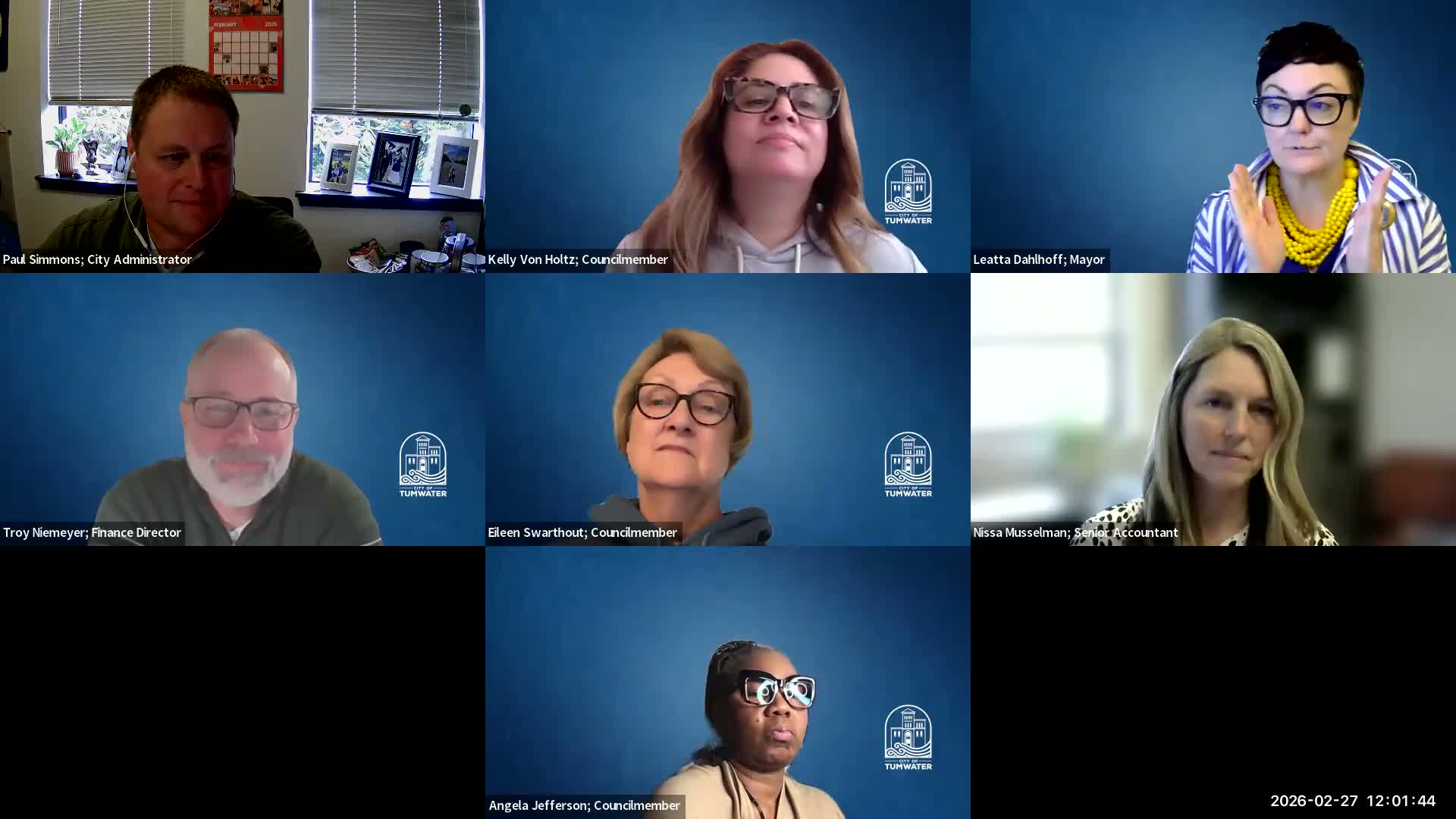
Troy, a finance staff member presenting the monthly update to Tumwater’s Budget & Finance Committee on Feb. 27, said the city finished most of 2025 with stronger-than-expected activity in some revenue streams while noting pockets of shortfall.
“Overall, $212,000 more collected in 2025 than in 2024,” Troy said when summarizing sales-tax results, a 2.1% year-over-year increase. He also told the committee lodging tax rose about 26.8% over 2024, crediting several hotels returning to service as a driver of that gain.
The presentation shifted to a budget-to-actual view. Troy said the city’s budgeted general fund revenue for 2025 was $48.9 million and that, before allocating interest earnings, receipts stood at about $47.6 million. He reported a revenue shortfall of roughly $1.3 million against budget but said expenditures were underspent by about $6 million across departments. Troy told the committee that, as a result, the city has not had to draw on its fund balance for the year-close numbers presented.
Committee members praised the results but urged caution. The mayor noted that prior budgets used reserves for one-time salary costs and said the optics of improved reserves need careful explanation. A council member asked Troy to present a 10-year forecast at upcoming sessions to show the impact of moving from partially vacant positions to fully staffed operations, and to clarify long-term sustainability.
Council members also pressed staff to clarify the city’s share of property tax collections after a member said local assessed values recently declined. Troy agreed to provide a slide breaking down how a property tax dollar is allocated among schools, the county and the city and to bring the 10-year forecast to the March work session and the March 7 council retreat.
On lodging tax policy, members raised whether extended-stay properties and homestay/short-term rentals (VRBO/Airbnb-style units) generate LTAC or lodging-tax revenue; Troy said he would research how extended-stay and alternative lodging types are treated and report back.
Troy closed with an economic outlook noting recent positive GDP readings, modest improvements in unemployment, lingering CPI volatility and national risks such as tariffs and geopolitical uncertainty. He flagged that some forecasts attribute as much as 1.1% of current GDP growth to artificial intelligence investment and said staff would monitor how those trends affect local revenue assumptions.
The committee approved minutes from Oct. 24, 2025 (motion by Eileen, second by Kelly) and confirmed the committee’s recurring meeting time on the fourth Friday at noon, with staff to confirm calendar invites. The meeting adjourned at 12:40 p.m.
“Overall, $212,000 more collected in 2025 than in 2024,” Troy said when summarizing sales-tax results, a 2.1% year-over-year increase. He also told the committee lodging tax rose about 26.8% over 2024, crediting several hotels returning to service as a driver of that gain.
The presentation shifted to a budget-to-actual view. Troy said the city’s budgeted general fund revenue for 2025 was $48.9 million and that, before allocating interest earnings, receipts stood at about $47.6 million. He reported a revenue shortfall of roughly $1.3 million against budget but said expenditures were underspent by about $6 million across departments. Troy told the committee that, as a result, the city has not had to draw on its fund balance for the year-close numbers presented.
Committee members praised the results but urged caution. The mayor noted that prior budgets used reserves for one-time salary costs and said the optics of improved reserves need careful explanation. A council member asked Troy to present a 10-year forecast at upcoming sessions to show the impact of moving from partially vacant positions to fully staffed operations, and to clarify long-term sustainability.
Council members also pressed staff to clarify the city’s share of property tax collections after a member said local assessed values recently declined. Troy agreed to provide a slide breaking down how a property tax dollar is allocated among schools, the county and the city and to bring the 10-year forecast to the March work session and the March 7 council retreat.
On lodging tax policy, members raised whether extended-stay properties and homestay/short-term rentals (VRBO/Airbnb-style units) generate LTAC or lodging-tax revenue; Troy said he would research how extended-stay and alternative lodging types are treated and report back.
Troy closed with an economic outlook noting recent positive GDP readings, modest improvements in unemployment, lingering CPI volatility and national risks such as tariffs and geopolitical uncertainty. He flagged that some forecasts attribute as much as 1.1% of current GDP growth to artificial intelligence investment and said staff would monitor how those trends affect local revenue assumptions.
The committee approved minutes from Oct. 24, 2025 (motion by Eileen, second by Kelly) and confirmed the committee’s recurring meeting time on the fourth Friday at noon, with staff to confirm calendar invites. The meeting adjourned at 12:40 p.m.
Don't Miss a Word: See the Full Meeting!
Go beyond summaries. Unlock every video, transcript, and key insight with a Founder Membership.
✓
Get instant access to full meeting videos
✓
Search and clip any phrase from complete transcripts
✓
Receive AI-powered summaries & custom alerts
✓
Enjoy lifetime, unrestricted access to government data
30-day money-back guarantee
